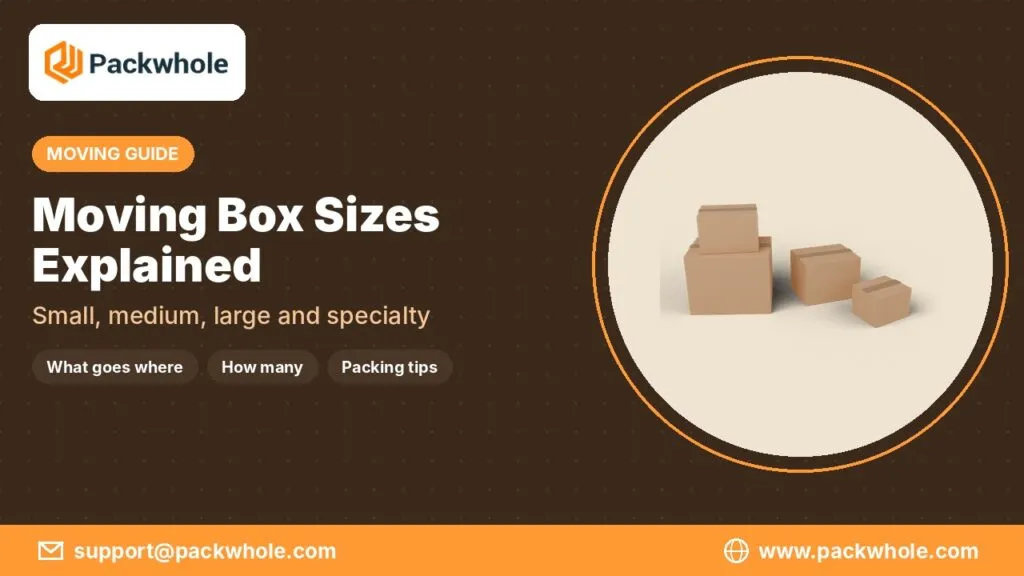
Choosing moving boxes sounds simple until you stand in a room full of belongings and realize that every item seems to need a different carton. Books want small boxes, lamps want tall ones, and bedding fills space faster than you expect. The right mix of sizes makes packing faster, keeps boxes light enough to lift and helps everything stack safely in the truck.
This guide explains the standard sizes sold in the United States, what to put in each one, how to estimate quantities and how to pack so cartons survive the trip. If you are trying to save money, our separate guide on free moving boxes covers where to collect used cartons.
Standard Moving Box Sizes
Most moving supply stores sell the same basic family of cartons. Exact measurements vary a little between suppliers, so treat these as common reference sizes rather than fixed standards. Dimensions are length by width by height in inches.
| Size | Typical dimensions | Approx. volume |
|---|---|---|
| Small | 16 x 12 x 12 | 1.3 cubic feet |
| Medium | 18 x 18 x 16 | 3 cubic feet |
| Large | 18 x 18 x 24 | 4.5 cubic feet |
| Extra large | 24 x 18 x 24 | 6 cubic feet |
| Book box | 12 x 12 x 12 | 1 cubic foot |
Our shipping box sizes guide lists more carton dimensions if you also ship products.
What to Pack in Each Size
The golden rule is simple: the heavier the item, the smaller the box. A large box full of books can weigh more than most people can lift safely, and it puts strain on the bottom seam. Use small cartons for dense items and save the bigger ones for light, bulky things.
- Small: books, records, canned food, tools, files.
- Medium: kitchen items, small appliances, toys, shoes.
- Large: towels, pillows, lampshades, stuffed animals.
- Extra large: comforters, couch cushions, seasonal decor.
- Book box: paperbacks, binders, heavy paperwork.
Specialty Cartons Worth Buying
Some belongings need purpose-built packaging. Dish packs have thick double walls and come with cell dividers for plates and glasses. Wardrobe cartons have a hanging bar so clothes stay on hangers; see our guide to wardrobe box sizes for the options. Picture and mirror cartons telescope to fit framed art, and TV boxes include foam corners.
| Specialty box | Used for |
|---|---|
| Dish pack | Plates, bowls, glassware |
| Wardrobe carton | Hanging clothes |
| Picture or mirror box | Framed art, mirrors |
| TV box | Flat screen televisions |
| Lamp box | Floor lamps and tall decor |
How Many Moving Boxes Do You Need?
Estimating quantity is easier when you count by room rather than by home size. A typical kitchen often needs more boxes than any other room, because it is full of small, breakable items. Bedrooms need a mix of medium boxes for clothes and large ones for bedding, while living rooms need cartons for books, electronics and decor.
- Walk through each room and list what needs packing.
- Estimate small, medium and large boxes per room.
- Add specialty boxes for dishes, clothes and art.
- Add a buffer of extra boxes for last-minute items.
Buying a few extra moving boxes is usually smarter than running out on the last night, and unused cartons can be kept for storage or passed on.
Choosing Box Strength
Not all corrugated cartons are equally strong. Single-wall boxes suit most household goods, while double-wall cartons resist crushing better when stacked under heavier loads. Many boxes carry a manufacturer’s certificate stamp on the bottom flap showing the board rating. For more on board grades, read our corrugated flute types article.
- Single-wall for clothes, linens and light goods.
- Double-wall for dishes, books and long storage.
- New boxes for fragile items that need even stacking.
Packing Tips That Protect Your Belongings
Good packing habits matter as much as good boxes. Tape the bottom with an H pattern, fill gaps so items cannot shift and close every box flat so cartons stack evenly. A box that bulges at the top or caves in at the sides weakens everything stacked above it.
- Tape bottom seams in an H pattern with a strip across the middle.
- Keep the heaviest pieces at the base of each carton.
- Wrap breakables individually in packing paper.
- Fill empty space with towels, paper or clothing.
- Keep each carton at a weight you can lift comfortably.
Labeling for an Easy Unpack
Labeling turns a stack of identical cartons into an organized system. Write the destination room and a short contents list on two sides and the top, so you can read the label even when boxes are stacked. Color-coded tape or stickers for each room make unloading even faster. Number the boxes and keep a simple list, so you know if anything is missing at the new home.
- Mark the room name on at least two sides.
- Use “Fragile” and “This Side Up” where needed.
- Pack an essentials box for the first night.
- Number every carton and keep a master list.
Loading the Truck
How you load matters as much as how you pack. Put the heaviest boxes on the floor of the truck, near the cab, and stack lighter ones on top. Keep boxes of similar size together so stacks stay level. Fill gaps with soft items such as bagged bedding so the load cannot shift on turns.
Moving Boxes for Businesses and Offices
Office and shop moves follow the same principles, with a few extras. Files and stock should go into uniform cartons that stack neatly and carry clear labels for each department or shelf. If you sell online, a move is a good time to rethink your shipping cartons as well; our custom shipping boxes can be printed with your logo and sized for your best sellers.
Storing and Reusing Moving Boxes
After unpacking, flatten your cartons and keep a few of each size in a dry spot. They are useful for storage, seasonal decor and future moves. Damaged or damp boxes should go to recycling. Most corrugated cardboard is widely accepted in US curbside programs, but local rules differ, so check with your city; our guide to packaging symbols explains common recycling marks.
Common Moving Box Mistakes
A few habits cause most packing problems. Overfilled large boxes, half-empty cartons that crush under weight and boxes with only one strip of tape on the bottom are the usual culprits. Mixing heavy and fragile items in the same carton is another frequent mistake.
| Mistake | Better approach |
|---|---|
| Books in large boxes | Use small boxes for heavy items |
| Half-empty cartons | Fill gaps so boxes keep their shape |
| One strip of tape | Tape seams in an H pattern |
| No labels | Mark room and contents on two sides |
Moving rules about what carriers or moving companies will accept vary, so check with your mover before packing hazardous or high-value items. This article offers general packing advice rather than professional moving guidance.
Budgeting for Moving Boxes
Boxes, tape and paper add up quickly, so it helps to plan a budget before you shop. Buying a moving kit can be cheaper than buying single cartons, especially if the kit includes tape and paper. Mixing new boxes with good used ones is another way to save. Use new cartons for fragile items and long-term storage, and free or secondhand moving boxes for linens, clothes and toys.
Do not forget the extras. Packing tape, markers, stretch wrap for furniture drawers and packing paper for dishes are all part of the cost. Tape guns speed up sealing and are worth having if you are packing dozens of cartons. Keep receipts, since some stores accept returns of unused boxes after the move.
Packing Room by Room
Working one room at a time keeps the process organized. Start with spaces you use least, such as guest rooms, storage areas and seasonal closets, and leave the kitchen and bathroom for the final days. Finish each room before starting the next, and stack the completed boxes near the door so they are ready for loading. This approach also makes it easy to see how many moving boxes you have left and whether you need to buy more before moving day.
Printed Cartons for Your Growing Business
Once the move is done and orders start flowing again, we can produce shipping cartons that carry your brand from the warehouse to the doorstep. Send us your product dimensions; our team drafts the dieline free of charge, shares an on-screen proof for your sign-off, works with modest starting quantities and keeps lead times short. Write to support@packwhole.com, or explore carton styles on www.packwhole.com.