Look at the cut edge of a cardboard box and you will see a wavy layer sandwiched between two flat sheets. That wave is the flute, and its size decides how thick, strong, cushioned and printable the box will be. Understanding corrugated flute types helps you order boxes that protect products without paying for extra board you do not need.
This guide covers the five common single flutes, double-wall combinations, and how to match each flute to mailers, shipping cartons, retail displays and heavy freight.
What a Flute Is and Why Its Size Changes Everything
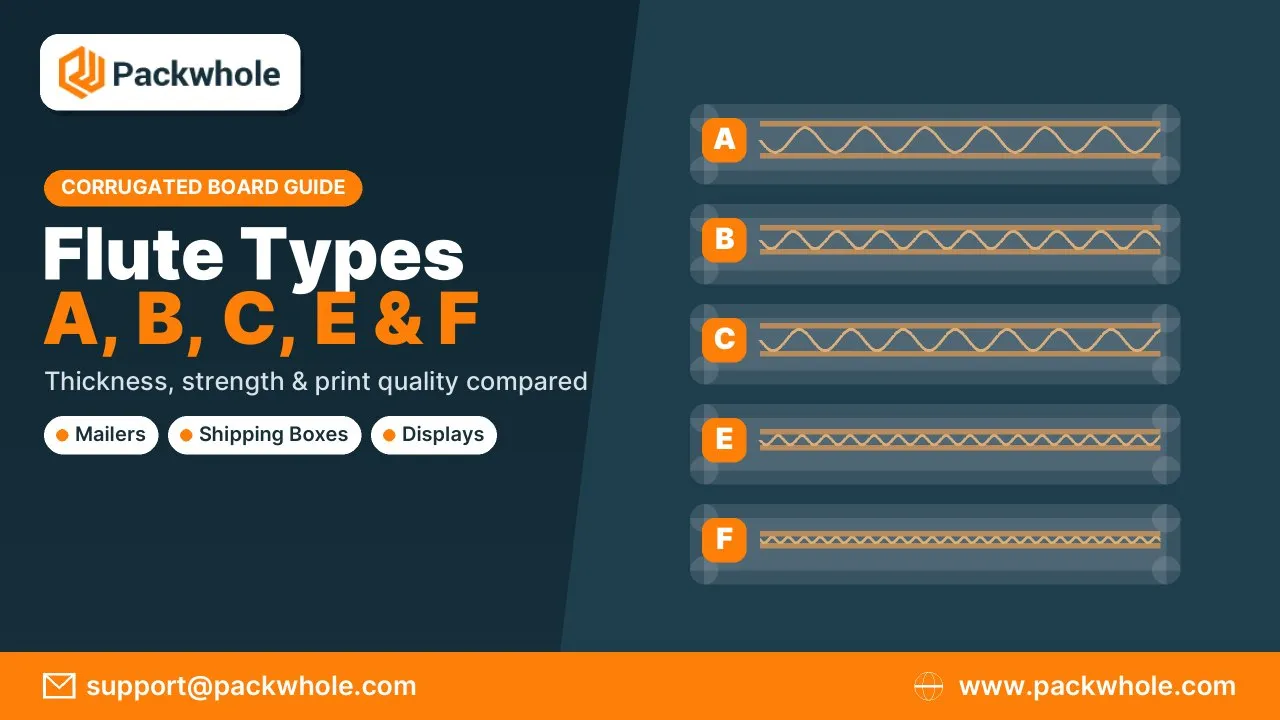
Corrugated board is made of liner sheets glued to a fluted medium. The medium is formed into arches that act like small columns, resisting crushing from above and cushioning impacts from the side. Larger arches create thicker board with more cushioning and stacking strength, while smaller arches create thinner board with a smoother surface for printing.
The letter names come from when each flute was first developed, so they do not run in size order, which is why the labels can seem random. A-flute came first and is one of the largest; E- and F-flute came later and are much smaller. The letter tells a buyer roughly how thick the wall will be and how many arches fit in one foot.
Corrugated Flute Types at a Glance
The table below compares the most common single-wall flutes used in North America. Thickness and flute counts are approximate, because each mill’s equipment differs slightly. Use them as a guide when comparing quotes and samples.
| Flute | Approx. Thickness | Flutes per Foot | Main Strength | Typical Uses |
|---|---|---|---|---|
| A-flute | 3/16 in (about 4.8 mm) | About 33 | Best cushioning and top-to-bottom strength | Fragile items, glass, some displays |
| B-flute | 1/8 in (about 3.2 mm) | About 47 | Good crush resistance, decent print surface | Retail cartons, canned goods, displays |
| C-flute | 5/32 in (about 4 mm) | About 39 | Balanced stacking and cushioning | Standard shipping boxes |
| E-flute | 1/16 in (about 1.6 mm) | About 90 | Thin, smooth, strong for its size | Mailer boxes, retail boxes, pizza boxes |
| F-flute | 1/32 in (about 0.8 mm) | About 125 | Very thin, excellent print surface | Shoe boxes, cosmetics, premium retail |
C-flute is the most common board for standard brown shipping cartons in the US, while E-flute dominates printed e-commerce mailers.
Large Flutes: A, B and C for Protection and Stacking
Larger flutes give the board more height, which means better cushioning and more vertical strength when boxes are stacked in warehouses and trucks. These flutes are the workhorses of shipping and distribution. They are less suited to fine printing, because the larger arches can show through the surface as faint lines, an effect often called washboarding.
When to choose each:
- A-flute: choose for products that need extra cushioning, such as glassware or delicate electronics, though it is less common today.
- B-flute: choose for retail-ready cartons, die-cut displays and products like canned goods that need puncture and crush resistance.
- C-flute: choose for everyday shipping boxes that will be stacked on pallets and handled by carriers.
For heavy contents, double-wall board that combines two flutes is often a better choice than a single large flute. Our comparison of single wall vs double wall boxes covers that decision in detail.
Small Flutes: E and F for Printing and Retail Presentation
Smaller flutes create thinner, smoother board that behaves almost like heavy paperboard while keeping the strength benefits of corrugation. They fold crisply, hold sharp printed graphics and give a premium feel. This is why most printed mailer boxes and many retail boxes now use E-flute or F-flute.
Benefits of small flutes:
- Better print quality: full-color images, small text and barcodes print more clearly.
- Space savings: thinner walls mean more boxes per pallet and lower storage needs.
- Strength for size: E-flute resists crushing better than paperboard of a similar weight.
- Clean folding: tuck flaps and locking tabs close neatly.
If you are weighing the two most popular mailer options, read our side-by-side guide on E-flute vs B-flute.
Double-Wall and Triple-Wall Combinations
When one flute is not strong enough, manufacturers combine two or three fluted layers separated by an extra liner. These multi-wall boards are named by combining letters, such as BC-flute or EB-flute. They are heavier and more expensive, but they can carry far more weight and survive rough freight handling.
| Combination | Approx. Thickness | Common Uses |
|---|---|---|
| EB double wall | About 3/16 in | Heavier mailers, premium shipping boxes with good print |
| BC double wall | About 1/4 in | Heavy products, moving boxes, appliances |
| AC double wall | About 5/16 in | Very heavy or fragile freight |
| Triple wall (AAC and others) | 1/2 in or more | Bulk containers, industrial parts, export crates |
Double-wall boxes are a smart upgrade when products weigh more than about 40 to 50 pounds or when cartons travel by freight rather than parcel.
Strength Ratings Behind Corrugated Flute Types
Flute size is only part of the strength story. Box makers in the US commonly describe board with an Edge Crush Test (ECT) value or a Mullen burst rating. ECT measures how much force the board edge can take before crushing and relates directly to stacking strength. Mullen measures resistance to bursting and puncture, which matters for rough handling.
Common ratings you may see on quotes:
- 32 ECT: standard single-wall shipping boxes for lighter products.
- 44 ECT: stronger single wall for heavier products or tall stacks.
- 48 ECT and 51 ECT: double-wall strength for heavy goods.
- 200# Mullen: common burst rating for general shipping cartons.
Major parcel carriers publish packaging guidelines that reference box strength, so matching the rating to your product weight helps reduce damage claims. This is general information rather than carrier policy advice; review each carrier’s current guidelines before shipping.
How to Pick the Right Flute for Your Product
Choosing among corrugated flute types becomes simpler when you start from how the box will be used. A box that sits on a retail shelf has very different needs from one that rides in a delivery van. Answering a few questions narrows the choice quickly.
Ask yourself:
- Will the box be printed in full color or only with a simple logo?
- How heavy is the product, including inserts?
- Will boxes be stacked high in storage or on pallets?
- Is the product fragile, sharp or liquid?
- Does the box need to fit through mail slots or into lockers?
As a rule of thumb, printed e-commerce boxes lean toward E-flute, everyday shipping cartons toward C-flute, retail displays toward B-flute, and heavy or fragile goods toward double wall.
Common Mistakes When Choosing a Flute
Many brands either over-specify board, paying for strength they do not need, or under-specify and face crushed boxes and returns. Both mistakes are avoidable with a quick sample test. The most frequent problems are listed below.
- Choosing B-flute for a highly detailed print design that would look sharper on E-flute.
- Using thin E-flute for heavy items shipped in bulk freight.
- Ignoring stacking height in warehouses.
- Forgetting that inserts add weight and change how a box fails.
- Comparing quotes without checking whether the flute and ECT rating are the same.
Get the Right Corrugated Flute Types From PackWhole
PackWhole manufactures custom corrugated boxes, mailer boxes and shipping cartons in all popular corrugated flute types, from thin F-flute retail boxes to strong double-wall shippers. Our packaging team will recommend a flute and strength rating based on your product weight and shipping method. Design support is free, and short runs are welcome.
Send your product size and weight to support@packwhole.com, and we will suggest the best board, or start a quote at www.packwhole.com.
FAQs About Corrugated Flute Types
These answers address the most common questions buyers ask when they compare corrugated boards. If you are unsure, request a sample in two flutes and test them with your product.
Which flute is best for printed mailer boxes?
E-flute is the most popular choice because it prints cleanly and folds neatly.
Which flute is used for standard shipping boxes?
C-flute is the most common for everyday brown shipping cartons.
Is B-flute stronger than E-flute?
B-flute is thicker and offers more crush resistance, while E-flute offers a better print surface.
What does BC-flute mean?
It is a double-wall board combining a B-flute and a C-flute layer.
Does the flute size affect shipping cost?
Indirectly. Thicker boards add weight and size, which can raise dimensional weight charges.