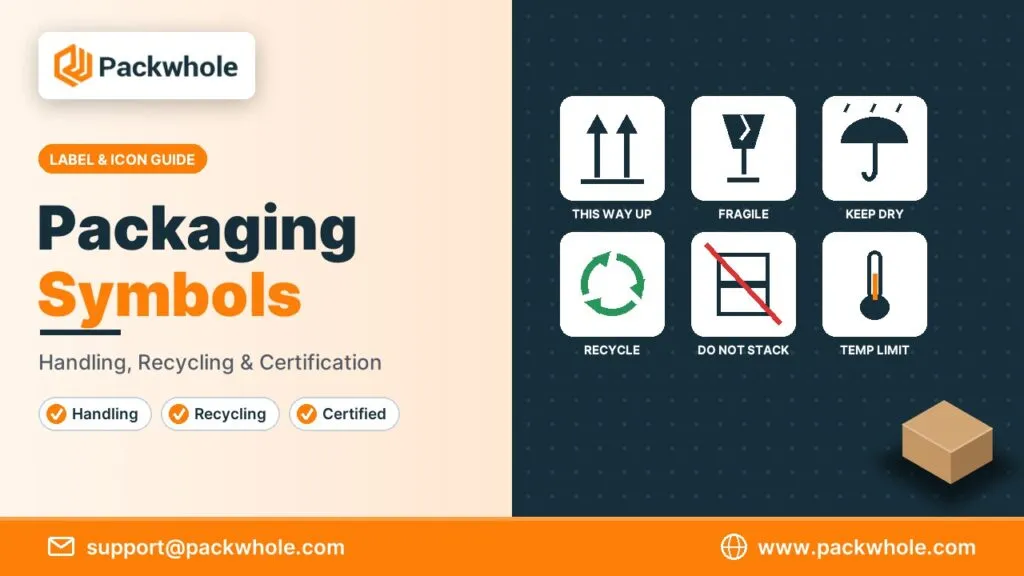
Arrows pointing up, a broken wine glass, an umbrella, a triangle of chasing arrows with a number inside: boxes are covered in small icons that most people never think about. Yet those packaging symbols tell warehouse staff how to handle a carton, tell shoppers how to recycle it, and tell retailers what standards the product meets. Using the right ones, in the right places, makes your packaging clearer, safer, and more professional.
This guide groups the most common symbols into handling, recycling, certification, and product information marks, and explains how US brands can use them correctly on custom boxes.
Why Symbols Matter on Custom Packaging
Symbols communicate instantly, without language barriers. A handler in a busy distribution center may glance at a carton for a second; a clear “This Way Up” icon prevents a costly mistake. For consumers, recycling marks and certification logos shape buying decisions and reduce confusion at the bin. At the same time, some symbols carry legal or certification rules, so they should never be added just for decoration.
Most handling pictograms used worldwide come from the international standard ISO 780, which keeps them recognizable across countries and carriers.
Handling Symbols for Shipping Cartons
Handling symbols appear mainly on outer shipping boxes and master cartons. They guide warehouse staff, freight handlers, and delivery drivers. Use only the marks that genuinely apply; a box covered in every warning is easy to ignore.
| Symbol | Meaning | When to Use |
|---|---|---|
| Two upward arrows | This way up | Liquids, candles, assembled items |
| Broken glass | Fragile, handle with care | Glass, ceramics, electronics |
| Umbrella with rain | Keep dry | Paper goods, electronics, cosmetics |
| Box with crossed-out stack | Do not stack | Crushable or irregular items |
| Stack with number | Stacking limit | Shows max boxes stacked on top |
| Thermometer with limits | Temperature limits | Chocolate, candles, some cosmetics |
| Sun with cover | Keep away from sunlight | Light-sensitive products |
| Hook crossed out | Do not use hand hooks | Bags and soft cartons |
| Center of gravity mark | Center of gravity | Heavy, uneven items |
| Clamp arrows | Clamp here | Large freight cartons |
Most carriers, including USPS, UPS, and FedEx, still rely mainly on how a box is packed, so symbols support but do not replace good packaging. For packing guidance, see our article on how to ship large boxes.
Recycling Symbols US Shoppers See
Recycling marks are the most misunderstood packaging symbols. The familiar chasing arrows (Mobius loop) suggest an item is recyclable, while a number inside a triangle on plastics is a resin identification code that tells recyclers which plastic it is, not that it is accepted everywhere. Labels like How2Recycle give clearer, location-aware instructions.
| Symbol | What It Means |
|---|---|
| Mobius loop (chasing arrows) | Item is designed to be recyclable |
| Mobius loop with percentage | Contains that share of recycled content |
| Resin codes 1 to 7 in a triangle | Type of plastic (PET, HDPE, PVC, LDPE, PP, PS, Other) |
| How2Recycle label | Specific instructions for each part of the package |
| “Please Recycle” text mark | General reminder for paper and cardboard |
| Compostable logo (e.g. BPI) | Certified for commercial composting |
In the US, environmental claims are governed by the FTC Green Guides, and some states, such as California, restrict use of the chasing arrows on items that are not widely recyclable there.
This is general guidance rather than legal advice; check the rules in each state where you sell.
Certification and Sourcing Logos
Certification marks prove that packaging materials meet a third-party standard. They can only be used if your supplier or product is certified and you follow the certifier’s rules. Ask your packaging partner for certificates or chain-of-custody numbers before printing any of these.
- FSC: paper comes from responsibly managed forests or recycled sources.
- SFI: sustainable forestry certification common in North America.
- BPI Compostable: certified for commercial compost facilities.
- Recycled content marks: show the percentage of recycled fiber.
- Non-GMO, Organic, Kosher: product certifications, often required on food labels.
Product Information Symbols on Retail Boxes
Retail cartons often carry small icons that help shoppers use the product. Some are regulatory in certain markets, while others are simply helpful. Brands selling in both the US and Europe often see more of these on imported items.
- Period-after-opening jar: shows how many months a cosmetic lasts after opening (common on EU cosmetics).
- Estimated sign (℮): used in Europe next to net quantity.
- Microwave-safe and freezer-safe icons: food containers.
- Age warnings and small parts icons: toys and games under CPSC rules.
- Barcodes (UPC/EAN): required by most retailers for scanning.
How to Place Symbols on Custom Boxes
Placement matters as much as choice. Handling marks belong on the outside of shipping cartons, usually on at least two sides, while recycling instructions often go on the bottom or a side panel of retail boxes. Size icons so they stay readable but don’t compete with your brand.
Placement tips:
- Put handling marks near the top corner of two adjacent sides.
- Keep recycling marks on the bottom panel or the back.
- Make icons at least 0.4 to 0.5 inch high on shipping cartons.
- Use one color, often black or your brand navy, for clarity.
- Keep icons outside glue areas and fold lines on the dieline.
Packaging Symbols for Exporting and Selling Online
If you sell beyond the US or through large online marketplaces, your packaging may need extra marks. Europe, Canada, and other markets use their own recycling and conformity symbols, and some retailers set their own labeling rules for cartons arriving at their warehouses. Planning a flexible layout makes it easier to adapt one box for several markets.
Points to plan for:
- A space on the bottom panel for market-specific recycling marks.
- Room for bilingual text where required, such as English and French in Canada.
- Carton labels with barcodes and handling marks for retailer or Amazon warehouses.
- Separate stickers for country-specific marks, so the main print run stays the same.
Keep a simple spreadsheet listing which packaging symbols appear on each box and why. When regulations change or you enter a new market, it becomes easy to update artwork without missing anything.
Mistakes Brands Make With Packaging Symbols
Symbols are small, so it is easy to treat them as decoration. Misused marks can confuse customers, mislead recyclers, or even create legal risk. These are the most common errors.
- Printing the chasing arrows on packaging that isn’t recyclable in most areas.
- Using certification logos without being certified.
- Adding “Fragile” to every box, so handlers ignore it.
- Placing icons where folds or tape cover them.
- Using outdated or distorted versions of standard symbols.
Add the Right Packaging Symbols With PackWhole
PackWhole’s designers can add accurate packaging symbols to your custom boxes, shipping cartons, and labels, placed correctly on the dieline. We print on custom corrugated boxes, mailer boxes, and retail cartons. Design help is included, and order minimums stay small.
Ask us to review your box artwork at support@packwhole.com, or start a design on www.packwhole.com.
Packaging Symbols FAQs
These answers cover the questions brands ask most about box icons. Because rules for recycling claims and certifications change, check current guidance before finalizing artwork.
Are handling symbols required by law?
Generally not for standard parcels, but some hazardous goods require specific DOT labels and markings.
What does the number in the recycling triangle mean?
It identifies the type of plastic resin, not whether it is accepted in every recycling program.
Can I print the recycling symbol on any cardboard box?
Corrugated and paperboard are widely recycled, but keep claims accurate and avoid misleading wording.
Where should “This Way Up” arrows go?
On at least two opposite or adjacent sides, near the top corners.
Do I need FSC certification to show the FSC logo?
Yes. Only certified products or suppliers may use the FSC logo.