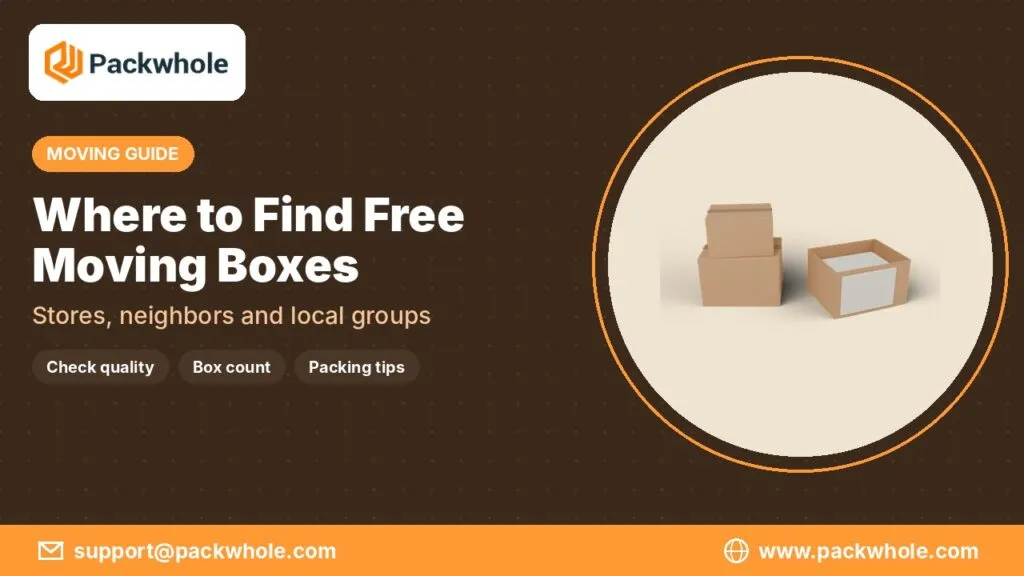
Moving is expensive, and boxes are one of those costs that sneak up on you. A full apartment can use dozens of cartons, plus tape, paper and markers. The good news is that free moving boxes are easy to find if you know where to look and start a little early. Stores, offices and neighbors throw away clean cardboard every day, and much of it is perfectly strong enough for books, kitchen items and clothes.
This guide covers the best places to ask, how to judge whether a used box is safe to pack, how many boxes a typical move needs and when it is worth buying new boxes instead.
Best Places to Find Free Moving Boxes
The easiest sources are businesses that receive deliveries every day. Their boxes are usually sturdy, clean and the right size for household items. Ask politely, find out when they restock and come back at that time, since many stores break down and recycle boxes within hours.
| Source | Typical boxes | Best for |
|---|---|---|
| Grocery stores | Produce and dry goods cartons | Pantry items, toys, linens |
| Liquor stores | Small, strong boxes with dividers | Glassware, bottles, mugs |
| Bookstores and libraries | Small, sturdy book cartons | Books, records, files |
| Office buildings | Paper ream boxes with lids | Documents, small items |
| Pharmacies and beauty shops | Small product cartons | Toiletries, cosmetics |
| Furniture and appliance stores | Large cartons | Lamps, bedding, cushions |
Neighbors, Friends and Online Groups
People who just moved are often happy to hand off their boxes rather than break them down. Ask friends and coworkers, and post in neighborhood groups, community message boards or local online marketplaces. Many people list bundles of used moving boxes for free, often already sorted by size. This is also a good way to find packing paper and bubble wrap.
- Post a short request with your pickup area and dates.
- Offer to collect quickly so the giver can clear space.
- Pass the boxes on again after your move.
More Places Worth Asking
Beyond the obvious stores, several other spots receive steady deliveries. Schools, small restaurants, coffee shops and bike shops all get cartons in various sizes. Recycling centers sometimes let residents take clean cardboard. Some apartment buildings have a shared area where residents leave boxes after moving in. If you work in an office or warehouse, ask whether you can take extra cartons home.
- Restaurants and coffee shops (ask for dry goods boxes only).
- Schools and community centers after supply deliveries.
- Recycling drop-off sites that allow reuse.
- Your own workplace mail room.
- Building management or moving-in areas.
- Retailers that sell large items such as electronics.
How to Check If a Free Box Is Good Enough
Not every carton is worth taking. A box that held produce may be damp, a box from a restaurant may carry odors and a box that has been flattened many times may have weak corners. Before loading the car, give each box a quick inspection. A weak box that fails on moving day can cost more than the box itself.
- Dry and clean: no water stains, mold or food residue.
- Firm corners: the box should stand square when taped.
- No pests: check seams and flaps for insects.
- No chemical smells: avoid boxes that held cleaning products or fuel.
- Strong flaps: flaps should fold without tearing.
How Many Moving Boxes Do You Need?
Every household is different, but rough ranges help with planning. People who own many books or kitchen items need more small boxes, while minimal households can use fewer. The table below gives rough starting points only; count your rooms and possessions and adjust from there.
| Home size | Rough box range | Mix to aim for |
|---|---|---|
| Studio | 15 to 30 | Mostly small and medium |
| One bedroom | 25 to 45 | Small for books, medium for kitchen |
| Two bedroom | 40 to 70 | Add large boxes for bedding |
| Three bedroom or more | 60 and up | Add wardrobe and specialty boxes |
Matching Box Size to What You Pack
The most common packing mistake is putting heavy items in big boxes. A large carton full of books is hard to lift and likely to split. Small boxes are for heavy items, medium boxes for mixed household goods and large boxes for light, bulky items. Our shipping box sizes guide lists common carton dimensions, and our article on how to measure a box helps you compare boxes correctly.
- Small: books, tools, canned food, records.
- Medium: kitchenware, toys, electronics, shoes.
- Large: pillows, blankets, lampshades, stuffed toys.
- Wardrobe: hanging clothes and long coats.
Packing Tips That Make Used Boxes Last
Free moving boxes work best when you reinforce them. Tape the bottom seam with an H pattern, add a second strip across the middle and fill empty space so the box does not collapse when stacked. Label each box on two sides with the room and a short contents list.
- Rebuild each box and tape the bottom in an H pattern.
- Line boxes with paper if the inside is dusty.
- Pack heavy items low and light items on top.
- Keep each box under a weight you can lift comfortably.
- Mark fragile boxes clearly and stack them on top.
When to Buy New Boxes Instead
Used boxes are great for many items, but some things deserve new cartons. Fragile glassware, artwork, electronics and items going into long-term storage benefit from clean, uniform boxes that stack evenly. If you are short on time, buying a bundle of new boxes can save several trips around town. Many people combine the two: free moving boxes for books and linens, new boxes for the most delicate items.
| Item | Free box okay? |
|---|---|
| Books and linens | Yes, if dry and firm |
| Kitchen glassware | Better with dividers or new boxes |
| Electronics | Original box or new carton |
| Long-term storage | New, uniform boxes |
Specialty Boxes You May Still Need
Some items rarely show up in the free pile. Wardrobe boxes for hanging clothes, mirror and picture boxes, mattress bags and dish packs with dividers are designed for specific jobs. You may find them from neighbors who just moved, but plan to buy a few if you cannot. Our guide to wardrobe box sizes explains which hanging box suits which closet.
- Wardrobe boxes for coats, suits and dresses.
- Mirror or picture boxes for framed art.
- Dish packs with cell dividers for plates and glasses.
- Mattress bags to keep bedding clean.
Moving a Business Instead of a Home
Small businesses moving an office, studio or stockroom face the same questions at a larger scale. Inventory needs boxes that stack neatly, protect products and can be labeled clearly for the new space. Free moving boxes from suppliers can work for supplies and files, but stock you plan to sell is better protected in uniform cartons. Some businesses use the move as a chance to switch to branded custom shipping boxes for orders once they settle in.
Questions to Ask Before Taking Free Moving Boxes
A quick conversation with store staff can save a wasted trip. Ask whether you may take boxes at all, since some stores send cardboard back to a distribution center or bale it for recycling income. Ask when deliveries arrive, how many boxes are usually available and whether they prefer you to come at a certain time. Being polite and taking only clean boxes makes staff more willing to help again. If you need many free moving boxes, try several stores in the same week rather than relying on one source.
Recycling and Passing Boxes On
After the move, flatten your boxes and keep a few for storage or future shipping. The rest can go to someone else who is moving, back to a local group or into curbside recycling. Most cardboard is widely recycled in the United States, but local programs differ, so check what your city accepts. Our post on packaging symbols explains the recycling marks you may see on cartons. Local rules vary, so treat this as general guidance and confirm details with your municipality.
Planning Your Box Hunt Timeline
Collecting free moving boxes takes a little planning. Starting two to three weeks before your move gives you time to visit stores on restocking days and gather a good mix of sizes. Store collected boxes flat in a dry place so they stay strong.
- Three weeks out: ask stores and post in local groups.
- Two weeks out: sort boxes by size and condition.
- One week out: buy any specialty boxes you still need.
- Moving week: keep spare boxes for last-minute items.
Need Boxes for Your Business After the Move?
Once you are settled, we can help your brand ship orders in boxes made for your products. Tell us what you sell and the sizes you need; our designers create the dieline at no charge, you approve a digital mockup before printing, we accept modest first orders and turn the job around quickly. Reach the team at support@packwhole.com, or look through printed box styles at www.packwhole.com.