Some products are fragile on their own and even more fragile when they touch each other. Glass bottles clink, jars chip and small cosmetic items slide into a tangle. Divider boxes solve this problem by adding cardboard partitions that create individual cells for each item. They keep products separated, organized and protected, whether in a shipping carton, a retail display or a storage box.
This guide explains how partitions work, the common layouts and materials, where divider boxes are used and how to size them correctly for your products.
What Divider Boxes Are
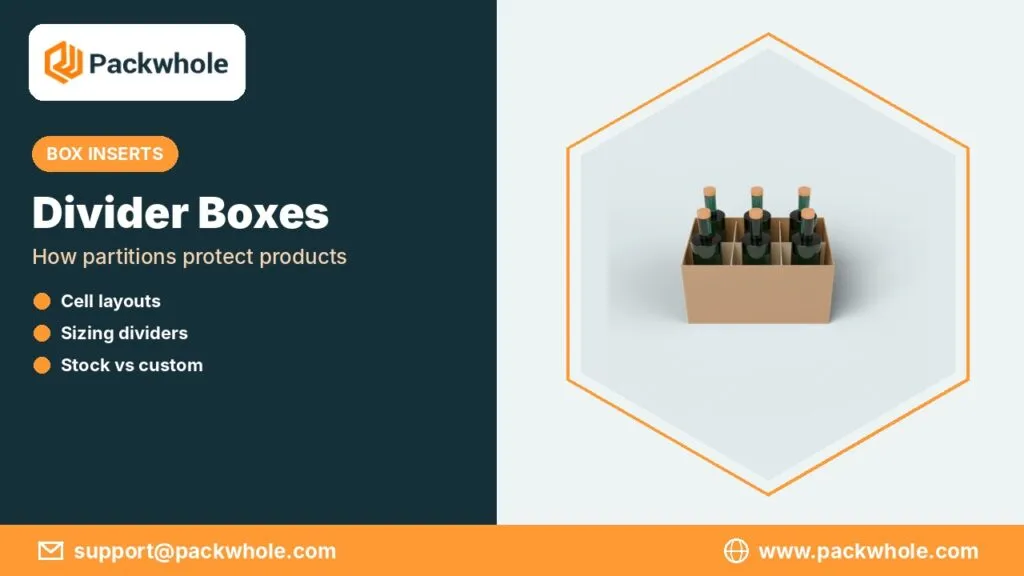
A divider box is a box fitted with an internal grid of cardboard strips. The strips slot together at right angles to form cells, often called a partition or a “fence.” Each product sits in its own cell, so it cannot knock into its neighbors. Partitions can be removable inserts or built into the box structure.
How Partitions Are Built
Most partitions are made from flat strips of paperboard or corrugated board with slots cut halfway through. The long strips slot into the short strips, forming a grid. Because they ship flat and assemble in seconds, partitions are easy to store and cost-effective. Our fence partition product shows a common example of this design.
| Partition material | Best for |
|---|---|
| Thin paperboard | Light items, cosmetics, small jars |
| Single-wall corrugated | Bottles, glassware, heavier jars |
| Double-wall corrugated | Heavy glass and industrial parts |
| Kraft board | Natural look for gift sets |
Common Cell Layouts
The number of cells depends on the product and the box size. Layouts are often described by rows and columns, such as 2 x 3 for six cells or 3 x 4 for twelve.
| Layout | Cells | Typical use |
|---|---|---|
| 2 x 2 | 4 | Small gift sets, candles |
| 2 x 3 | 6 | Bottles, jars, cosmetic sets |
| 3 x 4 | 12 | Wine, sauces, glassware |
| 4 x 6 | 24 | Small vials, ornaments |
Where Divider Boxes Are Used
Partitions show up across many industries. Beverage brands use them for bottles and cans. Candle makers and skincare companies use them for jars and glass bottles. Holiday decor brands use them for ornaments. Moving companies use dish packs with dividers for glasses and stemware. Even electronics and hardware suppliers use partitions to keep parts organized.
- Wine, beer, sauces and craft beverages
- Candles, skincare jars and perfume bottles
- Ornaments and glass decor
- Glassware during moves
- Small parts and components
Benefits of Using Dividers
The main benefit is protection. When items cannot touch, there is far less chance of chips, scratches and breakage. Partitions also add strength to the box, because the internal walls support the top and sides. Products look neat and organized when the box is opened, which improves the unboxing experience. For retail, a divided box can double as a display, showing each item in its own space.
Sizing Divider Boxes Correctly
Accurate measurements matter. Measure each product at its widest point and its height. Each cell should be slightly larger than the product so it slides in easily without rattling. The partition height should usually reach at least two-thirds of the product’s height, and full height for fragile glass. Then size the outer box around the partition.
- Measure product width, depth and height.
- Add a small allowance to each cell.
- Choose partition height relative to the product.
- Calculate the outer box from the full grid size.
- Test with real products before production.
Combining Dividers With Other Inserts
Dividers work well with other protective elements. A pad on the bottom and top of the box cushions products from vertical impact. Foam or paper sleeves can add extra protection for very fragile items. For products of different sizes, a custom die-cut insert may work better than a grid. Other insert styles are compared in custom box inserts for shipping.
Divider Boxes for Shipping
When shipping glass or heavy items, the outer box must be strong enough for the total weight. Corrugated boxes with matching corrugated partitions are the standard choice. Mark the box with “Fragile” and “This Side Up” if products must remain upright. Our custom shipping boxes can be paired with partitions sized to your products, and handling marks are explained in labeling a box for shipping.
Divider Boxes for Retail and Gifts
In retail, divided boxes help present product sets beautifully. A candle trio, a skincare set or a sampler of sauces looks curated when each item sits in its own cell. Printed partitions and a printed inside lid add brand color. Gift boxes with dividers are popular for holiday sets and subscription boxes. A window on the lid can show off the arrangement without opening the box.
Sustainability Considerations
Paper and corrugated partitions are generally recyclable along with the outer box in many US programs, which makes them a simpler choice than mixed-material inserts. Using a single material for both box and partition makes disposal easier for customers. As always, recycling rules vary by location.
Testing Before You Order
Before ordering a large run, request a sample. Load it with real products, close it and give it a gentle shake. Check that nothing rattles, that items slide in and out easily and that the box closes flat. If you ship, send a test parcel to yourself. Testing divider boxes in real conditions prevents costly surprises after production.
Choosing Between Stock and Custom Partitions
Stock partitions come in standard layouts and sizes, and they work well if your products match common bottle or jar dimensions. They are quick to buy and affordable for small runs. Custom partitions are designed around your exact products, which means a snugger fit and better protection. They also allow printed surfaces and unusual layouts, such as mixed cell sizes for a set that contains different items.
If your products vary in size or need a premium presentation, custom divider boxes are usually worth the investment. If you ship standard bottles in large volumes, stock partitions may be enough. Many brands start with stock options and switch to custom once their product line settles.
Assembling Partitions Efficiently
Partitions ship flat and must be assembled before packing. Set up a station where strips are slotted together and dropped into boxes in one smooth motion. For high-volume operations, pre-assembled partitions or machine-assembled options can speed things up. Train staff to check that all slots are fully engaged, because a loose partition offers less protection and can collapse when products are inserted.
Cost Factors to Consider
The price of divider boxes depends on material, number of cells, partition height, printing and order quantity. More cells mean more strips and more assembly time. Taller partitions use more board. Printed partitions cost more than plain ones, but they can lift the presentation of a premium gift set. Ordering larger quantities usually reduces the cost per unit. Balancing protection with cost is easier once you know how fragile your products are and how far they travel, so start with testing and adjust the design before committing to a large order.
Partitioned Boxes Sized to Your Products
If your products need separate cells, send us their measurements and how many you pack in each box. We will design the partition and outer box together, create the template with no extra fee, send a proof for review, support small trial quantities and turn orders around quickly. Contact support@packwhole.com, or request partition box pricing at www.packwhole.com.