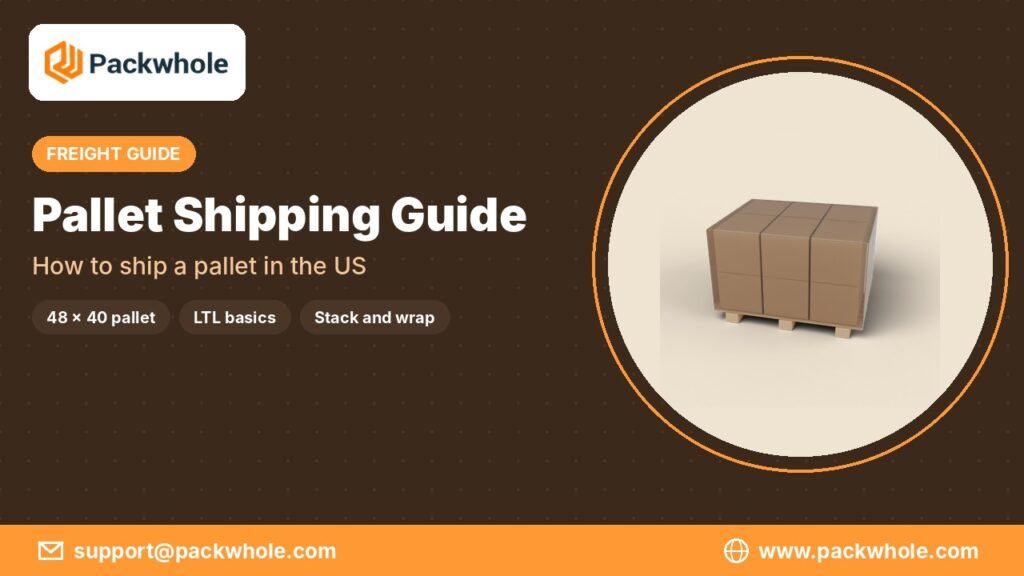
When orders outgrow parcel shipping, many businesses move to pallets. Sending a stack of cartons on a pallet can be cheaper, safer and simpler than shipping dozens of individual boxes, especially for wholesale orders, retail deliveries and warehouse transfers. Pallet shipping does come with its own vocabulary, rules and best practices, which can feel confusing the first time.
This guide explains standard pallet sizes, the difference between less-than-truckload and full truckload freight, how to stack and wrap cartons, the basics of freight class and how to label a pallet so it arrives in good shape.
When to Ship on a Pallet
Pallets make sense when a shipment is too large or heavy for parcel carriers to handle efficiently. A wholesale order of many cartons, a retail store delivery or a trade show shipment are common examples. Grouping cartons on one pallet reduces handling, which lowers the chance of individual boxes being lost or damaged.
- Large wholesale orders to stores or distributors
- Restocking a fulfillment center or warehouse
- Trade show and event shipments
- Bulk raw materials or packaging supplies
Standard Pallet Sizes
The most common pallet in the United States measures 48 x 40 inches, often called the GMA pallet. Other sizes exist for specific industries, but carriers and warehouses are set up for the standard size, so it is usually the safest choice.
| Pallet size (inches) | Common use |
|---|---|
| 48 x 40 | Most general freight and retail |
| 42 x 42 | Telecom, paint and some industrial goods |
| 48 x 48 | Drums and larger containers |
| 40 x 40 | Dairy and some food products |
Check the receiving facility’s requirements, because some retailers specify pallet type, height and condition.
LTL vs. Full Truckload
Less-than-truckload (LTL) freight combines your pallets with shipments from other businesses in one truck. It is usually the best choice for one to several pallets. Full truckload (FTL) means you use the whole trailer, which suits very large shipments or time-sensitive loads. LTL is cheaper for small volumes but may involve more stops and handling.
| Option | Best for | Trade-offs |
|---|---|---|
| LTL | One to several pallets | More handling, flexible pricing |
| Full truckload | Large volumes | Higher total cost, less handling |
| Partial truckload | Mid-size loads | Fewer stops than LTL |
How to Stack Cartons on a Pallet
Good stacking protects products and makes the pallet stable. Use uniform carton sizes when possible, place the heaviest boxes on the bottom and keep the edges of cartons aligned with the pallet edges. Avoid letting cartons hang over the sides, because overhang weakens boxes and can lead to crushing. Stacking in a column pattern gives the most compression strength, while an interlocking pattern adds stability.
- Choose a sturdy pallet in good condition.
- Place heavy cartons on the bottom layer.
- Align cartons flush with the pallet edges.
- Keep the top flat and level.
- Add corner boards for extra support if needed.
Strong cartons make a big difference. Our post on corrugated flute types explains which board grades handle stacking best.
Wrapping and Securing the Load
Once stacked, wrap the pallet tightly with stretch film, starting at the base and tying the film to the pallet so the load and pallet move as one unit. Wrap several layers around the bottom and top. Straps and edge protectors add security for heavy or tall loads. A well-wrapped pallet stays square and stable through loading, transit and unloading.
Freight Class Basics
LTL carriers in the United States use freight classes to help set prices. Classes are based on factors such as density, ease of handling, value and liability. Density, which compares weight to the space a shipment occupies, plays a major role. Dense, compact shipments usually fall into lower classes and cost less per pound. Freight classification rules are maintained by an industry organization and are updated from time to time, so confirm the correct class with your carrier or freight broker before booking.
Measuring and Weighing Your Pallet
Accurate measurements are essential for quotes. Measure the length, width and height of the finished pallet, including the pallet itself and any overhang. Weigh the entire load. Inaccurate dimensions or weights can lead to re-classification and extra charges after pickup.
Labeling a Pallet
Every pallet needs clear labels so warehouses and carriers can identify it. Attach a label with shipper and consignee information on at least two sides. Include the bill of lading number, purchase order number if required, and the pallet count, such as “1 of 2.” Many retailers require specific label formats, so check their supplier guide.
- Shipper and receiver addresses on two sides
- Bill of lading or reference numbers
- Pallet count for multi-pallet orders
- Handling marks such as “Do Not Stack” if needed
Our guide on how to label a box for shipping covers carton labels that sit inside the pallet load.
The Bill of Lading
The bill of lading (BOL) is the key shipping document for freight. It lists the shipper, receiver, description of goods, number of pallets, weight and freight class. It also serves as a receipt when the carrier picks up the load. Keep copies for your records, and make sure the information matches the pallet labels exactly.
Reducing Damage on Pallet Shipments
Most pallet damage comes from weak cartons, poor stacking, loose wrapping or overhanging boxes. Using strong, right-sized cartons and filling empty space inside them reduces crushing. Corner boards and top sheets spread weight evenly. Photographing the pallet before pickup helps if you need to file a claim later.
Packaging That Stacks Well
Cartons designed for pallet shipping save money and reduce damage. Uniform sizes stack more efficiently, and stronger board resists compression in tall stacks. Retail-ready trays can travel on pallets and go directly onto store shelves; our post on shelf ready packaging explains how. Our custom shipping boxes can be sized so your cartons fit neatly on a 48 x 40 pallet.
Getting Started
For your first few pallet shipments, a freight broker or a carrier’s customer service team can help you choose the right service, freight class and pickup options. Ask about liftgate service if the pickup or delivery location has no loading dock. With a little practice, pallet shipping becomes a routine part of growing a wholesale business.
Choosing a Carrier or Broker
For first-time shippers, a freight broker can simplify the process by comparing carriers, booking pickups and handling paperwork. Brokers earn a fee or margin, but they can save time and help avoid mistakes. Larger shippers often work directly with carriers once they understand their needs. Either way, compare quotes, transit times and accessorial charges, which are extra fees for services like liftgates, residential delivery or appointments.
Reading the terms carefully prevents surprises. Ask what happens if dimensions or weight are different from the quote, and how claims for damage are handled. Clear communication at the start makes pallet shipping smoother over time.
Planning Pickup and Delivery
Freight pickups and deliveries often happen within a time window rather than at an exact time. Make sure someone is available to load or receive the pallet, and confirm whether the location has a dock or requires a liftgate. Retail distribution centers usually require delivery appointments and may refuse loads that arrive late or do not match their requirements. Planning ahead keeps pallet shipping on schedule and reduces costly re-deliveries.
Cartons Built for Pallets
If you are moving into wholesale or retail distribution, we can help design cartons that stack efficiently on standard pallets. Share your product sizes and units per carton; our team works out a pallet-friendly layout, draws the dieline at no charge, sends a proof for approval, handles modest volumes and keeps production on schedule. Email support@packwhole.com, or ask for carton pricing at www.packwhole.com.