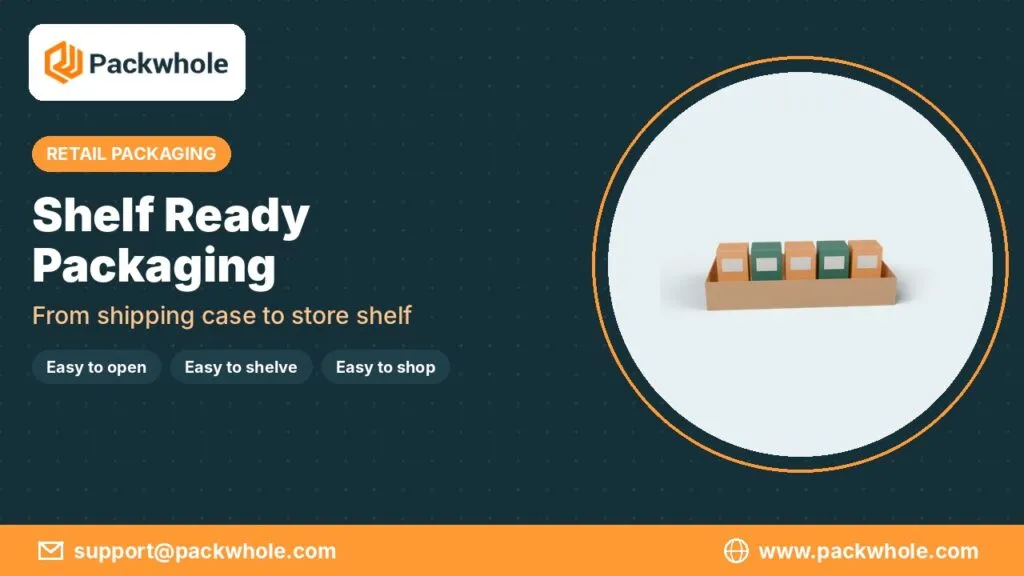
When a product lands on a store shelf, a lot happens behind the scenes. Someone has to open the shipping case, take products out, line them up and throw away the cardboard. Shelf ready packaging, often called SRP or retail ready packaging, shortens that process by turning the shipping case itself into a neat display that goes straight onto the shelf. For brands selling into grocery, pharmacy and big-box stores, it can make the difference between easy acceptance and frustrated store staff.
This guide explains what shelf ready packaging is, the styles retailers commonly use, the design rules that matter and how small and mid-sized brands can get started.
What Shelf Ready Packaging Means
Shelf ready packaging is a case or tray that ships products to the store and then sits directly on the shelf with minimal handling. Store staff tear off a perforated panel or lift a lid, and the products are instantly visible and organized. Retailers value this because it saves labor, keeps shelves tidy and makes it easier to see when stock is running low.
The Five Principles Retailers Look For
Industry groups often summarize good shelf ready design with five simple ideas. They are a helpful checklist for any brand designing a retail case.
| Principle | What it means |
|---|---|
| Easy to identify | Staff can find the right case quickly in the stockroom |
| Easy to open | Clear opening instructions and perforations |
| Easy to shelve | Fits shelf depth and height, stacks neatly |
| Easy to shop | Shoppers can see and take products easily |
| Easy to dispose | Simple to flatten and recycle |
Common Shelf Ready Styles
Shelf ready cases come in several formats. The right one depends on product size, weight and how the retailer displays the category.
- Tray with tear-off lid: a shipping case with a perforated top that removes cleanly.
- Open front tray: a front panel tears away so products face the shopper.
- Display case with header: a tray with a printed header card for branding.
- Wrap-around case: a sleeve or wrap that leaves a display base behind.
- Counter display: smaller units for checkout areas and impulse items.
Our custom display boxes cover many of these counter and shelf formats.
Design Rules That Matter
A shelf ready case must survive shipping like a regular carton, then look like a display once opened. That means balancing strength with clean perforations and good graphics. Perforations that are too weak can open in transit; perforations that are too strong frustrate staff and tear unevenly.
- Test perforations so they open cleanly by hand.
- Print opening instructions on the case.
- Keep the brand and product name visible after opening.
- Match case size to the retailer’s shelf depth and height.
- Leave the barcode and case code easy to scan.
Material and Board Choices
Most shelf ready cases use corrugated board because it combines strength with good print quality. E-flute and B-flute are common choices, depending on product weight and stacking needs. The differences are laid out in E-flute vs. B-flute. White board provides bright graphics, while kraft board gives a natural look that suits organic and artisan brands.
| Board option | Good for |
|---|---|
| E-flute | Lighter products, sharp printing |
| B-flute | Heavier products and stacking |
| White top liner | Bright, colorful graphics |
| Kraft liner | Natural, rustic brands |
Graphics That Sell on the Shelf
Once opened, the case becomes part of the shelf display. Bold branding on the front lip, a clear product name and consistent colors help shoppers spot your products quickly. Avoid placing important artwork on panels that will be torn away. Many brands repeat their logo on the tray front and sides so it remains visible from different angles.
Working With Retailer Requirements
Large retailers often publish packaging guidelines for suppliers, covering case dimensions, labeling, barcodes and opening features. Requirements differ between chains, so ask each buyer for their supplier manual before finalizing your design. These guidelines can change, and this article provides general information rather than the requirements of any specific retailer.
- Request the supplier packaging manual early.
- Confirm case pack quantities with the buyer.
- Check pallet patterns and maximum stack heights.
- Plan for case labels and barcodes on specified panels.
Benefits for Brands
Shelf ready packaging is not only for the retailer’s benefit. A neat display keeps your products facing forward, protects the brand image and makes restocking faster, which can reduce empty-shelf time. It can also give you extra branding space compared with loose products on a plain shelf. Brands that make retail easy to work with often find buyers more receptive to new listings.
Shelf Ready Packaging Examples by Category
Different store aisles use different formats. Snack and confectionery brands often use small trays with tear-off fronts near checkout. Beauty and personal care brands use counter displays with header cards. Canned and jarred foods frequently use low trays that keep rows straight. Looking at how competitors in your category present shelf ready packaging helps you choose a format buyers already recognize.
| Category | Common format |
|---|---|
| Snacks and candy | Counter tray with tear-off lid |
| Beauty and cosmetics | Display box with header card |
| Canned and jarred foods | Low open-front tray |
| Beverages | Wrap-around case with display base |
Costs and Trade-Offs
Shelf ready cases can cost more than plain shipping cartons because of extra printing, perforations and design work. However, the savings in store labor and the improved shelf presence often justify the investment for retail partners. Start with one product line, gather feedback from store staff and refine before rolling it out across your range.
Getting Started as a Smaller Brand
Smaller brands do not need a huge budget to begin. Start by measuring your product and the shelf space you expect to occupy. Decide how many units go in each case and choose a simple tray style. A prototype or sample run lets you test how the case ships, opens and looks on the shelf before larger orders. Our post on what is a dieline explains the flat template behind every case, and individual custom printed boxes can complement your shelf ready trays.
- Measure product and expected shelf space.
- Choose case quantity and tray style.
- Create a dieline and artwork.
- Test a sample run for shipping and opening.
- Refine based on store staff feedback.
Sustainability and Shelf Ready Design
Retailers and shoppers increasingly expect packaging that is easy to recycle. Corrugated shelf ready cases are generally recyclable in US programs, which is one reason they are popular. Avoiding plastic windows, mixed materials and heavy coatings keeps disposal simple for store staff. Clear opening and flattening instructions also help the case end up in the right bin.
Right-sizing is part of the picture. A case that fits the products closely uses less board and fits more units on a pallet, which can reduce transport emissions and cost. Any environmental statement printed on the case should be accurate and specific, since vague claims can confuse buyers and may conflict with advertising rules.
Working With Your Packaging Partner
A good packaging partner can save time during development. Share your product samples, case count, shelf measurements and the retailer’s manual at the start. Ask for a plain white sample first to test structure and perforations, then move to a printed sample once the structure works. This step-by-step approach catches problems early, before you commit to a full print run.
Keep notes on every change and the reason for it. When you expand to new retailers or products, those notes make it much faster to adapt your shelf ready packaging to a new set of requirements.
Make Retail Easier With Your Next Case
If you are preparing for a retail launch, share your product size, case quantity and retailer requirements. We prepare the structural dieline without a design fee, send a proof for your approval, support pilot quantities and produce on tight timelines. Contact support@packwhole.com, or request display packaging pricing on www.packwhole.com.