Open a packaging quote and you will probably see a line like “E flute, white kraft” or “B flute, 32 ECT.” Those letters describe the wavy layer hidden between the outer sheets of corrugated board, and they quietly decide how your box looks, how much it protects, and how much it weighs. The e flute vs b flute decision is one of the most common choices brands face when ordering mailer boxes and shipping cartons.
This article explains the difference in plain language, shows where each flute shines, and helps you choose the right board without paying for strength or print quality you do not need.
What a Flute Is and Why the Letter Matters
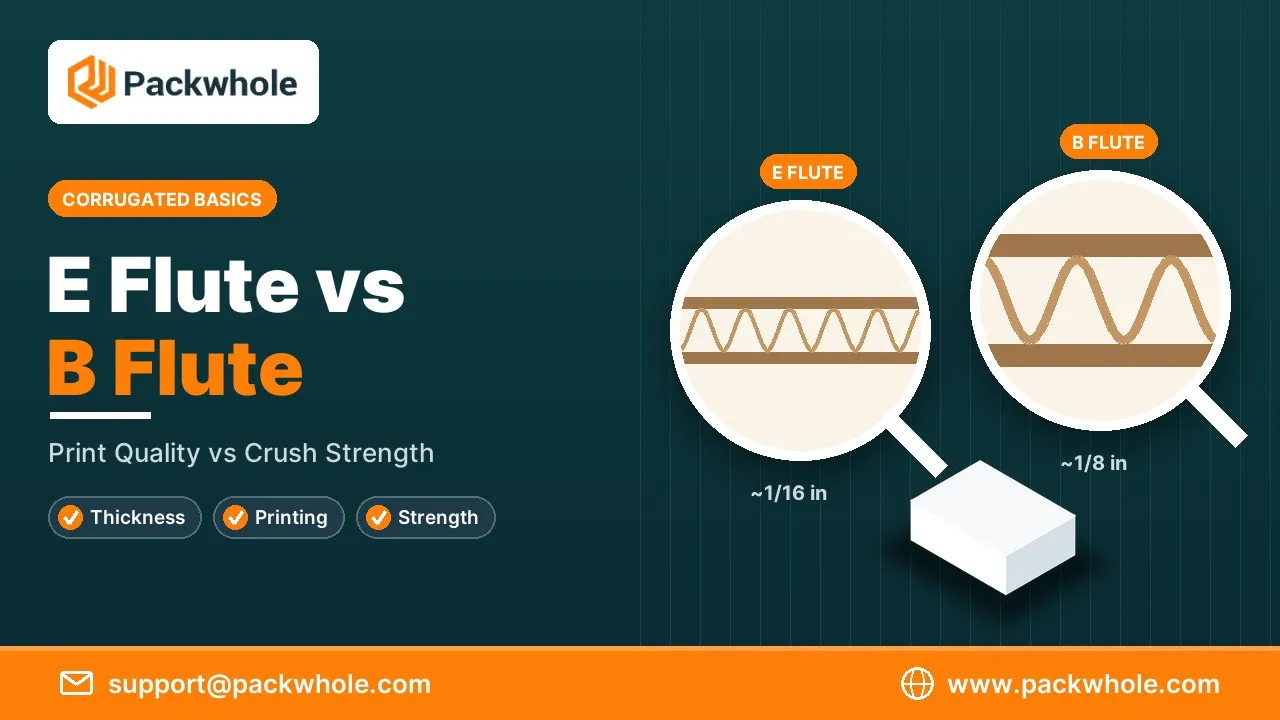
Corrugated board is made of two flat paper liners with a fluted (wave-shaped) paper medium glued between them. The flutes work like a row of tiny arches: they resist crushing, cushion impacts, and keep the board rigid. Flute sizes are named with letters that reflect the order they were introduced, not their size, which is why the alphabet seems random. A, B, C, E, and F are the most common, and E and B are the two most popular for product packaging.
The key idea: bigger flutes give more cushioning and stacking strength, while smaller flutes give a smoother surface for printing and a slimmer, neater box.
E Flute vs B Flute Side by Side
The numbers below are typical values; exact thickness varies slightly between mills and paper grades. Use them to understand the general trade-offs. Both flutes can be made in kraft or white liners and printed inside and out.
| Factor | E Flute | B Flute |
|---|---|---|
| Typical thickness | About 1/16 in (1.2 to 1.8 mm) | About 1/8 in (2.5 to 3.2 mm) |
| Flutes per foot | About 90 | About 47 |
| Print surface | Smooth, crisp graphics | Slight “washboard” lines possible |
| Crush resistance | Good for light items | Better for heavier items |
| Cushioning | Moderate | Higher |
| Fold quality | Tight, clean folds | Bulkier folds |
| Weight | Lighter | Heavier |
| Flat storage | More boxes per pallet | Fewer boxes per pallet |
| Common uses | Mailer boxes, retail cartons, cosmetics | Shipping boxes, heavier mailers, food delivery |
When E Flute Is the Better Choice
E flute is the go-to choice for branded ecommerce mailers and retail-ready cartons. Its fine flutes create a smooth surface that holds detailed artwork, small text, and photos, much closer to the look of a folding carton. It also folds into crisp edges, which makes the unboxing feel more premium. Because it is thinner and lighter, it can lower dimensional weight and freight costs.
Both flutes can also be printed on the inside, which turns the opening moment into part of the brand experience without changing the outer board.
E flute works best for:
- Subscription boxes and influencer PR kits
- Cosmetics, skincare, and supplement mailers
- Apparel boxes for tees, hoodies, and accessories
- Small electronics and accessories
- Retail display cartons that need high-quality print
Our custom mailer boxes buying guide shows popular mailer styles that use E flute.
When B Flute Is the Better Choice
B flute is thicker and tougher. It handles heavier products, rougher transit, and more stacking in warehouses. The trade-off is a slightly rougher printing surface and a bulkier fold. For many shipping cartons, that trade-off is well worth it because protection matters more than fine artwork.
B flute works best for:
- Heavier products such as candles in glass, bottles, and small appliances
- Shipping cartons that carry several items
- Boxes stacked on pallets or in delivery trucks
- Food delivery boxes and meal kits
- Outer shippers that protect a retail box inside
Print Quality: What to Expect on Each Flute
Printing on corrugated board is different from printing on paperboard. The flutes beneath the top liner can show through as faint parallel lines, especially on large areas of solid color. This effect, called washboarding, is more visible on B flute because the flutes are wider apart. On E flute the waves are close together, so the surface looks smoother and more even.
Tips for better results on both:
- Use a printed top liner (litho-lamination) for photo-quality graphics on B flute.
- Avoid very fine text and hairlines on B flute; keep text at 7 pt or larger.
- Break up large solid areas with patterns or gradients.
- Ask for a printed sample on your chosen flute before full production.
- Consider inside printing on E flute for a premium reveal.
Strength Ratings You May See on a Quote
Flute letter alone doesn’t tell you how strong a box is. Paper weight and board construction matter too. US quotes often include an ECT (Edge Crush Test) value or a burst strength rating. A common single-wall shipping box is rated 32 ECT, which suits many ecommerce products. For heavier loads, 44 ECT single wall or a double-wall board may be recommended.
| Rating | What It Measures | Typical Use |
|---|---|---|
| 32 ECT | Stacking strength of single-wall board | Most ecommerce boxes |
| 44 ECT | Stronger single-wall board | Heavier items, more stacking |
| 200# burst | Resistance to puncture and rough handling | Traditional shipping cartons |
For a broader look at board types, see our guide to corrugated boxes.
Cost and Weight Differences in E Flute vs B Flute
E flute uses slightly less material and is lighter, so it can be marginally cheaper per square foot and saves on freight because more flat boxes fit on a pallet. B flute uses more board and weighs more, but it may prevent damage that would cost far more than the packaging. The smartest comparison is cost per safely delivered order, not cost per box.
Questions to ask before deciding:
- What is the total weight once the product is packed?
- Does the box travel on its own through carrier networks?
- How important is detailed artwork on the outside?
- How many boxes will be stacked during storage?
Mistakes to Avoid When Choosing a Flute
Picking a flute based only on price or looks often leads to crushed corners or disappointing print. The right choice comes from balancing protection and presentation. Watch for these slip-ups in the e flute vs b flute decision.
- Using E flute for heavy glass items without inserts.
- Using B flute for a premium cosmetics mailer with fine print.
- Ignoring ECT ratings when products are stacked on pallets.
- Forgetting that thicker board changes inside dimensions slightly.
- Approving artwork without a printed sample on the real flute.
Order E Flute vs B Flute Boxes From PackWhole
PackWhole produces printed mailer boxes and shipping cartons on E flute, B flute, and other board grades. Tell us your product weight, size, and how it ships, and we will recommend the right side of the e flute vs b flute choice. You get free design help, sample options, and low minimum orders on custom mailer boxes and custom corrugated boxes.
Share your product weight with support@packwhole.com, or explore board options at www.packwhole.com.
E Flute vs B Flute: Frequently Asked Questions
These quick answers cover the questions buyers ask most when comparing these two flutes. If your product sits between the two, a sample of each is the fastest way to decide. Send us your product and we can test both.
Is E flute strong enough for shipping?
Yes, for light to medium products. Many ecommerce mailers use E flute and ship safely through USPS, UPS, and FedEx.
Which flute prints better?
E flute prints better because its fine flutes create a smoother surface.
Is B flute thicker than E flute?
Yes. B flute is roughly twice as thick as E flute.
Can I combine flutes?
Yes. Double-wall board combines two flutes, such as B and E, for extra strength with a better print face.
Which is cheaper?
E flute is often slightly cheaper and lighter, but the right choice depends on protection needs.