
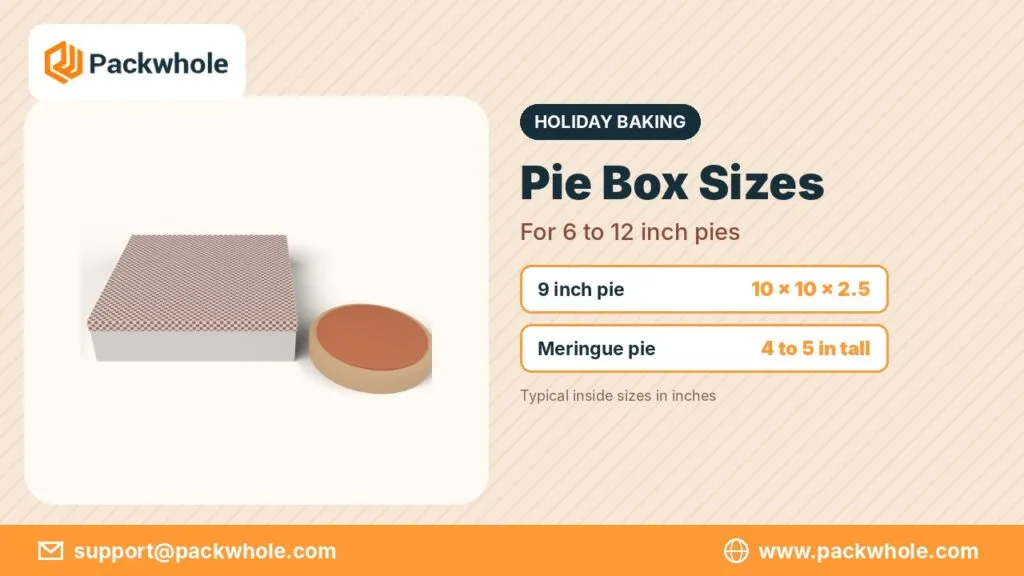
Pies are wider and shallower than most bakery items, and the top crust is where all the craftsmanship shows. A lattice, a crimped edge or a tall meringue can be ruined in seconds if the box is too tight. That is why getting pie box sizes right matters as much as the recipe, especially around Thanksgiving and the winter holidays when pie orders spike.
This guide explains how to measure a pie in its tin, gives typical inside dimensions by pie size and covers height for meringue, cream and deep-dish pies. As always, measure your own pans, because rims and flutes vary between bakeware brands.
Measure the Pan, Not the Recipe
A recipe that says “9 inch pie” usually refers to the inside diameter of the pan at the top. The rim adds width, and decorative crimping can add more. Disposable aluminum tins often have a wider lip than glass or ceramic dishes. To size a box, measure the widest point of the finished pie, including the pan rim and crust edge.
- Check the finished pie across the top where it is widest.
- Check the height from the pan base to the tallest part of the topping.
- Add about half an inch to the width and a little clearance to the height.
Typical Pie Box Sizes Chart
Square boxes are the most common choice for round pies because they are easy to fold, stack and store. The following inside dimensions are typical starting points for standard pies baked in disposable or standard pans.
| Pie diameter | Inside box measurements in inches |
|---|---|
| 4 to 5 inch mini pie | 5.5 x 5.5 x 2.5 |
| 6 inch | 7 x 7 x 2.5 |
| 8 inch | 9 x 9 x 2.5 |
| 9 inch | 10 x 10 x 2.5 |
| 10 inch | 11 x 11 x 3 |
| 12 inch | 13 x 13 x 3 |
Many bakeries standardize on a 10 x 10 inch box because it fits most 9 inch pies with a modest crimped edge.
Height for Meringue, Cream and Deep-Dish Pies
A fruit pie with a flat top crust might be under 2 inches tall, but cream pies and meringue pies are a different story. Meringue peaks can rise well above the pan, and whipped cream toppings can easily add an inch. Deep-dish pies are taller from the start. If the lid touches a soft topping, it flattens the peaks and leaves a mess on the inside of the box.
| Pie style | Suggested inside height |
|---|---|
| Single-crust fruit or pumpkin | 2.5 inches |
| Double-crust or lattice | 2.5 to 3 inches |
| Deep-dish pie | 3 to 3.5 inches |
| Cream or whipped topping | 3.5 to 4 inches |
| Tall meringue | 4 to 5 inches |
Pie Box Sizes for Slices and Hand Pies
Not every customer wants a whole pie. Slice boxes let cafes and restaurants sell pie by the piece, and hand pies have become popular at markets and coffee shops. Slice boxes are usually triangular or small square boxes with a window, while hand pies fit flat rectangular boxes or sleeves.
- Pie slice: many standard slices fit a wedge box of roughly 5 by 5 by 3 inches.
- Hand pie: small boxes around 5 x 4 x 1.5 inches suit most turnover sizes.
- Mini pie sampler: a box with a 2 x 2 or 2 x 3 insert holds several minis.
Windows and Vents
A clear window on the lid shows off the crust and filling, which helps pies sell from a display case. Warm pies, however, release steam that can fog a window and soften the crust. If pies go into boxes while still warm, small vent holes on the sides let moisture escape. Many bakers let pies cool fully before boxing to avoid condensation altogether.
Our custom pie boxes can be made with or without windows and vents. For more on windows, see our post on window patching in packaging.
Planning for Holiday Pie Orders
Thanksgiving is the biggest pie day of the year for many bakeries, and Christmas is close behind. Pre-orders can multiply normal volume, so it pays to have boxes ready weeks in advance. A single box size that fits most of your pies simplifies packing on busy days. Printed handles or a lock tab make it easier for customers to carry pies to the car without tilting them.
- Order seasonal boxes well before the busiest week.
- Pick one or two standard sizes for most pies.
- Add a label area for flavor names and pickup names.
- Consider stackable boxes for customers ordering several pies.
Food Contact and Labeling
Pies are perishable, and cream or custard pies need refrigeration. Boxes need a clean, dry inside that is fit for food contact, and an inside coating can help with butter and fruit juices. Home bakers selling under state cottage food laws may need specific label details, and some states limit which pies can be sold from a home kitchen. Our cottage food labeling requirements post summarizes common rules; please confirm with your local health department, because this is general information rather than legal guidance.
Matching Pie Boxes to Your Bakery Range
Most bakeries sell pies alongside cakes, cookies and pastries. Using the same artwork across all boxes keeps your brand consistent on the counter and in customers’ kitchens. Our bakery box sizes article covers cakes, cookies and pastries, and our custom cake boxes for matching options.
Pie Box Sizes for Different Pan Types
Not all pie pans are equal. Disposable aluminum tins, glass dishes, ceramic bakers and tart pans all have different rims and depths. A deep ceramic dish may be heavier and wider than the same size aluminum tin, which can change the box you need. When you finalize pie box sizes, base them on the pan you actually sell in, not just the recipe size.
| Pan type | Sizing tip |
|---|---|
| Disposable aluminum | Wide lip; add extra width |
| Glass pie dish | Heavier; consider stronger board |
| Ceramic baker | Often taller and wider |
| Tart pan with removable base | Shallow; lower box height |
Strength and Carrying
A whole pie can weigh two to three pounds, especially fruit pies baked in glass or ceramic. A flimsy box bends when lifted from the sides, which can crack the crust or tip the filling. Choosing a slightly thicker board or adding a lock tab helps the box stay square. Handles are useful for customers carrying several pies at once during the holidays.
- Use thicker board for heavy fruit pies.
- Add handles for multi-pie pickups.
- Keep the box flat; tilting moves soft fillings.
- Consider a cake board under pies without a pan.
Shipping Pies to Customers
Some bakeries ship pies, usually frozen or shelf-stable varieties. Shipping requires a sturdy inner box, insulation and often cold packs. The pie box should fit snugly inside the shipper so it cannot slide. Testing a shipment first helps you understand how long the pie stays in good condition. These shipping tips are general; perishable food shipments may be subject to carrier policies that you should review before sending.
Choosing Pie Box Sizes for a Mixed Menu
Bakeries that sell several pie sizes do not need a separate box for each one. Grouping is usually more efficient: one box for minis and slices, one for 8 and 9 inch pies and one taller box for cream and meringue pies. Choosing pie box sizes this way keeps storage manageable and makes holiday packing faster.
| Box group | Fits |
|---|---|
| Small | Mini pies, hand pies and slices |
| Standard | 8 and 9 inch fruit and pumpkin pies |
| Tall | Cream, meringue and deep-dish pies |
| Large | 10 and 12 inch pies for gatherings |
Label each group clearly in your storage area, and your team will reach for the right box without measuring every time.
Get Pie Boxes That Fit Your Pans
Tell us your pan sizes, your tallest pie and whether you need windows, vents or handles. Our team prepares dielines at no cost, shares an on-screen proof, welcomes small first orders and keeps production moving quickly ahead of the holidays. Email support@packwhole.com about your pie range, or request holiday pie box pricing on www.packwhole.com.