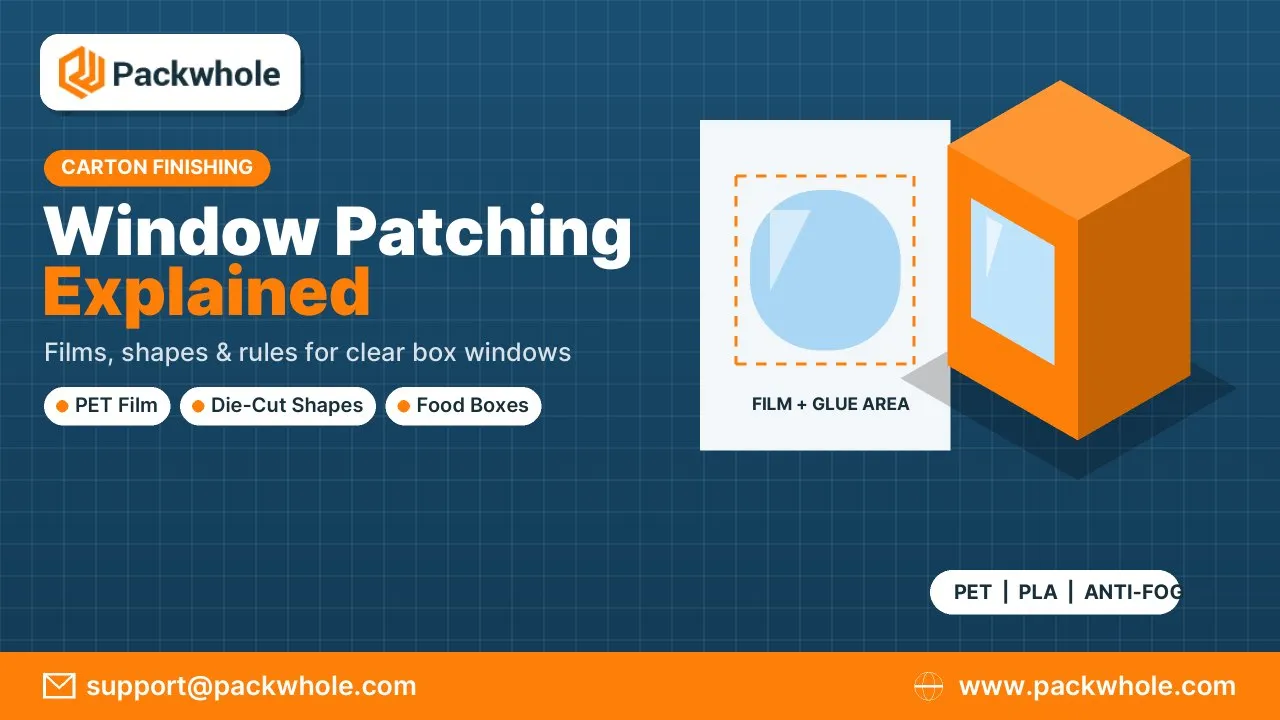
A clear window lets shoppers see the cupcakes, socks or soap inside a box without opening it, and that small view often closes the sale. The process behind it is called window patching. Window patching packaging means gluing a piece of transparent film over a die-cut opening in a carton so the product is visible but still protected from dust, fingerprints and moisture.
This guide walks through how the process works, the film options US brands can choose from, and the design details that separate a crisp window from a wrinkled one.
How Window Patching Works on a Folding Carton Line
Window patching happens after printing and die cutting, but before the carton is folded and glued. The flat sheet already has the window shape cut out. A window patching machine applies a thin line of adhesive around the opening, cuts a piece of film from a roll, and presses it onto the inside of the carton. The flat blanks then move to folding and gluing as usual.
Because the film sits on the inside, the printed outer surface stays smooth and the edges of the film are hidden. Most machines can place one window per carton at high speed, and some handle two windows or films that wrap around a corner of the box.
The steps in order:
- Print the sheet and apply any coating or lamination.
- Die cut the carton outline, creases and window opening.
- Apply glue around the window and place the film patch.
- Fold, glue and pack the cartons flat.
Clear Film Options for Window Patching Packaging
The film you choose affects clarity, stiffness, food safety and recyclability. Most window films used in North America are PET, but brands with sustainability goals or special products sometimes choose other materials. Each has trade-offs worth comparing before you place an order.
| Film | Clarity | Strengths | Considerations |
|---|---|---|---|
| PET | Excellent | Stiff, glossy, common for food and retail | Plastic; separate from paperboard to recycle |
| Anti-fog PET | Excellent | Stays clear for chilled or fresh bakery items | Slightly higher cost |
| PVC | Good | Low cost, flexible | Less popular due to environmental concerns |
| PLA (plant-based) | Good | Made from renewable resources, compostable in industrial facilities | More sensitive to heat; needs proper disposal |
| Cellulose acetate | Very good | Plant-derived, premium look | Higher cost, limited availability |
| Glassine or parchment window | Translucent | Paper-based, plastic-free look | Shows shape and color, not fine detail |
For most bakery and cosmetic boxes, standard PET film between 0.006 and 0.012 inch thick is a good balance of clarity and stiffness. Thicker film stays flatter on large windows.
Choosing a Window Shape That Shows Off the Product
The window shape should frame the most attractive part of the product, not just reveal it. A cookie box may use a round window that echoes the cookie shape, while a sock box might use a tall rectangle that shows the pattern. Creative shapes, such as a heart, a logo silhouette or an arch, turn the window into part of the brand design.
Ideas that work well:
- Rectangle or rounded rectangle: clean and versatile for most retail products.
- Circle or oval: ideal for cookies, candles, macarons and round jars.
- Die-cut silhouette: a product outline, animal or logo shape for gift and kids’ items.
- Wraparound corner window: shows the product from two sides on premium boxes.
- Multiple small windows: works for assortment boxes, such as chocolate or tea samplers.
Keep sharp internal corners to a minimum, because very tight angles are harder to cut cleanly and can tear.
Design Rules for Clean Window Patching Packaging
Most window problems come from artwork and structural choices made before production, not from the machine itself. A window that sits too close to a fold or glue flap may wrinkle or lift. Leaving the right margins and planning where the glue goes makes a big difference in the final result.
Follow these guidelines on your dieline:
- Keep the window at least 1/4 inch away from creases, folds and glue flaps.
- Leave a 1/4 to 3/8 inch overlap of film around the opening for adhesive.
- Avoid placing heavy ink or foil where the glue line runs on the inside, if the inside is printed.
- Make large windows on stiff board, such as 18 pt or heavier, so the panel does not bow.
- Check that the window lines up with the product position inside the box.
Ask your supplier to mark the film area on the proof so you can confirm the placement before printing. Our guide to what a dieline is explains how these layers appear on a structural file.
Food Safety and Freshness Considerations for Windowed Boxes
Bakery and candy brands are some of the biggest users of windowed boxes, which raises questions about food contact. In the United States, packaging materials that touch food should be suitable for food contact under FDA regulations. Window films used for bakery boxes are usually made to meet these requirements, but you should confirm with your supplier, especially when food sits directly against the film.
Practical tips for food products:
- Use anti-fog film for refrigerated cakes, cupcakes and fresh pastries.
- Add a glassine or greaseproof liner when buttery foods touch the board.
- Remember that a window does not seal the box; plan shelf life accordingly.
- Choose window placement so frosting or toppings do not press against the film.
Treat this as general guidance and not legal advice; food-contact requirements depend on your specific product and materials.
Sustainability: Recycling Boxes With Plastic Windows
Customers increasingly ask whether windowed boxes can be recycled. In most US programs, paperboard boxes with small plastic windows are accepted, because the film is separated during pulping. Still, labeling should be honest. Under the FTC Green Guides, recyclability claims must reflect what local programs actually accept, so avoid absolute claims if you are unsure.
Ways to lower the impact of windowed packaging:
- Choose the smallest window that still shows the product well.
- Use plant-based films for brands that want compostable components.
- Try a die-cut open window with no film for products that do not need sealing.
- Print a simple instruction such as “Remove window before recycling” when space allows.
Window Patching Packaging Mistakes to Avoid
A window should make packaging look premium, but small errors can make it look cheap. Wrinkled film, fingerprints and windows that show the wrong part of the product are the most common complaints. Most of these issues can be prevented with a sample or a careful proof review.
- Placing the window over the back of a product or an unattractive label.
- Using thin film on a very large window, causing waves and dents.
- Forgetting that inside printing may show through the window.
- Cutting windows too close to folds, which causes lifting.
- Skipping a physical sample on a new product shape.
Order Custom Window Boxes From PackWhole
PackWhole produces custom window boxes, bakery boxes, cookie boxes and retail cartons with clean, precisely placed window patching packaging. Our team will help you pick the right film, shape and board thickness, and we provide free design support with every order. Low minimums make it easy to test a new window design before a larger run.
Tell us about your product and window idea at support@packwhole.com, or browse box styles at www.packwhole.com.
Window Patching Packaging FAQs
These quick answers cover what brands usually ask before ordering their first windowed boxes. If your product is unusual in shape or size, a sample is the safest way to confirm the result.
Does window patching add a lot to the cost?
It adds a small amount per box for film and an extra production step, which drops at higher quantities.
Can a window be added to corrugated boxes?
Yes, on E-flute and other thin corrugated grades, though it is most common on folding cartons.
Which side of the board is the film glued to?
Usually the inside, so edges stay hidden and the outer print remains smooth.
Can I have a window without plastic film?
Yes. An open die-cut window works for products that do not need dust protection.
Is anti-fog film necessary for bakery boxes?
It helps for chilled or fresh items that release moisture, keeping the window clear.