A subscription box has a tougher job than most packaging. It must fit different products every month, protect them across the country, look exciting on a doorstep and stay affordable to ship hundreds or thousands of times. That is why choosing subscription box sizes is one of the most important early decisions for any box club. Change the size later and you may have to rethink inserts, shipping rates and storage.
This guide covers the dimensions many subscription businesses start with, how to plan for changing contents and how box size affects shipping cost. Use the sizes as references, then test with real products from your first few months.
Popular Subscription Box Sizes
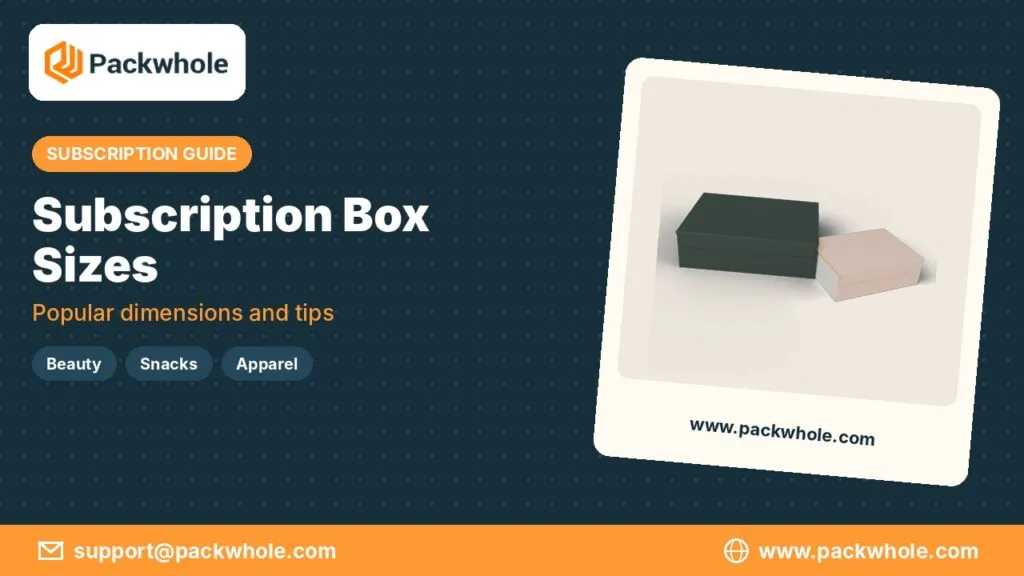
Most subscription brands use mailer boxes because they ship without an outer carton and open with a satisfying lift. The table shows common inside dimensions and the categories that often use them.
| Size (L x W x H, inches) | Common uses |
|---|---|
| 6 x 4 x 2 | Jewelry, sample beauty, pins |
| 8 x 6 x 2 | Beauty minis, socks, small accessories |
| 9 x 6 x 3 | Skincare, stationery, small snacks |
| 10 x 8 x 4 | Snack boxes, candles, coffee |
| 12 x 9 x 4 | Apparel, books, mixed lifestyle boxes |
| 14 x 10 x 4 | Larger apparel, home goods |
| 14 x 10 x 6 | Bulky kits, hobby boxes |
These are widely used sizes rather than formal standards, and many brands adjust by a quarter or half inch to fit their products.
Planning for Changing Contents
Unlike a single product box, a subscription box must handle a different lineup every cycle. One month might be flat items, the next a bottle and a jar. The best approach is to define your “design envelope”: the largest item and the most items you are willing to send in one box. Build the size around that, then use inserts or crinkle paper to fill space in lighter months.
- List the products you plan to include over the next three to six months.
- Note the largest single item and the tallest item.
- Arrange a heavy month and a light month to see how both fit.
- Choose the smallest box that handles the heavy month comfortably.
How Size Affects Shipping Cost
Carriers often charge based on dimensional weight, which uses the box’s size rather than its actual weight when the box is large and light. Subscription boxes are frequently in that range, so even small reductions in size can lower monthly shipping costs. Our post on right-sized mailer boxes explains the math, and our shipping box sizes guide shows how outer dimensions compare.
| Change | Possible effect |
|---|---|
| Reducing height by an inch | Lower dimensional weight |
| Switching to a lighter flute | Less weight per box |
| Using inserts instead of filler | Smaller box for the same items |
| Consolidating sizes | Bigger runs, lower unit cost |
Exact savings depend on your carrier contract and zones, so model a few scenarios with your shipping software.
Choosing Board and Flute
Most subscription boxes use corrugated board. E-flute is thin, prints well and protects most beauty, apparel and stationery items. B-flute is thicker and better for heavier or more fragile contents like glass jars or candles. Our comparison of E-flute vs B-flute explains the trade-offs in more detail.
- E-flute for lighter, flatter monthly contents.
- B-flute for glass, candles and heavier kits.
- Kraft board for natural or rustic brands.
- White board for bright full color printing.
Inserts That Adapt Month to Month
Inserts make a subscription box feel curated rather than tossed together. A printed card insert with cutouts holds items in place and creates a neat layout. The challenge is that contents change. Some brands use a universal insert with several common cutout shapes; others print a new insert each season. Crinkle paper remains a flexible option for months with unusual items. See our post on custom box inserts for shipping for ideas.
Designing for the Reveal
Subscribers often share their unboxing online, so the inside of the box matters as much as the outside. Interior printing, a welcome card and a short note about this month’s theme turn a delivery into an event. Keeping the outside design consistent while changing a sticker, sleeve or insert each month gives variety without reprinting the whole box.
Explore subscription box packaging and custom mailer boxes for formats that work for monthly shipping.
Storage and Fulfillment Considerations
Subscription boxes are usually shipped flat and assembled at a packing station. Storage space, assembly speed and how many boxes fit on a pallet all affect operations. Choosing one or two main sizes keeps fulfillment simpler, especially when temporary staff help during busy months. Tuck-front mailers fold quickly without tape, which saves time on large send-outs.
Mistakes to Avoid
Subscription brands often learn these lessons after the first few shipments. Planning ahead avoids costly reprints:
- Choosing subscription box sizes based on one month’s products only.
- Ignoring dimensional weight when picking a size.
- Using a thin board for glass or heavy items.
- Designing artwork that needs a full reprint every month.
Subscription Box Sizes by Category
Different subscription categories tend to settle on different dimensions. A beauty box full of minis needs far less space than an apparel club sending a sweater. Looking at what similar programs use can help you choose subscription box sizes that match customer expectations, then you can adjust for your own products.
| Category | Typical contents | Common size range (inches) |
|---|---|---|
| Beauty and skincare | Minis, full-size items | 8 x 6 x 2 to 9 x 6 x 3 |
| Snacks | Bags, bars, small jars | 10 x 8 x 4 to 12 x 9 x 4 |
| Apparel | Folded clothing | 12 x 9 x 4 to 14 x 10 x 4 |
| Books | One or two books | 10 x 8 x 3 to 12 x 9 x 4 |
| Coffee and tea | Bags, tins, tools | 10 x 8 x 4 |
| Hobby kits | Craft supplies, tools | 14 x 10 x 6 |
Testing a Box Before Launch
Before launching, build a full sample box with real products and send it to yourself and a few friends in different states. Check how it arrives: are items shifted, is the box dented, does the reveal look the way you imagined? This simple test confirms your subscription box sizes work in the real world before you commit to thousands of units.
- Pack a heavy month and a light month.
- Ship both through your normal carrier.
- Photograph the boxes on arrival.
- Adjust inserts or size if anything moved.
Growing From One Size to Several
As a subscription grows, brands often add tiers, such as a basic and a deluxe box. That may require a second size. Keeping the same width and length while changing only height can simplify inserts and storage. Planning a size family early makes it easier to add tiers later without redesigning everything.
Balancing Presentation and Cost
Subscription businesses live on margins, and packaging is a recurring cost every single month. The right subscription box sizes balance a memorable reveal with efficient shipping. A box that is a little too large adds cost to every shipment, while one that is too tight crushes products and creates support tickets. Most brands find a middle ground by investing in printing and inserts rather than extra size.
- Spend on interior printing rather than a bigger box.
- Use a reusable insert design across several months.
- Review your shipping invoices quarterly to spot dimensional weight charges.
- Survey subscribers about which unboxing details they notice most.
These small habits keep packaging costs predictable while the experience still feels premium to your members.
Plan Your Box Club Packaging With Packwhole
Send us a few months of planned products, your expected volume and the look you want, and we will suggest a size and board that fits. We support you with free dieline and design work, a digital proof before production, small starting quantities for new clubs and speedy runs. Contact support@packwhole.com about your subscription plan, or open a box club quote at www.packwhole.com.