Flat rate shipping is popular because it is simple. If the item fits in the box and stays under the weight limit, the postage is the same whether the parcel travels across town or across the country. The catch is that the boxes come in a short list of fixed shapes, and an item that is a quarter inch too tall will not fit no matter how you rotate it. Knowing the USPS flat rate box sizes before you buy inventory, design a product or quote shipping to a customer saves a lot of guesswork at the counter.
This guide lists the current boxes, explains what tends to fit in each one and shows when flat rate pricing helps a small business and when a right-sized custom mailer makes more sense.
Current USPS Flat Rate Box Sizes at a Glance
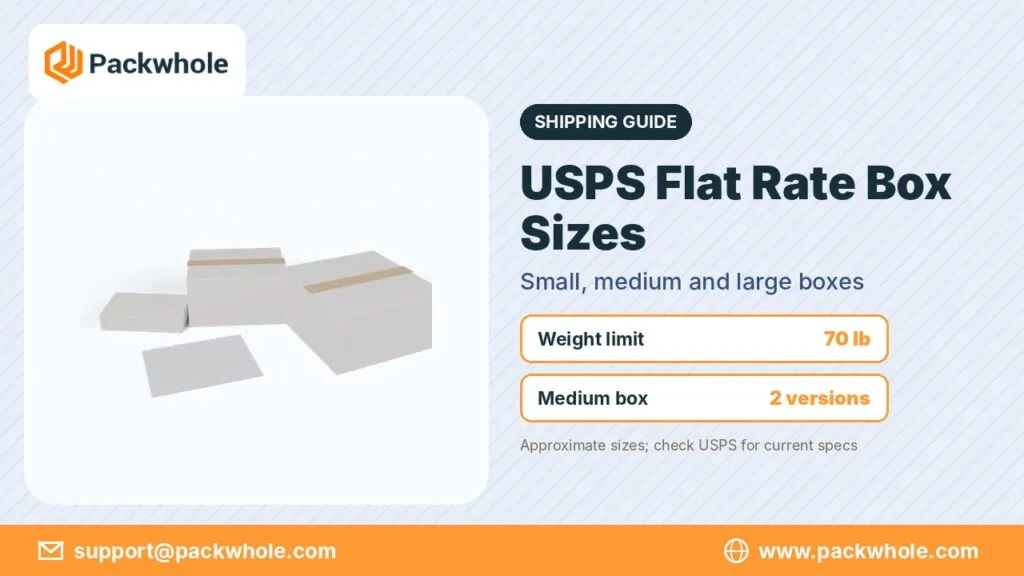
The Postal Service offers its Priority Mail Flat Rate boxes in three main sizes, with two versions of the medium box. The figures below are approximate outside dimensions based on USPS product listings; inside space is slightly smaller because of the board thickness. Always check the measurement printed on the box you receive, because the published USPS flat rate box sizes describe the box rather than the usable space, because USPS can update its packaging.
| Box | Approx. outside size (inches) | Approx. inside space (inches) | Weight limit |
|---|---|---|---|
| Small Flat Rate Box | 8 11/16 x 5 7/16 x 1 3/4 | about 8 5/8 x 5 3/8 x 1 5/8 | 70 lb |
| Medium Flat Rate Box (top loading) | 11 1/4 x 8 3/4 x 6 | about 11 x 8 1/2 x 5 1/2 | 70 lb |
| Medium Flat Rate Box (side loading) | 14 1/8 x 12 x 3 1/2 | about 13 5/8 x 11 7/8 x 3 3/8 | 70 lb |
| Large Flat Rate Box | 12 1/4 x 12 1/4 x 6 | about 12 x 12 x 5 1/2 | 70 lb |
USPS also sells flat rate envelopes, including legal and padded versions, which suit documents and soft goods. The older board game box was retired in 2022, so guides that still list it are out of date.
What Fits in Each Flat Rate Box
Dimensions on paper are hard to picture. A quick way to plan is to compare each box with everyday items. The small box is shallow, so anything thicker than about an inch and a half will not close. The two medium boxes have nearly the same volume but very different shapes, which matters more than most people expect.
- Small box: phone accessories, jewelry, small cosmetics, a few greeting cards, sticker packs.
- Medium top loading: shoes for small children, candles, a few jars, folded hoodies.
- Medium side loading: flat items such as framed prints, books, binders and folded shirts.
- Large box: small appliances, several apparel pieces, boxed gift sets, heavier bundles.
If your item fits the medium box in one direction but not the other, try the alternate version before moving up to the large size.
How Flat Rate Pricing Works
With flat rate service, the box you choose sets the price, not the weight or the destination. You can pack up to 70 pounds inside any of the boxes, and the cost stays the same for any domestic address. That is why heavy, dense items such as metal parts, books or tools are often cheaper to send this way, while light items in big boxes can cost more than regular Priority Mail priced by weight and zone.
Retail rates change from time to time, and USPS sometimes applies temporary adjustments during busy seasons. Check the current price list on the USPS website or in your shipping software before you quote customers, rather than relying on a figure you saw months ago.
Rules to Know Before You Pack
USPS flat rate boxes come with a few conditions. They are only for Priority Mail Flat Rate service, so using one with a different label can lead to extra postage being charged. You may tape the box to strengthen it, but you should not cut it down or build it into a different shape. The box must close normally without bulging. These rules are summarized from public USPS guidance; please read the current Domestic Mail Manual or ask a postal clerk if you have an unusual item, since this article is not official postal advice.
- Use the box only with a flat rate label.
- Keep the contents under 70 pounds.
- Close the flaps normally; reinforcing tape is fine.
- Do not alter the box dimensions.
Where to Get Flat Rate Boxes
The boxes themselves are provided by USPS at no charge. You can pick them up at a post office or order them online through the USPS store, which delivers supplies to your door. Many shipping platforms that print discounted labels also support flat rate options, so you can buy postage at home and drop the parcels off or schedule a pickup.
- Order in packs online if you ship the same size often.
- Keep a few of each size on hand for unusual orders.
- Store flat boxes somewhere dry so they stay rigid.
USPS Flat Rate Box Sizes vs. Right-Sized Custom Boxes
Flat rate boxes are convenient, but they are generic. The USPS flat rate box sizes were designed to suit many products at once, not your product in particular. Every parcel looks like every other Priority Mail package, and the fixed shapes often leave empty space around your product. For light products, a right-sized box billed by weight and zone can cost less. The right-sized mailer boxes article walks through how dimensional weight changes that math, and our shipping box sizes guide lists common outer dimensions.
| Situation | Usually better choice |
|---|---|
| Heavy, dense item that fits a flat rate box | Flat rate box |
| Light item that leaves empty space | Right-sized box priced by weight and zone |
| Branded unboxing for repeat customers | Printed custom mailer |
| Odd shape or long item | Custom size box |
Using Flat Rate Boxes for Your Business
Many sellers mix both approaches. They keep flat rate boxes for heavy or one-off orders and use printed custom mailer boxes for their core products so the brand shows up at the door. When you compare USPS flat rate box sizes with your product line, list your top sellers, measure each one in its retail packaging and see which flat rate box fits with room for padding. Products that fit badly are good candidates for a custom size.
Packing Tips for Flat Rate Shipments
A flat rate box is still a parcel moving through sorting machines and trucks. Good packing prevents damage claims and returns. Wrap fragile items separately, fill empty corners so items cannot shift and place heavier pieces at the bottom. Put a packing slip or a copy of the address inside in case the outer label is damaged.
- Fill gaps with paper or a simple card insert.
- Seal all seams with packing tape.
- Remove old labels and barcodes if reusing a box for another service.
- Photograph high-value contents before sealing.
Common Mistakes With USPS Flat Rate Box Sizes
Most problems come from assuming a box will fit or that flat rate is always cheapest. Measure the item, not just the retail package, and remember that the inside space is a little smaller than the outside measurement. Compare prices with a weight-based Priority Mail label for light parcels, especially to nearby zones.
- Choosing the large box for a light item that would cost less by weight.
- Forcing a bulging box closed.
- Using a flat rate box with the wrong label type.
- Forgetting that envelopes may be cheaper for flat goods.
Comparing the Two Medium Boxes
Shippers often ask which medium box to use, because both cost the same. The top loading version is deeper, which suits upright items like candles, jars and small boxed products. The side loading version is wider and flatter, which suits clothing, books and prints. If an item is close to the limit in one, measure it against the other before moving up to the large box. Among all USPS flat rate box sizes, these two cause the most confusion simply because their shapes differ while their price does not.
| Feature | Top loading medium | Side loading medium |
|---|---|---|
| Shape | Deeper, more compact | Wider, flatter |
| Good for | Jars, candles, small boxed items | Apparel, books, prints |
| Opening | Lid on top | Flap on the long side |
When to Move Beyond Flat Rate
As order volume grows, many businesses find that a branded box in one or two sizes gives them more control over cost and presentation. Printed shipping boxes let you add your logo, a message inside the lid and inserts that hold products in place. Our custom shipping boxes can be sized around your product so you are not paying to ship air, and you can keep flat rate boxes for the occasional heavy order. Reviewing your shipping mix every few months shows which approach is cheaper for each product.
Turn Your Shipping Box Into Part of the Brand
If flat rate boxes are not giving you the fit or the look you want, share your product sizes and monthly volume with us. Our designers prepare the dieline at no cost, you approve a digital proof before anything prints, small runs are welcome and production moves fast. Write to support@packwhole.com with your measurements, or start a shipping box quote at www.packwhole.com.