For most small businesses in the United States, two USPS services handle the bulk of parcels: Ground Advantage and Priority Mail. They overlap in many ways, which makes the choice confusing. The answer to the ground advantage vs priority mail question depends on how fast the parcel must arrive, how heavy and large it is and how much you are willing to pay for speed.
This guide compares the two services side by side, explains when each one tends to be cheaper and shows how packaging size affects the final price.
Quick Comparison
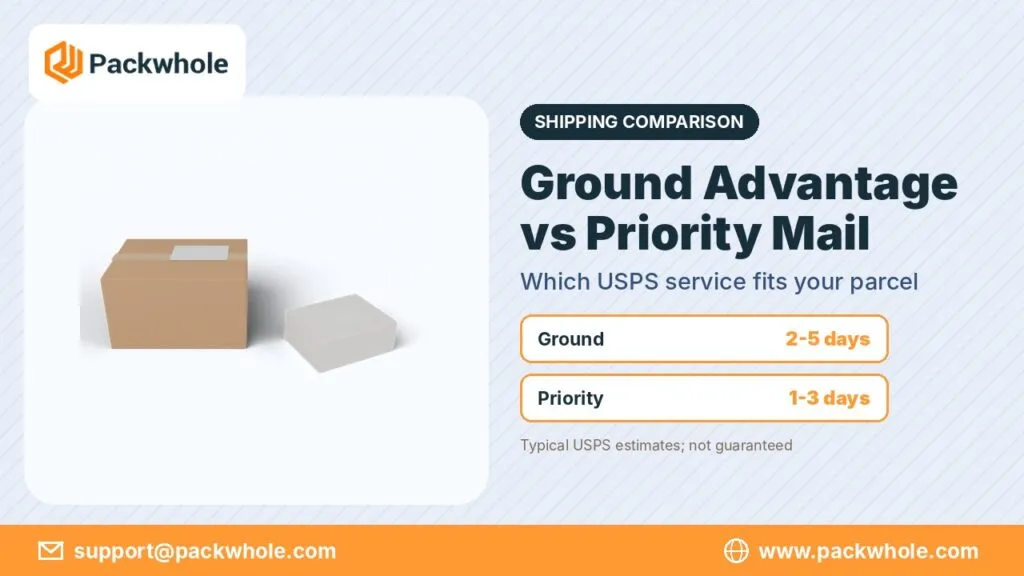
Both services cover all domestic addresses, include tracking and accept parcels up to 70 pounds. The main differences are speed, price and the availability of flat rate boxes. The figures below reflect commonly published USPS service standards; actual delivery times are estimates, not guarantees.
| Feature | Ground Advantage | Priority Mail |
|---|---|---|
| Typical delivery | About 2 to 5 business days | About 1 to 3 business days |
| Maximum weight | 70 lb | 70 lb |
| Tracking | Included | Included |
| Included insurance | Up to $100 for most parcels | Up to $100 for most parcels |
| Flat rate boxes | Not available | Available |
| Free USPS boxes | No | Yes |
Delivery Speed
Priority Mail is the faster service, which matters for gifts, time-sensitive orders and customers who pay for quicker shipping. Ground Advantage is slower but still reliable for most everyday orders. During holidays and severe weather, both services can take longer than usual, so plan promotions and shipping cutoffs with some margin.
Price Differences
For light parcels, especially those under a pound, Ground Advantage is usually cheaper. As weight and distance increase, the gap can narrow. Priority Mail flat rate boxes can beat both services for heavy, dense items that fit inside. Prices change periodically, and USPS sometimes adds temporary seasonal adjustments, so always compare current rates in your shipping software rather than relying on old figures.
- Light items: Ground Advantage often wins.
- Heavy items going far: compare Priority flat rate.
- Urgent orders: Priority Mail for speed.
How Box Size Changes the Math
Both services use dimensional weight for larger boxes, which means a big, light parcel can be billed as if it weighed more. This is why packaging matters as much as service choice. Shipping a small product in an oversized carton can push the price up on either service. A right-sized box often saves more than switching services. You can read more about cutting billed weight with right-sized mailer boxes, and our guide to shipping box sizes lists common dimensions.
| Packaging choice | Effect on cost |
|---|---|
| Snug custom mailer | Lower dimensional weight |
| Oversized generic box | Higher billed weight |
| Flat rate box with heavy item | Fixed price regardless of weight |
| Poly mailer for soft goods | Light and compact |
When to Choose Ground Advantage
Ground Advantage suits everyday orders where a few extra days do not matter. It is popular with apparel brands, small accessory shops and sellers of lightweight items. Because it does not use USPS-branded boxes, you can ship in your own printed packaging, which keeps the unboxing on-brand.
- Lightweight products under a few pounds.
- Orders without urgent deadlines.
- Shipments in your own branded boxes.
- Cost-sensitive customers choosing standard shipping.
When to Choose Priority Mail
Priority Mail is the better fit when speed matters or when a heavy item fits a flat rate box. It is also helpful for gifts close to a holiday and for products that customers expect quickly. Free Priority Mail boxes are available from USPS, but they display USPS branding rather than yours; our guide to USPS flat rate box sizes covers those options.
- Expedited shipping offered at checkout.
- Heavy, dense items that fit a flat rate box.
- Last-minute gifts and urgent replacements.
Offering Both at Checkout
Many online stores let customers choose. Standard shipping uses Ground Advantage, and a faster option uses Priority Mail. Showing clear delivery estimates at checkout reduces support questions. Some brands also set a free shipping threshold on standard delivery and charge for faster service.
Real-World Examples
Looking at typical orders makes the ground advantage vs priority mail choice clearer. A one-pound T-shirt order going across the country is usually cheaper with Ground Advantage, and the customer rarely needs it overnight. A ten-pound box of books that fits a flat rate box may cost less with Priority Mail. A birthday gift ordered three days before the party needs Priority Mail for speed, even if it costs more.
| Order | Likely best choice |
|---|---|
| Light apparel item, no rush | Ground Advantage |
| Heavy books in a flat rate box | Priority Mail Flat Rate |
| Gift needed within days | Priority Mail |
| Small accessory under a pound | Ground Advantage |
Tracking and Customer Communication
Both services include tracking, so share tracking numbers automatically with customers. Clear updates reduce “where is my order” emails. If you offer both options, explain the difference in plain words at checkout, such as “Standard: 2 to 5 business days” and “Faster: 1 to 3 business days.” Setting expectations helps whichever answer you choose in the ground advantage vs priority mail debate.
Packaging Tips for Both Services
Whichever service you choose, good packaging protects your product and your margin. Use a box that fits closely, add inserts or filler so items cannot move and seal all seams. A printed box adds brand recognition on the doorstep. Our custom shipping boxes and kraft mailer boxes are common choices for both services.
- Measure the product and choose the smallest safe box.
- Add padding or inserts for fragile items.
- Weigh the finished parcel accurately.
- Print the label at full size on a flat panel.
Common Mistakes When Choosing a Service
Most overspending comes from habit rather than strategy. Sellers often default to one service for every order without checking whether the other would be cheaper. Reviewing a month of shipping data usually reveals easy savings.
| Mistake | Better approach |
|---|---|
| Using Priority for every order | Compare with Ground Advantage for light parcels |
| Oversized boxes | Right-size packaging to cut billed weight |
| Ignoring flat rate | Check flat rate for heavy items |
| No delivery estimates at checkout | Show clear timelines for each option |
Reviewing Your Choice Over Time
Rates and rules change, and so does your product mix. Revisit the ground advantage vs priority mail decision every few months using real order data. Look at average weight, common destinations and how many customers choose faster shipping. Small adjustments to packaging size and service rules can add up to meaningful savings over a year. This comparison is general guidance; check USPS for current service standards, insurance terms and prices before making changes.
How Weight and Distance Interact
Postage for both services depends on weight and on the distance between the origin and destination, measured in zones. A light parcel going to a nearby zone is cheap on either service, and the difference may be small. As parcels get heavier and travel farther, Priority Mail prices rise faster in some ranges, while flat rate boxes stay fixed. That is why a quick comparison inside your shipping software is so valuable.
If most of your customers are in a few regions, look at your typical zones and weights. A seller in Texas shipping mostly within the South may see different results than a seller shipping coast to coast. Running a sample of last month’s orders through both services shows the real answer to the ground advantage vs priority mail question for your business, rather than relying on general rules.
Returns and Exchanges
Returns deserve the same thinking. Many sellers use Ground Advantage for return labels because speed matters less and the lower cost protects margins. For exchanges where the customer is waiting for a replacement, a faster outbound service can turn a frustrating experience into a positive one. Writing these rules into your returns policy keeps decisions consistent for your team and clear for customers.
Consider who pays as well. Some brands offer free returns on standard service only, while others deduct the return label cost from the refund. Whatever you choose, state it clearly on your website so customers know what to expect before they order.
Packaging That Keeps Shipping Costs in Check
The right box can lower your postage on either service. Send us your product sizes and the services you use most; our designers build the dieline free, you review a proof before we print, low order quantities are fine and production runs quickly. Email support@packwhole.com, or get pricing for right-sized mailers at www.packwhole.com.