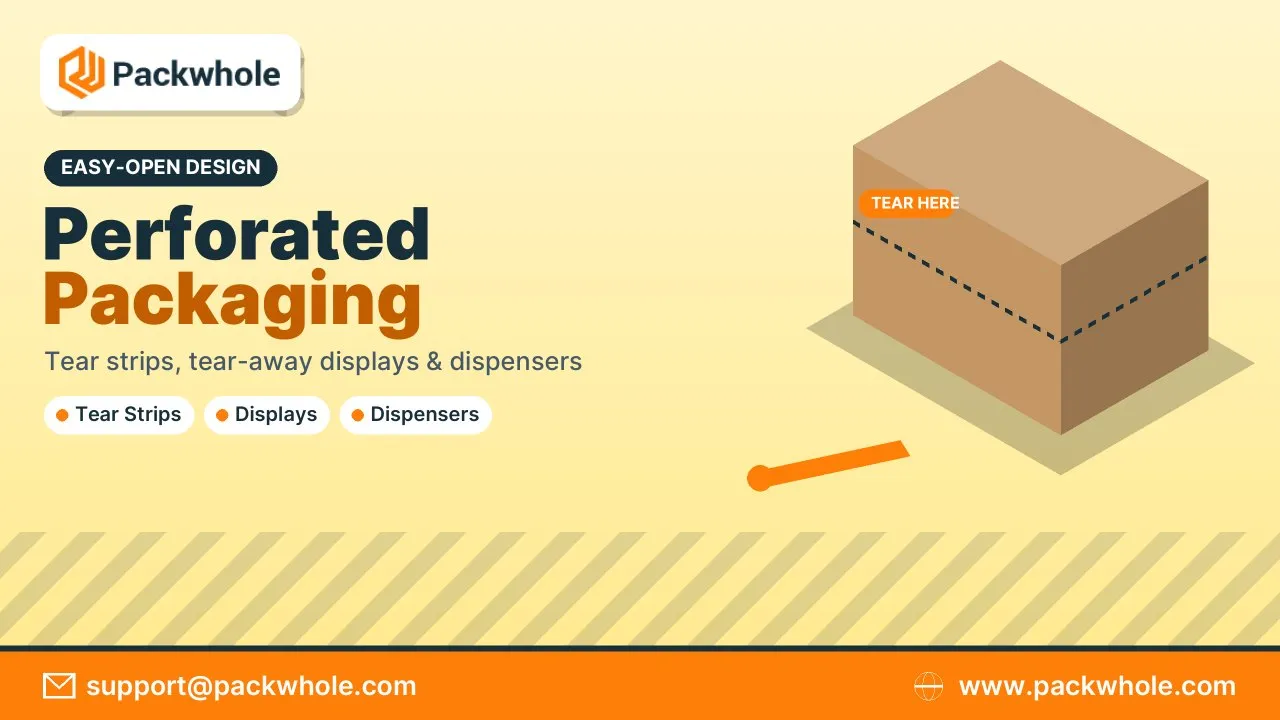
Pulling a zip strip on a delivery box, tearing open a tissue box or popping the front off a shelf display all rely on the same feature: a line of tiny cuts. Perforated packaging uses these planned weak lines so a box can open, convert or dispense exactly where the brand wants it to, without scissors or knives.
This guide explains how perforations are made, the most useful applications, and the design details that make a tear line clean instead of ragged.
What Perforations Are and How They Are Made
A perforation is a row of short cuts separated by small uncut sections called ties. The cuts weaken the board along a line, while the ties hold the package together until someone pulls or pushes. Perforations are added during die cutting, using a cutting rule with gaps that create the cut-and-tie pattern.
Two numbers describe a perforation: the length of each cut and the length of each tie. A pattern with long cuts and short ties tears very easily. A pattern with short cuts and long ties is stronger and harder to tear. Finding the right balance is the key to good perforated packaging.
Common Types of Perforated Packaging
Perforations show up in more products than most people notice. Each application uses perforations for a different reason, whether convenience, display or product access. Here are the most common uses in US retail and e-commerce.
| Application | How the Perforation Is Used | Common Products |
|---|---|---|
| Tear-strip mailers | Pull strip opens the box without tools | E-commerce shipments, subscription boxes |
| Tear-away display cartons | Front or top panel removes to create a shelf display | Snacks, candy, cosmetics, hardware |
| Dispenser boxes | Opening panel lets items be pulled out one at a time | Tissues, gloves, tea bags, straws |
| Shelf-ready packaging | Converts a shipper into a retail tray | Grocery and club store products |
| Tamper-evident closures | Tear line shows if the box was opened | Food, supplements, pharmacy items |
| Return-ready mailers | Second tear strip and adhesive for returns | Apparel and footwear e-commerce |
Each of these can be printed and branded just like any other custom box.
Tear-Strip Mailers for Easy E-Commerce Opening
Tear strips have become popular with online brands because they make unboxing easier and remove the need for a knife, which also protects the product inside. A tear strip is usually a perforated band or a reinforced tape that customers pull around the box. Some designs add a second glue line, letting customers close the carton again and send it back if a return is needed.
Benefits for online brands:
- Faster, safer opening with no blade near the product.
- A satisfying unboxing moment customers notice.
- Easier returns when combined with a resealable strip.
- Tamper evidence, since a torn strip shows the box was opened.
Our guide to frustration-free packaging explains why easy-open features matter for online marketplace sellers.
Tear-Away Displays and Shelf-Ready Packaging
In retail, perforated packaging often serves as a display. A shipper arrives at the store as a closed carton, and staff tear off the front or top panel to reveal a ready-made display tray. This saves time for store employees and keeps products neatly arranged on the shelf.
Design considerations for tear-away displays:
- Place the perforation so the remaining tray is tall enough to hold products upright.
- Print the inside of the tray, because it becomes the visible display.
- Add a “tear here” instruction or a thumb notch to start the tear.
- Test that the carton stays strong enough for shipping before it is opened.
For counter and shelf displays, see our article on counter display boxes that boost impulse sales.
Dispenser Boxes With Perforated Openings
Dispenser boxes use a perforated panel that customers push in or tear away to access products one at a time. This is common for tissues, disposable gloves, tea bags and food service items. The opening shape and size control how easily products come out and how well the rest stay inside.
Tips for dispenser designs:
- Match the opening size to the product so items do not fall out.
- Use an oval or slot shape for products pulled one at a time.
- Add a small tab or finger cut to make the first push easy.
- Consider a film-lined opening for tissues or wipes that need extra hold.
Design Rules for Clean Perforated Packaging
A perforation that tears unevenly or not at all frustrates customers and store staff. Most problems come from the wrong cut-and-tie ratio, placement near folds or the wrong board grade. A few design rules prevent most issues.
Follow these guidelines:
- Choose a cut-and-tie ratio based on board thickness; thicker board needs longer cuts.
- Keep perforations away from glue areas and heavy creases unless the design requires it.
- Run perforations in a straight line or gentle curve rather than tight angles.
- Start the tear with a notch, tab or semicircle cut.
- Request a physical sample to test tearing before full production.
Perforations on corrugated board, such as mailer boxes, behave differently from paperboard, so the same pattern may not work on both.
Balancing Strength and Easy Opening
The biggest challenge with perforated packaging is balancing two opposite needs. The box must be strong enough to survive shipping and handling, yet easy to open when the time comes. Too weak and the box may split in transit; too strong and customers struggle to tear it.
Ways to find the balance:
- Increase tie length for heavy products or long shipping routes.
- Place perforations on panels that carry less load.
- Use tear tape instead of a perforation for heavy mailers.
- Drop-test samples before approving the design.
Carriers expect packages to protect contents throughout transit, so test perforated shippers with real products. This is general packaging guidance, not carrier policy advice.
Perforated Packaging Mistakes to Avoid
Perforations are small details, but mistakes are very visible to customers. A display that tears in the wrong place or a mailer that opens during delivery can damage a brand’s reputation. These are the errors we see most often.
- Using the same perforation pattern on thin and thick boards.
- Placing tear lines across printed logos or important text.
- Forgetting instructions, so customers do not see the tear strip.
- Making perforations so weak the box opens in transit.
- Skipping sample testing on new structures.
Design Perforated Boxes and Displays With PackWhole
PackWhole designs custom display boxes, counter display boxes, mailers and dispenser boxes with tear strips and perforations tuned to your product. Our structural team will choose the right cut-and-tie pattern for your board and test samples before production. Design help costs nothing, and short production runs let you try a new opening feature without a big commitment.
Describe your opening or display idea to support@packwhole.com, and we will design a sample, or visit www.packwhole.com to see box styles.
Perforated Packaging FAQs
Below you will find short replies to the questions buyers raise most about tear strips, tear-away displays and dispenser openings. Testing a sample with your product is the best way to confirm the design.
Does adding perforations increase the cost?
Usually very little, since perforations are cut during the same die-cutting step.
Can perforations be added to corrugated boxes?
Yes. Corrugated mailers and shippers often use perforations or tear tape.
Will a perforated box survive shipping?
Yes, if the pattern and board are chosen correctly and samples are tested.
What is a cut-and-tie ratio?
It is the length of each cut compared with the uncut section between cuts.
Can I add a return strip to my mailer?
Yes. A second adhesive strip lets customers reseal the box for returns.