Ordering custom mailer boxes for the first time feels simple until the quote form starts asking questions. Which style do you want? E-flute or B-flute? Kraft or white? Inside dimensions or outside? Most brands know how they want the box to look, but far fewer know how to specify one.
This buyer’s guide walks through the decisions in the order a packaging supplier will ask about them. By the end, you will be able to read a spec sheet, compare quotes fairly, and order a box that fits your product, your budget and the way you ship across the USA.
What Custom Mailer Boxes Are and Why Their Structure Matters
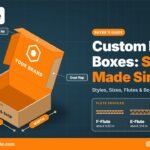
A mailer box is cut from a single sheet of corrugated board and folded into shape, with a hinged lid that tucks into the front wall. Because the side walls roll over and lock into the base, the finished box has double-thickness sides without any glue or tape. That self-locking design is why mailers assemble in seconds and still feel sturdy in the hand.
If you are still deciding between a mailer and a regular slotted carton, our comparison of the mailer box vs shipping box explains where each one fits. The rest of this guide assumes a mailer is the right structure for you.
The Main Mailer Box Styles and the Job Each One Does Best
Suppliers use a handful of industry names for mailer structures, and the abbreviations can look like alphabet soup on a quote. The differences come down to how the lid closes and how well the sides are sealed against dust and tampering. Knowing the names helps you ask for exactly what you need instead of accepting a default. Here are the styles you are most likely to be offered.
Roll End Tuck Front (RETF)
This is the classic ecommerce mailer. The lid has a front flap that tucks inside the front wall, and two small tabs (often called cherry locks) hold it shut. It is the most economical style and works for apparel, books, cosmetics and subscription kits.
Roll End Tuck Front with Dust Flaps
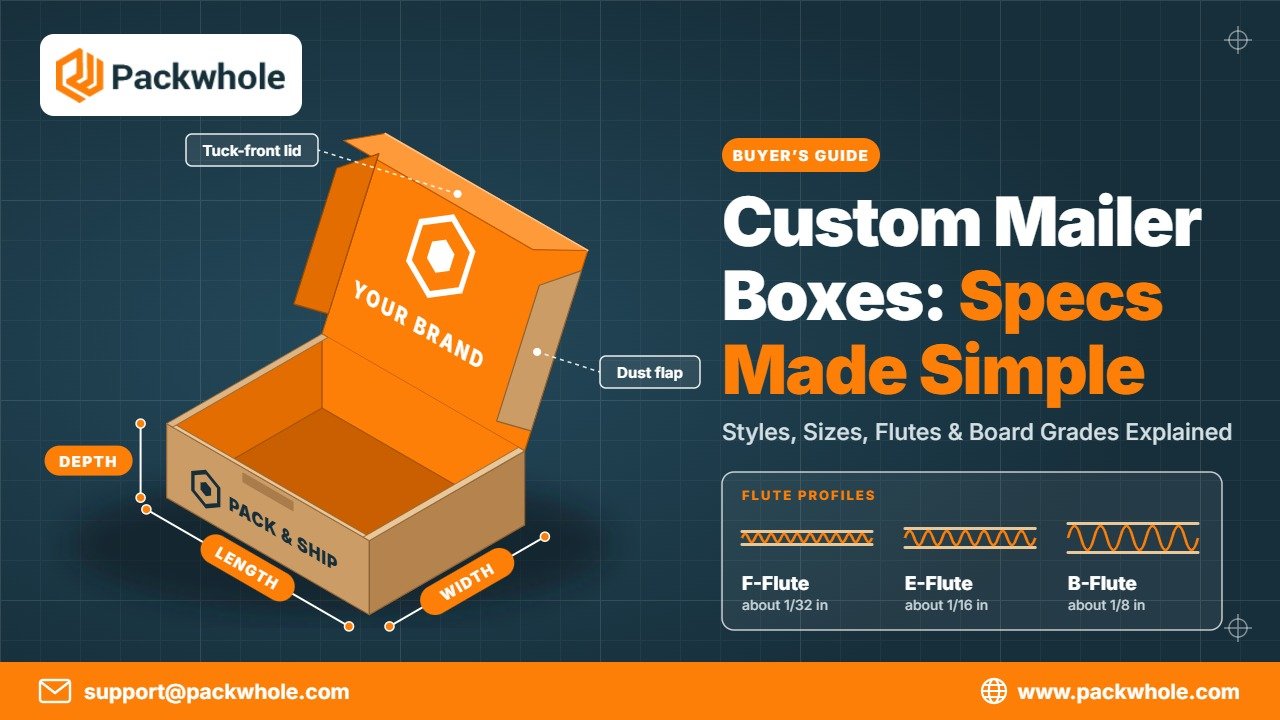
Dust flaps are two extra panels on the lid that fold down along the inside of the side walls. They close the small gaps at the corners, keep dust out and make the lid sit more firmly. Choose this version for products that must stay clean, such as food, skincare or electronics. We look at this dust-flap mailer structure more closely in a separate post.
Mailers with Tear Strips and Adhesive Seals
A peel-and-seal adhesive strip closes the box without tape, and a perforated tear strip gives the customer a clean way to open it. Some versions add a second adhesive strip so the same box can be resealed for returns. This style suits fashion and footwear brands with high return rates.
Double-Wall Front Mailers
On a double wall tuck front box, the front panel folds over to create a thicker front wall. The extra layer adds crush resistance and gives the lid a deeper pocket to lock into. It is a good upgrade for heavier items or premium gift sets.
Understanding Corrugated Flutes and Board Grades Before You Order
Corrugated board is a wavy inner layer, called the fluting, glued between flat liner sheets. The size of the wave is described by a letter, and it controls thickness, cushioning and how smooth the print surface is. Board strength is a separate number, usually shown as an Edge Crush Test (ECT) rating. Together, flute and ECT tell you most of what you need to know about how a box will behave in the mail.
| Flute | Approx. Thickness | Strengths | Typical Use in Mailers |
|---|---|---|---|
| F-flute | About 1/32 inch | Very smooth print surface, slim profile | Small cosmetics, jewelry, retail-style packs |
| E-flute | About 1/16 inch | Sharp printing, light weight, tidy folds | Most ecommerce and subscription mailers |
| B-flute | About 1/8 inch | Better cushioning and crush resistance | Heavier, fragile or stacked shipments |
| C-flute | About 5/32 inch | Strong stacking performance | Large shipping cartons more than mailers |
For board strength, 32 ECT is the common single-wall grade for everyday parcels, and heavier contents may call for a higher rating or double-wall board. You will also choose a liner color. Natural kraft has a warm, earthy look and hides scuffs, while white liners make printed colors brighter. For a deeper background on the material itself, see our guide to corrugated boxes.
How to Choose the Right Size for Custom Mailer Boxes
Size is where most first orders go wrong, because a box has two sets of dimensions. Inside dimensions describe the usable space, and outside dimensions are what the carrier measures for billing. Mailers are normally quoted by inside dimensions in the order length × width × depth. A quarter inch in the wrong direction can mean a product that rattles or a lid that will not close, so follow a clear process.
- Measure the packed product, not the bare product. Include any retail carton, pouch, tissue or sleeve that goes into the mailer.
- Add a small clearance. About 1/8 to 1/4 inch per side is usually enough for easy packing without movement.
- Allow for inserts. A corrugated or paperboard insert takes up space on every side it touches.
- Check the outside dimensions. Board thickness adds to each side, and the rolled walls of a mailer add more than a regular carton.
- Test with a sample. Pack a real order, close the lid and shake the box before approving production.
Common starting points include 6 × 4 × 2 inches for small accessories, 9 × 6 × 3 inches for beauty and wellness kits, and 12 × 9 × 4 inches for folded apparel. Treat these as references only. Our walkthrough on how to measure box dimensions shows the method step by step, and our article on right-sized custom mailer boxes explains how size affects what you pay the carrier.
Printing and Finishing Choices That Shape the Final Look
How custom mailer boxes are printed affects price, minimum quantity and color accuracy as much as the artwork does. The right method depends on how many boxes you need and how detailed the design is. It also helps to decide early whether you want printing on the outside only or on the inside as well, since inside print changes the setup. These are the options you will see most often.
- Flexographic printing: Best for simple one or two-color designs at higher volumes.
- Digital printing: No plates, so it suits short runs, multiple designs and fast turnarounds.
- Litho lamination: An offset-printed sheet is laminated to the board for photo-quality graphics.
- Inside printing: A pattern or message under the lid adds impact for a modest extra cost.
- Coatings and finishes: Matte or gloss coatings protect ink, while foil and spot UV add premium accents.
To compare the two main print methods in depth, read our guide to offset vs digital printing. For finish ideas, see spot UV vs soft-touch lamination.
What to Expect When You Order: Dielines, Proofs and Lead Times
A custom box order follows a predictable path, and knowing the steps makes it easier to plan a launch date. Delays almost always come from artwork revisions rather than from manufacturing. Here is the usual sequence from first inquiry to delivery.
- Quote request: Share the style, inside dimensions, board, print sides, finish and quantity.
- Dieline: The supplier sends a flat template showing cut lines, fold lines, bleed and safe zones.
- Artwork: Your designer places the design on the dieline in CMYK, with vector logos and a 1/8 inch bleed.
- Proof: You review a flat proof or a 3D mockup and approve colors, text and placement.
- Sample: For new sizes, a plain or printed sample confirms fit before the full run.
- Production and delivery: Boxes are printed, die-cut and shipped flat to save freight and storage space.
Unit price falls as quantity rises because setup costs are spread across more boxes. Our breakdown of how much custom boxes cost shows which choices move the price the most.
Common Mistakes Buyers Make on Their First Mailer Box Order
Most problems with a first order are specification errors, not printing errors. They are easy to avoid once you know where they come from. Reviewing this list before you approve a proof can save a reprint and several weeks.
- Mixing up inside and outside dimensions. Always confirm which one the quote uses.
- Choosing board by price alone. A thin board that crushes in transit costs more in replacements.
- Placing key artwork on fold lines. Logos and text near a crease can distort or crack.
- Skipping the physical sample. A screen mockup cannot show fit, stiffness or true color.
- Ordering too close to launch. Leave time for at least one round of proof changes.
Order Custom Mailer Boxes from PackWhole
PackWhole manufactures custom mailer boxes for ecommerce stores, subscription brands and retailers across the United States. Our team will help you pick the style, flute and board grade, send a dieline for your designer and supply a sample before production begins. We offer inside and outside printing, low minimum orders and free design support, so you can start small and scale up. Browse our mailer box range, then send your sizes and quantity to support@packwhole.com or start a quote request at www.packwhole.com.
Frequently Asked Questions About Custom Mailer Boxes
First-time buyers tend to ask the same practical questions before they place an order. The answers below cover the points that come up most often on quote calls. If your product has unusual requirements, send us the details and we will recommend a specification.
What is the best flute for a mailer box?
E-flute is the usual choice because it prints sharply and keeps the box slim. Move up to B-flute when the contents are heavy or fragile, or when boxes will be stacked.
Are mailer boxes measured inside or outside?
Suppliers normally quote inside dimensions as length × width × depth. Carriers measure the outside, so ask for both figures when shipping cost matters.
Can I print on the inside of the box?
Yes. Inside printing is available on most styles and is popular for thank-you messages, patterns and care instructions.
Do I need a sample before a full order?
A sample is strongly recommended for any new size. It lets you check fit, closure and board stiffness with your real product before you commit to a full run.