If you sell online, every order leaves your hands in a box. The box you pick decides how safe the product arrives, how much you pay the carrier, and what your customer feels when the parcel lands on the doorstep. Two options come up again and again: the mailer box and the standard shipping box. They look similar on a spec sheet, yet they do very different jobs.
This guide breaks down the real differences between a mailer box vs shipping box, so you can choose the right one for your products, your budget, and your brand.
What Is a Mailer Box?
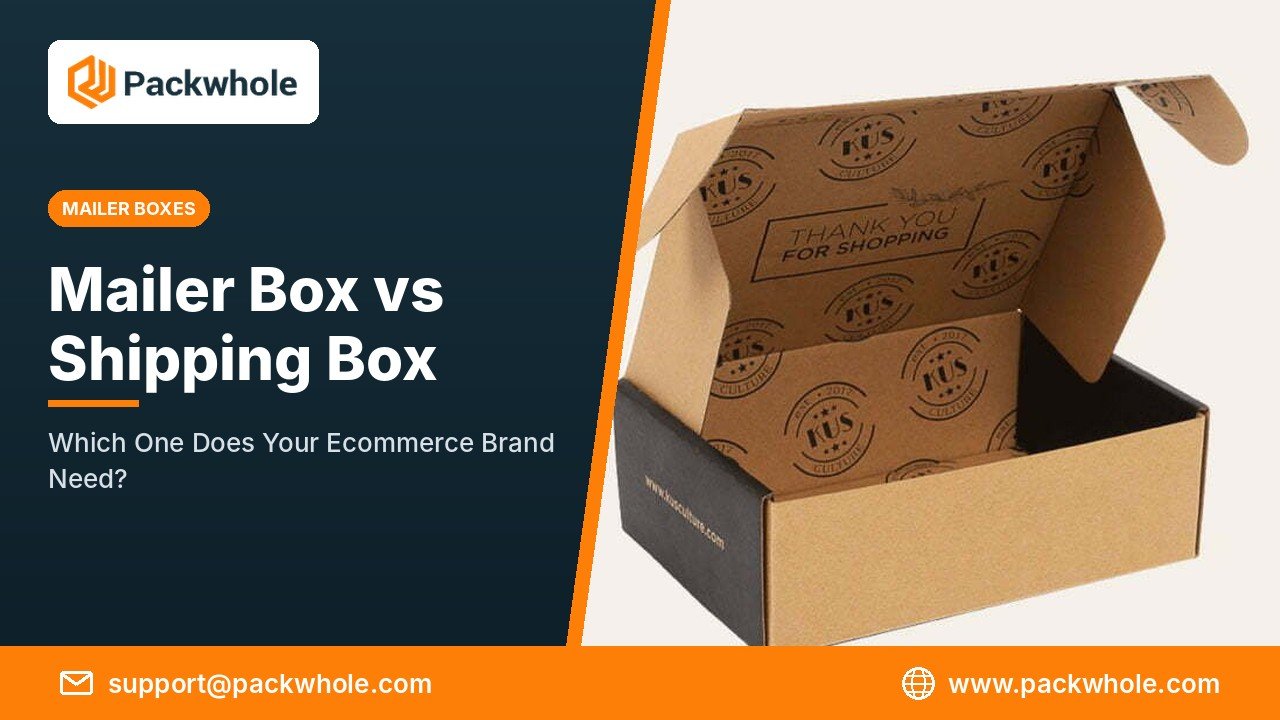
A mailer box is a one-piece, die-cut box made from corrugated board, usually E-flute or B-flute. It folds together without tape, has a hinged lid with tuck-in flaps, and opens like a small chest. Because the whole box is printed as a single flat sheet, you can add your logo, colors, and messages on the outside and the inside.
Mailer boxes are built for direct-to-consumer brands. Clothing, cosmetics, subscription kits, candles, small electronics, and gift sets are classic examples. They are strong enough to survive the postal network on their own, yet they look good enough to be opened on camera.
What Is a Shipping Box?
A shipping box, often called a regular slotted carton (RSC), is the familiar brown box with four flaps on the top and four on the bottom. The flaps meet in the middle and are sealed with tape. These boxes come in a huge range of sizes and board grades, from light single-wall cartons to heavy double-wall cases.
Shipping boxes are the workhorses of logistics. They move bulk orders, heavy items, wholesale shipments to retailers, and products that will be repacked further down the supply chain. Most of the time nobody expects them to look pretty; they simply need to protect what is inside.
Mailer Box vs Shipping Box: Key Differences
| Feature | Mailer Box | Shipping Box (RSC) |
|---|---|---|
| Construction | One-piece die-cut, tuck-front lid | Four top and bottom flaps |
| Sealing | Self-locking, optional tape or sticker | Requires tape |
| Typical flute | E-flute or B-flute | B, C, or double-wall BC |
| Best for | Small to mid-size retail items | Heavy, bulky, or bulk orders |
| Printing | Full color inside and outside | Usually one or two colors outside |
| Unboxing experience | Premium, gift-like | Functional |
| Unit cost | Higher | Lower |
1. Structure and Strength
Mailer boxes have double walls on the sides and a rolled front edge, which makes them stiff for their size. They handle the knocks of parcel delivery very well when the product is light to medium weight. Shipping boxes, on the other hand, can be made in heavier board grades and much larger sizes, which makes them better for items over roughly 10 to 15 kilograms, or for stacking pallets in a warehouse.
2. Packing Speed
Mailers fold in a few seconds and lock without tape, which speeds up small-batch packing. RSC boxes need tape on the bottom and the top. If you ship thousands of orders a day with an automated taping line, that is not an issue; if you pack by hand at a small studio, the mailer usually wins.
3. Branding and Presentation
This is the biggest difference. A mailer box is a marketing surface. You can print a bold outer design, a thank-you message under the lid, social handles, and care instructions on the inside panels. A shipping box typically carries a simple logo or a label. If your customers share unboxing photos, or you rely on repeat purchases, a printed mailer pays back through brand recall.
4. Cost
Because mailers are die-cut and often printed in full color, they cost more per unit than plain cartons. However, the gap shrinks as order quantity grows, and you often save on tape, filler, and separate gift boxes. Shipping boxes remain the cheaper option for high-volume, low-margin goods where presentation does not matter.
When to Choose a Mailer Box
- You sell direct to consumers. The box is the first physical contact a customer has with your brand.
- Your products are small to medium in size. Apparel, beauty, jewelry, books, accessories, and supplements fit well.
- You run a subscription service. A consistent, branded box builds anticipation each month.
- You want fewer packaging parts. A well-sized mailer can replace a carton plus an inner gift box.
- Social media matters to you. Printed interiors turn deliveries into shareable content.
When to Choose a Shipping Box
- Your items are heavy or bulky. Double-wall cartons carry more weight and resist crushing.
- You ship B2B or wholesale. Retailers care about protection and handling, not unboxing.
- You need many sizes quickly. RSCs are easy to source in a wide range of standard dimensions.
- Margins are tight. Plain cartons keep packaging cost per order as low as possible.
- The product already has retail packaging. If the item sits inside a printed retail box, an outer carton simply needs to protect it.
Can You Use Both?
Many growing brands use a mix. A common setup is printed mailer boxes for single orders to consumers, and plain or one-color corrugated shipping boxes for wholesale orders and multi-item bundles. Some brands also add a printed shipping box with a simple logo for large orders, so the brand stays visible without the cost of full-color printing.
Another smart option is a mailer box with minimal outside print and a vivid interior. The parcel looks discreet in transit, which reduces the risk of theft for high-value items, yet it still delivers a strong reveal when opened.
How to Size Your Box Correctly
Whichever style you choose, size has a direct effect on shipping cost and damage rates. Measure the inside dimensions you need (length × width × depth), then add a small allowance for inserts or tissue. Too much empty space means higher dimensional weight charges and more movement in transit. Too little space risks crushed corners. If you are unsure, our guide on how to measure box and packaging dimensions walks through the process step by step.
Material and Finish Options
Both box styles can be made from white or kraft corrugated board. Kraft gives a natural, eco-friendly look, while white board makes printed colors appear brighter. For mailer boxes, popular upgrades include matte or gloss lamination, spot UV on the logo, foil stamping, and custom inserts that hold products in place. For shipping boxes, most brands stick to one or two-color flexo printing on kraft board to keep costs down.
Our Recommendation
If your customer is the end user and the product is light to medium weight, a custom printed mailer box is almost always worth it. It protects the product, reduces extra packing materials, and makes your brand memorable. If you are shipping heavy goods, bulk orders, or products that already have their own retail packaging, a sturdy shipping box is the practical, cost-effective choice.
At PackWhole, we produce both custom mailer packaging and corrugated shipping boxes in any size, with free design support and low minimum orders. Tell us what you sell and how you ship, and our team will recommend the right structure for you.
Frequently Asked Questions
Is a mailer box strong enough for shipping?
Yes. Mailer boxes are made from corrugated board and are designed to travel through courier and postal networks without an extra outer carton, as long as the product is within a sensible weight range and the box is sized correctly.
Are mailer boxes more expensive than shipping boxes?
Per unit, usually yes, because of the die-cut structure and printing. The total cost per order can be close once you factor in reduced tape, filler, and separate gift packaging.
Can I print on the inside of a shipping box?
You can, but it is less common. Mailer boxes are the better choice if interior printing is important to your brand experience.
Which box is more eco-friendly?
Both are made from recyclable corrugated board. A right-sized box of either style, printed with water-based inks and free of plastic filler, is the most sustainable option.