A crushed box at the customer’s door costs far more than the packaging inside it. There is the replacement product, the return shipping, the support time, and the one-star review. Yet over-building every box wastes money on weight and material. Choosing between single wall vs double wall boxes is about matching strength to the real journey your product takes.
This guide explains how each construction is built, what weight and stacking each can handle, how they compare on cost, and a simple decision process you can use for every product in your catalog.
How Corrugated Walls Are Built
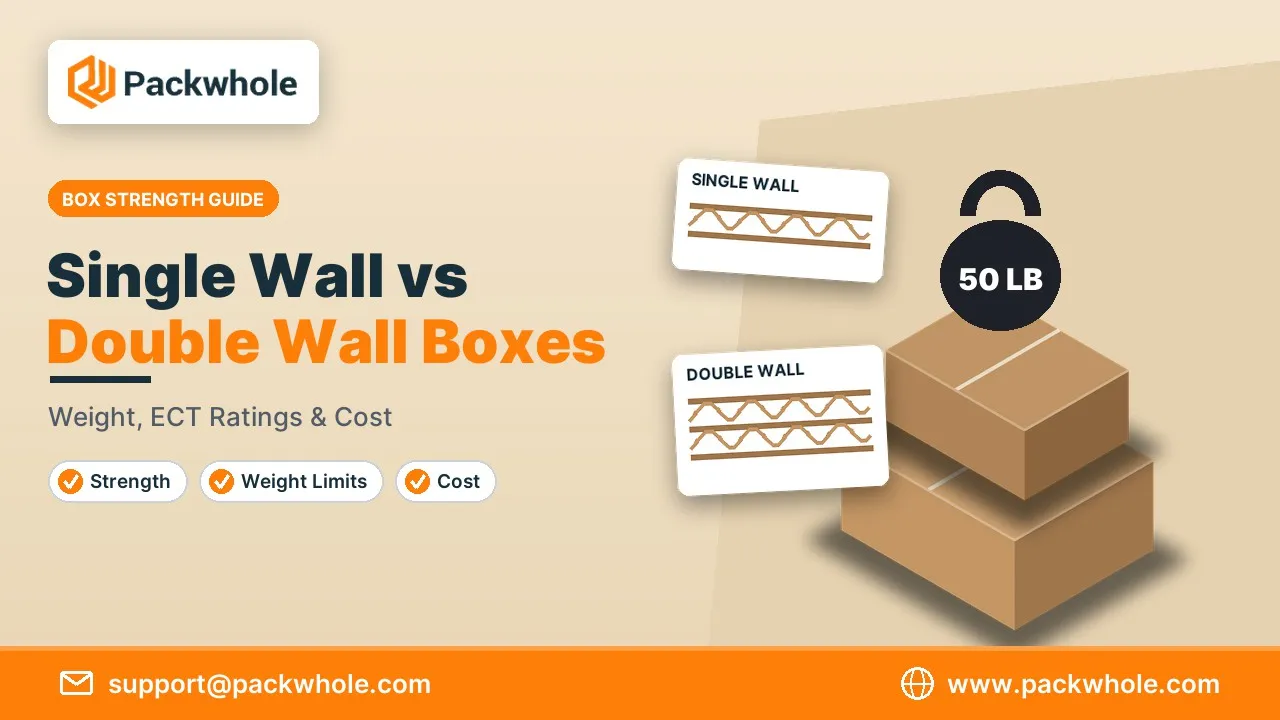
Every corrugated box is made from layers of paper. A single wall board has one fluted layer sandwiched between two flat liners, three paper layers in total. A double wall board has two fluted layers and three liners, five layers in total. There is also triple wall, with three fluted layers and seven paper layers, used for very heavy industrial loads.
| Construction | Paper Layers | Fluted Layers | Typical Thickness | Typical Use |
|---|---|---|---|---|
| Single wall | 3 | 1 | 1/16 to 3/16 in | Ecommerce, retail shipping |
| Double wall | 5 | 2 | 1/4 to 3/8 in | Heavy, fragile, stacked loads |
| Triple wall | 7 | 3 | 1/2 in and up | Industrial parts, bulk freight |
Flute combinations vary. Double wall is often BC flute, which pairs a B flute and a C flute, while lighter double wall may use BE flute for a smoother print face.
Single Wall vs Double Wall Boxes: Strength Compared
Strength is usually measured in two ways in the US. ECT (Edge Crush Test) shows how much weight a box can stack before collapsing. Burst strength (Mullen test) shows how well the board resists punctures and rough handling. Box makers print these ratings on a Box Maker’s Certificate on the bottom flap. The guideline weights below are approximate and assume a well-packed, right-sized box.
| Board | Typical Rating | Approx. Max Product Weight |
|---|---|---|
| Single wall, light | 32 ECT / 200# burst | Up to about 40 to 65 lb |
| Single wall, heavy | 44 ECT / 275# burst | Up to about 65 to 95 lb |
| Double wall | 48 ECT / 275# burst | Up to about 80 to 120 lb |
| Double wall, heavy | 61 ECT / 350# burst | Up to about 100 to 140 lb |
These figures are general guidance; exact capacity depends on box size, how it is packed, and how it will be stacked.
When Single Wall Boxes Are the Smart Choice
Most ecommerce orders ship perfectly well in single wall corrugated. It is lighter, cheaper, easier to print, and takes up less storage space. For products under roughly 30 pounds that are well cushioned, single wall is usually the right call. It also folds more neatly, which matters for branded mailers.
Single wall works well for:
- Apparel, cosmetics, books, and accessories
- Subscription boxes and printed mailer boxes
- Small electronics with inserts
- Retail cartons and shelf-ready packaging
- Light multi-item orders
When Double Wall Boxes Earn Their Cost
Double wall adds a second fluted layer, which roughly doubles cushioning and greatly improves stacking and puncture resistance. It is the safer choice when products are heavy, fragile, high value, or travel long distances with many handling points. It is also common for boxes that will sit at the bottom of a pallet with weight above them.
Use double wall for:
- Products over about 40 to 50 pounds.
- Glass, ceramics, and fragile décor.
- Small appliances and equipment.
- Long-distance or international shipments.
- Boxes stacked on pallets for freight.
- Large boxes where the panels might bow or buckle.
For more on oversized parcels, see our guide on how to ship large boxes.
Cost, Weight, and Storage Trade-Offs of Single Wall vs Double Wall Boxes
Double wall boxes cost more per unit because they use more paper and adhesive, often noticeably more than an equivalent single wall box. They also weigh more, which can push a parcel into a higher shipping tier, and they take up more room flat in your warehouse. Those costs are worth it when they prevent damage, but wasteful when the product would have arrived safely in single wall.
| Factor | Single Wall | Double Wall |
|---|---|---|
| Unit price | Lower | Higher |
| Box weight | Lighter | Heavier |
| Flat storage | More per pallet | Fewer per pallet |
| Print quality | Better, especially on fine flutes | Good, slightly rougher |
| Protection | Good for most items | High for heavy or fragile items |
| Stacking | Moderate | Strong |
A Simple Test Before You Commit
You don’t need a lab to make a sensible decision. A basic drop test with your real product reveals most weaknesses. Pack the item exactly as a customer order would be packed, then test it the way carriers handle parcels. Repeat with both constructions if you are unsure.
- Pack the product with your planned inserts or void fill.
- Drop the box from about 30 inches onto a hard floor: flat on the bottom, on one edge, and on one corner.
- Stack a weight on top equal to several boxes for 24 hours.
- Open and inspect the product, inserts, and corners.
- If anything breaks or the box crushes, upgrade the board or the inserts.
Formal tests such as ISTA procedures give more reliable results for high-value products, and some retailers require them.
Matching Single Wall vs Double Wall Boxes to Your Product Range
Many brands sell a mix of light and heavy products, so one construction rarely fits everything. Mapping each product to the right board keeps costs down while protecting fragile or heavy items. Think in terms of a small family of boxes rather than a single standard, and assign each product to the lightest construction that passes your tests.
| Product Example | Typical Weight | Suggested Construction |
|---|---|---|
| T-shirts, cosmetics, books | Under 5 lb | Single wall (E or B flute) |
| Candles, bottles, small kitchenware | 5 to 20 lb | Single wall 32 to 44 ECT with inserts |
| Small appliances, glass décor | 20 to 50 lb | Double wall |
| Equipment, bulk orders, freight cartons | Over 50 lb | Double wall or triple wall |
Review this map whenever you add products or change carriers, since rough handling or longer routes may push a product into a stronger category.
Mistakes to Avoid When Choosing Box Strength
Most strength problems come from guessing instead of testing, or from upgrading the box when the real issue is poor packing. A double wall box with no cushioning can still break a glass product. Here are the errors that come up again and again.
- Upgrading to double wall instead of fixing loose packing.
- Using oversized boxes that leave products free to move.
- Ignoring stacking loads in warehouses and trucks.
- Forgetting that double wall adds weight to every shipment.
- Not checking the Box Maker’s Certificate on stock boxes.
Get the Right Single Wall vs Double Wall Boxes From PackWhole
PackWhole makes custom printed corrugated boxes and corrugated cartons in single wall and double wall, sized exactly to your products. Our team will help you weigh single wall vs double wall boxes based on product weight, fragility, and shipping method. Design help is free and minimums stay low, so you can test before you scale.
Tell us your product weight at support@packwhole.com, or request heavy-duty pricing through www.packwhole.com.
Frequently Asked Questions About Single Wall vs Double Wall Boxes
These short answers cover what buyers ask most when choosing box strength. Every product is a little different, so treat weight guidelines as starting points and test with real orders when possible.
How can I tell if a box is double wall?
Look at the cut edge. Double wall shows two wavy layers between three flat sheets.
Is double wall always better?
No. It is stronger, but heavier and more expensive. Many products ship safely in single wall.
Can double wall boxes be printed?
Yes. Printing works well, though fine details look best on single wall with a fine flute.
What does 32 ECT mean?
It means the board can withstand about 32 pounds of force per linear inch on its edge, a common standard for shipping boxes.
Are double wall boxes recyclable?
Yes. Like single wall, they are widely recycled across the US.