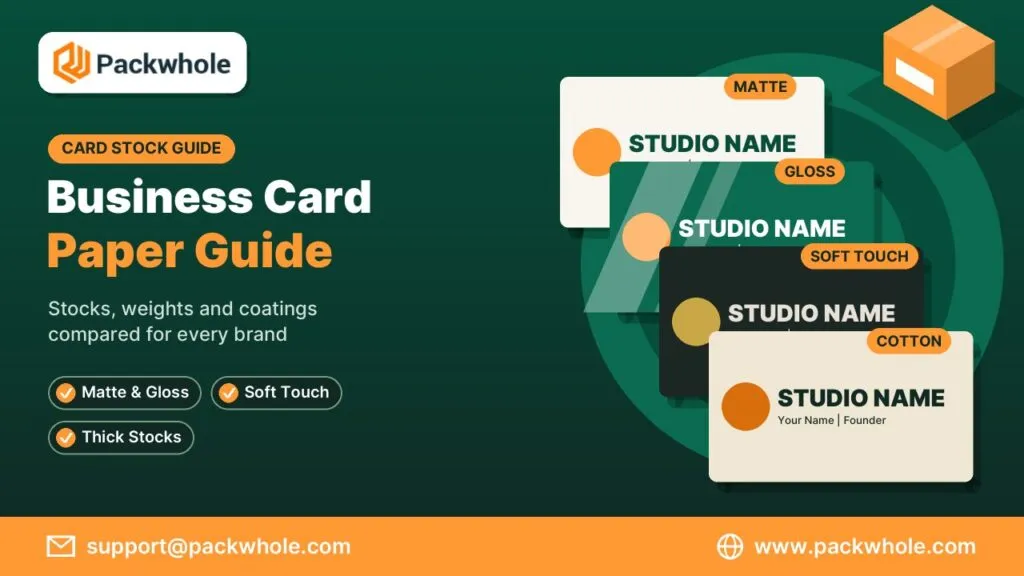
People judge a card with their fingers before they read a single word. The moment a client takes your card, the business card paper tells them whether your brand feels careful, creative, eco-minded or luxurious. Two cards with the same layout can send completely different messages simply because one is printed on flimsy copy-weight stock and the other on a heavy, smooth board. This guide breaks down the paper types, weights and coatings that US printers use most, so you can pick a stock with confidence instead of guessing.
Why Business Card Paper Matters More Than Most Designers Think
A great design printed on the wrong stock loses much of its impact. Paper affects color, texture, durability and even whether someone can write a note on the back. It also changes how long the card survives in a wallet or a pocket. Spending a few minutes on this choice is one of the cheapest ways to make every card you hand out feel more professional.
Think about three questions before you choose: how the card should feel, how it will be used and what finish your design needs. A real estate agent handing out hundreds of cards at open houses needs something different from a jewelry designer who gives one card with every purchase.
Understanding Business Card Paper Weight: Points, Pounds and GSM
Paper weight is the most confusing part of ordering cards because US printers describe it in several ways. You will see points (pt), pounds (lb) and grams per square meter (gsm), sometimes all on the same website. They measure slightly different things, but in practice each one tells you how thick and stiff the card will feel. A quick reference makes the numbers easier to compare.
| Common label | Approx. thickness | How it feels |
|---|---|---|
| 14 pt / 100 lb cover | About 0.014 inch | Light but acceptable for budget runs |
| 16 pt / 110 lb cover | About 0.016 inch | The standard, sturdy everyday card |
| 18 pt / 130 lb cover | About 0.018 inch | Noticeably firm and premium |
| 32 pt and up | About 0.032 inch or more | Extra thick, often duplexed or layered |
Points measure actual caliper thickness, which makes them the easiest to picture. If you want to dig deeper into the numbers, our article on paperboard thickness in GSM vs PT explains how the systems relate.
Coated and Uncoated Business Card Paper Compared Side by Side
The biggest split in card stocks is between coated and uncoated papers. A coating seals the surface so ink sits on top, which keeps colors bright and edges crisp. Uncoated paper lets ink sink in slightly, giving a softer, natural look. Neither is better in every case; each suits a different style of brand.
| Feature | Coated (matte or gloss) | Uncoated |
|---|---|---|
| Color brightness | Vivid and sharp | Softer and more muted |
| Writing with a pen | Matte is fine, gloss can smudge | Excellent |
| Feel | Smooth | Natural and slightly toothy |
| Best for | Photos, bold colors, modern brands | Eco, craft and minimalist brands |
Popular Business Card Paper Types and Who They Suit
Once you know the basics, the real decision is which stock matches your brand personality. Each paper below is widely available and works well for different industries. Read the short notes, then picture your logo on each one. Usually one option feels right almost immediately.
Matte Stock for Clean, Readable Cards
Matte paper has a smooth, low-glare surface that keeps text easy to read under any light. It is the safest all-round choice and accepts ballpoint pens well. See options on our matte business cards page.
Gloss Stock for Photos and Bright Colors
A gloss coating reflects light, so photos, food shots and saturated brand colors look rich and lively. It suits photographers, restaurants and real estate. Our glossy business cards show how much color a shiny surface can carry.
Soft Touch Laminate for a Luxury Feel
Soft touch is a laminate with a velvety, almost suede-like texture. It mutes colors slightly but makes the card feel expensive, which is why beauty, fashion and law firms love it. Explore our soft touch business cards for examples.
Textured, Linen and Cotton Papers for Character
Textured stocks such as linen or felt add a pattern you can feel, while cotton papers are soft, thick and slightly absorbent. They pair beautifully with letterpress and foil. Take a look at cotton business cards if you want a classic, crafted finish.
How Finishes Interact With Your Business Card Paper Choice
Special finishes do not work equally well on every stock, so it helps to plan paper and finish together. Foil stamping needs a smooth surface for clean edges, spot UV shows best against a matte or soft touch base, and letterpress needs a soft, thick paper to create a deep impression. Choosing them as a pair avoids disappointing results.
- Gold or silver foil: best on matte, soft touch or smooth uncoated stocks.
- Spot UV: creates contrast on matte and soft touch, but almost disappears on gloss.
- Raised spot UV: needs a firm, smooth surface to hold its height.
- Letterpress: looks best on thick cotton or soft uncoated paper.
- Rounded corners: work on any stock and reduce bent or frayed corners.
If you are unsure which finish suits your logo, our guide to matte vs gloss lamination compares the two most common coatings in more detail.
Matching Business Card Paper to Your Industry and Budget
Your industry gives useful clues about which paper will feel natural to your clients. A contractor needs durability, a designer wants personality and a financial advisor wants calm confidence. Budget matters too, because heavier and specialty stocks cost more per card. The suggestions below balance both.
- Trades and home services: 16 pt gloss or matte for durability at a sensible price.
- Corporate, legal and finance: heavy matte or soft touch with a subtle foil logo.
- Creative studios: textured, cotton or extra thick stock to show personality.
- Food, photography and real estate: gloss to make images pop.
- Eco and wellness brands: uncoated or recycled-look papers with earthy colors.
Simple Ways to Test a Card Stock Before Placing a Large Order
Photos online rarely show how a paper really feels, so a little hands-on testing goes a long way. You do not need special equipment, just a few everyday checks that reveal how a stock will behave once your cards are in the real world. Running these tests on a sample or a short first run helps you avoid ordering a thousand cards you are not happy with.
- The bend test: flex the card gently between two fingers. A sturdy stock springs back, while a thin one creases or stays curved.
- The pen test: write a short note with a ballpoint and a gel pen, then rub it with your thumb after a few seconds to see if it smears.
- The light test: hold the card under a desk lamp and near a window to see how much glare the surface throws back.
- The pocket test: carry a card in a wallet or jacket pocket for a week and check the corners and edges for wear.
- The color test: compare your brand color on the printed card against your other materials, such as packaging and signage.
These small checks tell you more than any product description. If a stock passes all five, it will represent your brand well at meetings, events and every counter where your cards are displayed. ## Common Mistakes When Ordering Business Card Paper Even experienced buyers make a few predictable errors when choosing a stock. Most of them come from ordering online without seeing the paper first or from picking a finish that fights the design. Avoiding these mistakes keeps your cards looking the way you imagined on screen.
- Choosing gloss for a card people need to write appointment times on.
- Picking the thinnest stock to save money on cards that represent a premium service.
- Adding spot UV to a gloss card, where the effect barely shows.
- Printing large dark areas on uncoated paper without expecting a softer, slightly mottled look.
- Forgetting that soft touch slightly darkens colors, so pale tones may need adjusting.
Order Business Card Paper Samples and Cards With Expert Help
The easiest way to choose is to talk through your design with someone who prints cards every day. Our team recommends the stock and finish that fit your logo and budget, offers free design help and sends a digital proof before printing. Low minimums mean you can try a premium paper without committing to a huge order.
Email support@packwhole.com with your design or idea, or compare every stock and finish at www.packwhole.com, and we will suggest the paper that makes your first impression count.