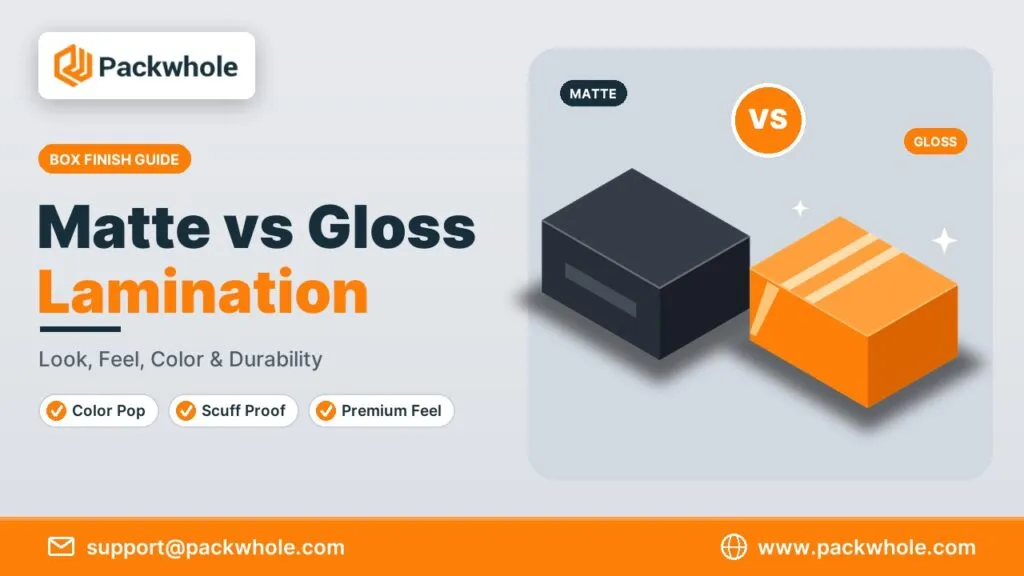
Two boxes can share the same artwork, the same board, and the same size, yet one looks like a luxury skincare brand and the other looks like a bright toy on a supermarket shelf. Very often the difference is a single thin film on top of the print. The matte vs gloss lamination choice changes how colors pop, how the box feels in a shopper’s hand, how well it survives shipping, and even which photos look best on social media.
This guide explains what each finish does, compares them side by side, and gives clear recommendations by product category so you can approve your next proof with confidence.
What Lamination Is and Why Printers Recommend It
Lamination is a very thin plastic film, usually polypropylene (BOPP) or polyester, bonded to printed paperboard after printing. It seals the ink, adds a protective skin, and creates the surface texture customers feel when they pick up the box. Without a protective layer, ink on folding cartons can rub off at the corners and fold lines, especially on dark designs. A laminate keeps those edges clean and makes the box more resistant to moisture and fingerprints.
Lamination is different from a coating. Aqueous and UV coatings are liquids applied on press; lamination is a film. Films generally give stronger scuff and tear protection, while coatings are cheaper and simpler to recycle. Many brands combine both, for example matte film with a spot UV logo. Our comparison of spot UV and soft-touch finishes covers those specialty options.
Matte vs Gloss Lamination at a Glance
The two films behave almost like opposites. Gloss reflects light in one direction, so colors look deeper and more saturated, much like a glossy magazine cover. Matte scatters light, so colors look softer and more muted, but glare disappears and the box feels calm and modern. Neither is better in every case; the right pick depends on your brand style and where the box will be seen.
| Factor | Matte Lamination | Gloss Lamination |
|---|---|---|
| Look | Soft, flat, no glare | Shiny, reflective, vivid |
| Color impact | Slightly muted, elegant | Brighter, higher contrast |
| Feel | Smooth, velvety on premium films | Slick, slippery |
| Fingerprints | Can show oils on dark colors | Wipes clean easily |
| Scuff marks | Shows rub marks on black boxes | Hides small scuffs better |
| Photography | Easy to photograph, no hot spots | Can glare under studio lights |
| Text legibility | Excellent from any angle | Can glare under store lighting |
| Typical feel of brand | Luxury, minimal, natural | Bold, playful, energetic |
| Relative cost | Similar to gloss | Similar to matte |
How Each Finish Changes Your Colors
Color is where buyers notice the biggest difference. Gloss film increases perceived saturation and contrast, so reds look redder and blacks look deeper. That can be perfect for candy, toys, and sports products, where energy and excitement sell. Matte film lowers contrast slightly and can make pale colors look chalky if the design was created on a bright screen. Designers usually adjust artwork for matte by adding a touch more saturation or deepening key colors.
Practical color tips:
- Always request a printed proof with the actual laminate, not a plain paper proof.
- For matte, deepen pastel brand colors slightly so they don’t wash out.
- For gloss, check that large dark areas don’t show glare in store lighting.
- Rich black (a mix of CMYK) looks better under matte than a single black ink.
- Ask how the printer converts your files; our CMYK guide explains the basics.
Durability and Shipping Performance
Both films protect print far better than bare ink, but they fail in different ways. Gloss is slicker, so boxes slide against each other more easily and small scratches blend into the shine. Matte has a slightly textured surface that can show white rub marks on very dark designs, especially when boxes are packed tightly in a master carton. For ecommerce mailers that travel through USPS, UPS, or FedEx networks, these details matter because customers judge the brand the second the box arrives.
Ways to keep each finish looking good:
- Use scuff-resistant matte film for dark boxes that ship on their own.
- Add a protective outer mailer for premium matte rigid boxes.
- Pack retail cartons with dividers so faces don’t rub together.
- Choose gloss for products handled often, such as games and kids’ items.
Matte vs Gloss Lamination by Product Category
Brand style should lead the decision, but product category gives strong clues. Shoppers have learned visual codes over decades: matte signals premium and natural, while gloss signals fun and vibrant. Following those codes helps your box feel “right” on the shelf. The list below shows which side of the matte vs gloss lamination debate usually wins for common US product categories.
- Skincare and cosmetics: matte, often with spot UV or foil on the logo.
- Fragrance and jewelry: matte or soft-touch for a luxury feel.
- Candles and home goods: matte for minimal designs, gloss for bright seasonal sets.
- Toys and games: gloss to make colorful artwork pop.
- Food and candy: gloss for photo-rich designs, matte for artisan or organic brands.
- Electronics: matte for a sleek tech look, gloss for budget accessories.
- Supplements: matte for clean wellness branding.
- Apparel mailers: matte for streetwear and premium labels.
Combining Finishes for Extra Impact
You don’t have to choose only one. Some of the most memorable boxes pair a matte base with gloss highlights. Spot UV adds a clear raised shine to selected areas, such as a logo or product photo, creating contrast you can see and feel. Foil stamping and embossing also stand out more on matte surfaces because the background stays quiet.
Popular combinations:
- Matte film + spot UV logo
- Matte film + gold foil stamping
- Matte film + embossed brand name
- Gloss film + matte varnish pattern (a “reverse” effect)
Cost, Lead Time, and Recycling Considerations
In most quotes, matte and gloss laminates cost about the same; the bigger price drivers are box size, quantity, and any extra finishes. Specialty films such as soft-touch, holographic, or scratch-resistant matte add cost. Lead time is usually unaffected unless the printer has to order a specialty film.
On sustainability, plastic laminates add a thin film layer to paperboard. Many recycling facilities can process laminated cartons in small amounts, but plain or aqueous-coated boxes are simpler to recycle. If an eco message is central to your brand, consider an aqueous coating or a paper-based finish instead of film, and keep any recyclability claims specific and accurate under the FTC Green Guides.
General information, not legal advice; check local recycling guidance before printing claims.
Mistakes Brands Make When Picking a Finish
Finish decisions are often made at the last minute, after the artwork is finished. That leads to boxes that look different from the mockup or that wear badly in transit. A few simple checks prevent most surprises. Review this list before you sign off.
- Approving colors on screen without a laminated proof.
- Choosing matte for a black mailer that will ship without an outer box.
- Choosing gloss for small text that shoppers read under bright store lights.
- Stacking too many effects (gloss, foil, spot UV, emboss) on one panel.
- Calling a laminated box “plastic-free.”
Get Your Matte vs Gloss Lamination Samples From PackWhole
PackWhole prints custom boxes with matte, gloss, and soft-touch laminates, plus spot UV, foil, and embossing. We can send finish samples so you can compare matte vs gloss lamination on real board before you order. Artwork help is free, and you can trial both finishes on a short run of custom product boxes or mailer boxes.
Ask for a finish sample kit at support@packwhole.com or compare finishes on www.packwhole.com.
FAQs About Matte vs Gloss Lamination
These are the questions customers ask most when choosing a box finish. They focus on look, durability, and cost. If you are still undecided, a split test, half your boxes in each finish, can show which one your customers prefer.
Is matte lamination more expensive than gloss?
Usually not. Standard matte and gloss films cost about the same. Specialty films like soft-touch cost more.
Which finish hides fingerprints better?
Gloss wipes clean easily. Matte can show oily fingerprints on dark colors unless you choose an anti-fingerprint matte film.
Can I print on both sides and laminate only the outside?
Yes. Most boxes are laminated on the outside only, while inside print stays uncoated or receives an aqueous coating.
Does lamination make boxes waterproof?
It makes the printed surface water resistant, but the board edges can still absorb moisture.
Which looks more premium?
Matte is generally seen as more premium, especially when paired with foil or spot UV.