Ask three suppliers about box stock and you may hear “16 pt,” “350 gsm” and “80 lb cover” for boards that feel almost the same. The mix of units confuses many buyers. Paperboard thickness decides how sturdy a box feels, how it folds and how much it costs, so understanding the numbers helps you compare quotes and order with confidence.
This guide explains points, GSM and basis weight, gives an approximate conversion chart, and shows which thickness fits common packaging products.
Thickness vs Weight: Two Different Measurements
The first thing to know is that some units measure thickness while others measure weight. Points measure caliper, which is physical thickness. GSM and basis weight measure how heavy the paper is for a given area. Two boards with the same weight can have slightly different thickness depending on fibers, coatings and density.
In the United States, folding carton board is usually described in points. In Europe and Asia, suppliers usually use GSM. Many overseas factories quote GSM, so US buyers often need to translate between the two.
What Points (pt) Mean for Paperboard Thickness
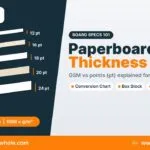
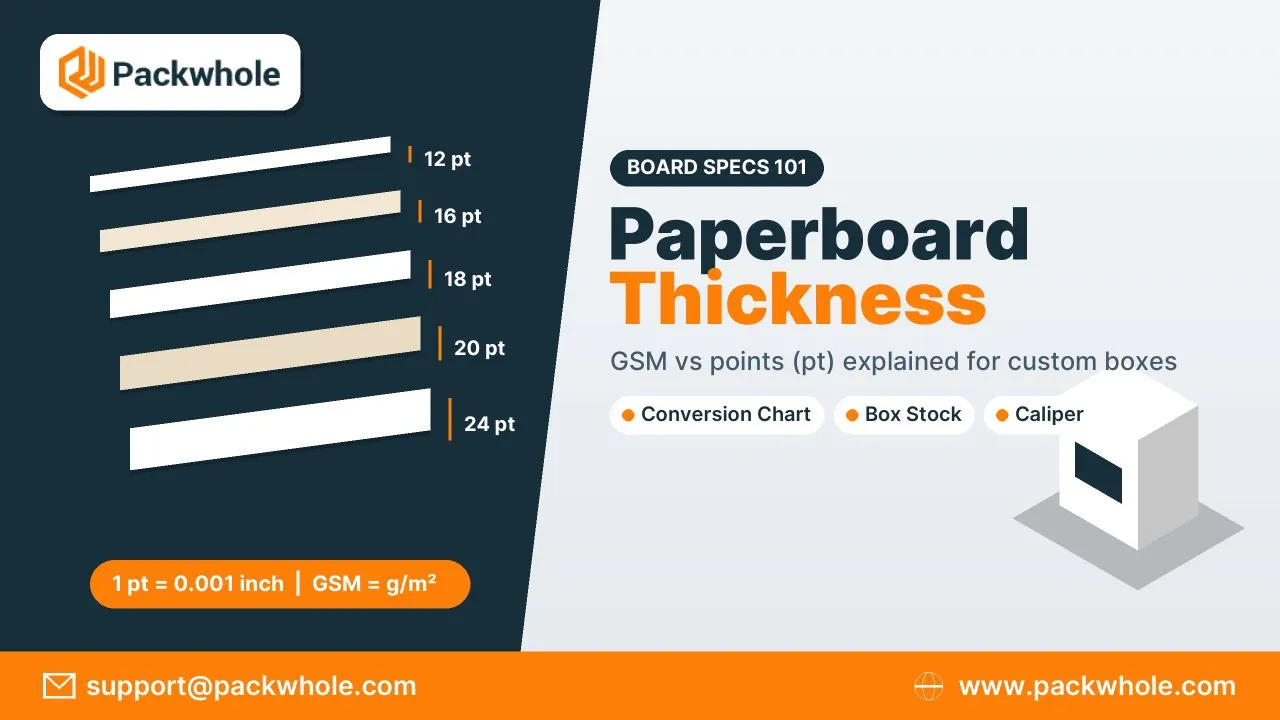
A point is one thousandth of an inch, so 16 pt board is 0.016 inch thick. This is the most common way US printers describe paperboard thickness for folding cartons, hang tags and business cards. The higher the number, the thicker and stiffer the board.
Typical point ranges in packaging:
- 10 to 12 pt: light cartons, sleeves and inserts.
- 14 to 16 pt: popular for cosmetics, supplements and small retail boxes.
- 18 to 20 pt: sturdier retail boxes and heavier products.
- 22 to 28 pt: premium cartons and products that need extra rigidity.
Because points measure thickness directly, they are easy to check with a simple caliper tool when you receive samples.
What GSM Means and How It Relates to Strength
GSM stands for grams per square meter. It is the weight of one square meter of the board, so 350 gsm board is heavier than 300 gsm board of the same type. Heavier board is usually thicker and stiffer, but density and coating also matter. A dense coated board can be heavier than a bulky uncoated board of similar thickness.
GSM is helpful when comparing boards of the same type from one mill. It is less reliable when comparing very different materials, such as coated white board versus kraft board, because they have different densities.
Approximate Conversion Chart: Points to GSM
The chart below shows approximate equivalents for coated paperboard commonly used in folding cartons. Real values vary by mill, coating and board grade, so always confirm with a physical sample before approving a large order.
| Points (pt) | Thickness (inch) | Approx. GSM | Typical Packaging Use |
|---|---|---|---|
| 12 pt | 0.012 | 230 to 260 gsm | Sleeves, light inserts, small tags |
| 14 pt | 0.014 | 260 to 300 gsm | Small cosmetic and supplement boxes |
| 16 pt | 0.016 | 300 to 330 gsm | Most retail folding cartons |
| 18 pt | 0.018 | 330 to 370 gsm | Heavier retail boxes, candles |
| 20 pt | 0.020 | 370 to 400 gsm | Larger cartons, gift boxes |
| 24 pt | 0.024 | 400 to 450 gsm | Premium or heavy products |
Use this chart as a translation guide when a supplier quotes in GSM and you are used to points, or the other way around.
Basis Weight in Pounds: The Third Unit You May See
Some US suppliers also describe paper by basis weight, such as 80 lb or 100 lb cover. Basis weight is the weight of 500 sheets of a paper’s standard size, and that standard size changes by paper category. That is why 80 lb text paper is much thinner than 80 lb cover stock. This unit is more common for printed paper and cardstock than for packaging board.
Quick tips when you see pounds:
- Check whether the paper is “text,” “cover” or “board,” because each uses a different base size.
- Ask for the caliper in points to compare with other quotes.
- Request a sample sheet if the product depends on stiffness.
Choosing Paperboard Thickness by Product Type
The right paperboard thickness depends on product weight, size and how the box will be handled. Lightweight items in small boxes do not need thick board, while heavy or large products need more rigidity to stop panels from bulging. Shelf presence also matters, since thicker board feels more premium in the hand.
| Product | Recommended Range | Why |
|---|---|---|
| Lip balm, lipstick, mascara | 14 to 16 pt | Small, light products; crisp folds |
| Serums and skincare bottles | 16 to 18 pt | Glass adds weight; better shelf feel |
| Candles in glass jars | 18 to 24 pt | Heavier contents; premium look |
| Supplements and vitamins | 16 to 18 pt | Medium weight; durable for handling |
| Bakery and cookie boxes | 16 to 20 pt food-safe board | Stiff panels for larger boxes |
| Hang tags | 14 to 24 pt | Depends on product and desired feel |
For our guide to standard tag sizes and paper weights, see hang tag sizes.
When Paperboard Is Not Enough: Corrugated and Rigid Options
Even the thickest folding carton has limits. If a product is very heavy, needs to survive shipping without an outer box, or should feel truly luxurious, it may be time to move to corrugated or rigid packaging. Each step up adds protection and cost.
Signs you should upgrade:
- The box bends or bulges when you hold it from one side.
- Products ship directly to customers without an outer carton.
- The product weighs more than a couple of pounds.
- You want a magnetic lid or a two-piece luxury presentation.
Rigid boxes use thick chipboard, usually measured in millimeters rather than points. Learn more in our guide to what chipboard is and compare options with rigid vs corrugated boxes.
How Coatings and Board Grades Affect Feel
Two boards with the same paperboard thickness can feel very different. Solid bleached sulfate (SBS) board is bright white throughout and prints sharply. Coated recycled board is grayer inside and usually less expensive. Kraft board has a natural brown look and strong fibers. Laminations and coatings add a little thickness and change how the surface feels.
Common grades:
- SBS: premium white board for cosmetics, pharmaceuticals and food.
- CUK (coated unbleached kraft): strong board often used for beverage carriers and food.
- CRB (coated recycled board): cost-effective board for cereal and dry food cartons.
- Kraft board: natural look for eco-friendly brands.
Mistakes Buyers Make With Board Thickness
Thickness problems show up when a box is filled with real products, not when it is empty. That is why sampling with the actual item matters. These are the most common errors.
- Comparing a GSM quote with a points quote as if they were the same unit.
- Choosing thin board for heavy glass products.
- Paying for thick board on tiny, light products.
- Forgetting that inserts add weight and stress to panels.
- Approving artwork without testing a printed sample.
Choose the Right Paperboard Thickness With PackWhole
PackWhole prints custom folding boxes, cosmetic boxes and rigid boxes on a wide range of boards and paperboard thickness options. Our team will recommend the right caliper and grade for your product and budget, and design support is always free. Order quantities start small, so testing two board options is easy.
Tell us what you are packaging at support@packwhole.com, and we will match it with the right board, or compare box styles at www.packwhole.com.
Paperboard Thickness FAQs
Thickness questions come up in almost every new packaging project. These short answers cover the basics. For an exact match, ask for a sample of the board you plan to use.
Is 350 gsm the same as 16 pt?
They are close for many coated boards, but exact equivalence depends on the board grade.
What thickness is most common for retail boxes?
Many retail folding cartons use 16 to 18 pt board.
How do I measure paperboard thickness myself?
Use a digital or micrometer caliper and read the value in thousandths of an inch.
Is thicker board always better?
No. Thicker board costs more and can make small boxes hard to fold neatly.
What thickness are rigid boxes?
Rigid boxes usually use chipboard measured in millimeters, often about 1.5 to 3 mm.