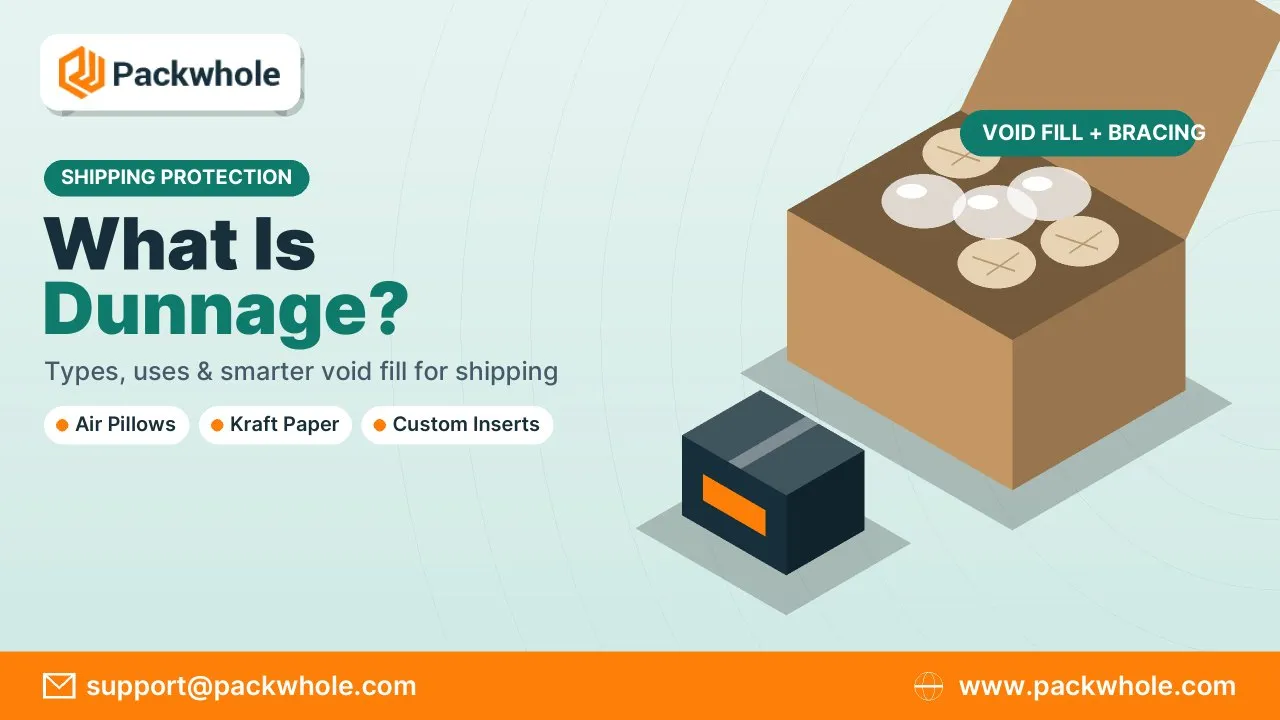
Open almost any delivery and you will find something besides the product: crumpled paper, air pillows, foam or a cardboard divider. All of that is dunnage. So, what is dunnage exactly? It is any material used to fill empty space, cushion, block or brace goods so they do not move or break during shipping and storage.
Dunnage is easy to overlook, yet it has a big effect on damage rates, shipping costs and how customers feel when they open a package. This guide explains the main types, when to use each and how to reduce waste.
Where the Word Comes From and What Dunnage Does
The term comes from the shipping industry, where loose wood, mats and other materials were placed in a ship’s hold to keep cargo dry and stop it from shifting at sea. Today the meaning covers everything from wooden blocks in a shipping container to a single sheet of kraft paper inside a mailer box. The purpose is the same at every scale: stop movement and absorb shocks.
Dunnage does three main jobs. It fills voids so products cannot slide around. It cushions products from drops and vibration. And it braces or separates items so they do not hit each other. Some materials do one job well; others do all three.
What Is Dunnage in E-Commerce? Types Used for Parcel Shipping
Small parcels shipped to customers use lightweight dunnage that is quick to pack and easy to dispose of. The right choice depends on product weight, fragility and how much empty space is in the box. The comparison below covers the most common options for parcel shipping.
| Dunnage Type | Best Job | Strengths | Drawbacks |
|---|---|---|---|
| Kraft paper (crumpled or fan-fold) | Void fill, light cushioning | Recyclable, good brand fit | Less cushioning for heavy items |
| Air pillows | Void fill | Very light, low shipping weight | Little protection from sharp drops |
| Bubble wrap | Cushioning and wrapping | Good shock absorption | Plastic; takes time to wrap |
| Packing peanuts | Void fill around odd shapes | Fills every gap | Messy, can settle in transit |
| Foam inserts | Cushioning and locking items in place | Excellent protection, custom fit | Higher cost; plastic unless paper-based |
| Corrugated or paperboard inserts | Blocking and separating | Recyclable, branded, precise | Needs custom sizing |
| Crinkle and shredded paper | Void fill and presentation | Attractive unboxing | Light cushioning only |
Many brands combine two types, such as a custom insert to hold the product and paper fill for any remaining space.
Industrial Dunnage for Pallets, Trucks and Containers
At freight scale, dunnage keeps whole pallets and containers stable. Without it, loads shift during braking, turns and ocean swells, which can crush cartons or damage vehicles. Industrial dunnage is heavier and more structural than the fill used in parcels.
Common freight dunnage includes:
- Dunnage airbags: inflatable bags placed between pallets to stop shifting in trucks and containers.
- Wood blocks and lumber: used to brace heavy machinery and raise loads off the floor.
- Corrugated pads and slip sheets: separate layers of cartons on a pallet.
- Edge protectors: corner boards that prevent strapping from crushing carton edges.
- Returnable dunnage: reusable trays and racks used in automotive and manufacturing supply chains.
For freight-sized cartons, the packing and carrier tips in shipping large boxes are a useful next read.
How Much Dunnage Is Enough for a Safe Delivery?
A common rule in parcel shipping is that products should not move when you shake the closed box, and there should be about 2 inches of cushioning between fragile items and the box walls. Too little dunnage leads to breakage. Too much wastes material, adds weight and frustrates customers who have to dig through filler.
A simple test before you finalize your packing method:
- Pack the box as a customer order would be packed.
- Shake it firmly in every direction and listen for movement.
- Drop it from waist height onto each face and corner.
- Open it and check for damage, shifting or crushed fill.
National parcel carriers publish packing guidelines, and following them can matter if you ever need to file a damage claim. This is general guidance, not carrier policy advice; always check current carrier rules for your products.
What Is Dunnage Costing You in Shipping Fees?
Dunnage itself is usually cheap, but the box it fills is not. Carriers charge by dimensional weight, which means a large box full of air pillows can cost more to ship than a small, well-fitted box with no filler. In many cases the best way to reduce dunnage is to reduce empty space by choosing a box that fits the product better.
Ways to lower costs:
- Offer two or three box sizes instead of one large size for all orders.
- Use custom inserts that hold products tightly in a smaller box.
- Choose lighter void fill, such as paper or air pillows, for light products.
- Review your most common order combinations and design boxes around them.
Right-sizing is covered in depth in our post about cutting shipping costs with better-fitting mailers, including how dimensional weight is calculated.
Sustainable Dunnage Choices Customers Appreciate
Shoppers notice filler, and many dislike plastic peanuts and excessive air pillows. Paper-based dunnage and fitted inserts feel more thoughtful and are easier to recycle in most US curbside programs. Sustainable choices can also support marketing claims, as long as those claims are accurate.
Greener options to consider:
- Kraft paper or honeycomb paper instead of plastic bubble wrap.
- Molded pulp trays for electronics and bottles.
- Corrugated or paperboard inserts printed with your brand.
- Shredded paper made from recycled content.
- Reusable dunnage for business-to-business shipments.
When describing packaging as recyclable or compostable, follow the FTC Green Guides so claims match what customers can actually do.
What Is Dunnage Doing for Your Unboxing Experience?
Dunnage is not only protection; it is part of the first impression. A product held neatly in a custom insert feels premium, while a product buried in loose peanuts can feel careless. For subscription boxes, gifts and direct-to-consumer brands, the filler is often visible in unboxing photos and videos shared online.
Presentation ideas:
- Use colored or branded crinkle paper that matches your packaging.
- Print a short message on the insert or tissue paper.
- Design insert cutouts that present products in a planned order.
- Keep filler tidy so the box looks curated when the lid opens.
Mistakes Brands Make When They Ask What Is Dunnage Only After Damage Happens
Most damage and complaints come from a few repeated errors. They often start when a brand grows quickly and packing habits are not reviewed. A short audit of your packing station can fix many of them.
- Using one oversized box for every order.
- Relying on air pillows for heavy or sharp items.
- Leaving fragile items touching each other or the box wall.
- Overfilling boxes until flaps bulge and tape fails.
- Ignoring customer feedback about messy or excessive filler.
Replace Loose Fill With Custom Inserts From PackWhole
PackWhole designs custom mailer boxes, fence partitions and dividers and shredded paper fill that protect products while reducing wasted space. Our team can create inserts that hold each item firmly so you need less loose dunnage. Free design help and low minimums make it simple to test a better packing method.
Send your product sizes and current packing setup to support@packwhole.com, or explore inserts and boxes at www.packwhole.com.
What Is Dunnage? Frequently Asked Questions
Below are short answers to the questions shippers ask most about dunnage. If your products are fragile or unusually shaped, a drop test is the best way to confirm your approach.
Is dunnage the same as packaging?
Dunnage is part of packaging. It is the material that fills, cushions or braces products inside the box or load.
Is crumpled paper good dunnage?
Yes, for void fill and light cushioning. Heavy or fragile items need more support.
Can dunnage be reused?
Yes. Airbags, wood blocking and many trays are reused, especially in business-to-business shipping.
Does dunnage affect shipping cost?
Indirectly. Large boxes with lots of filler raise dimensional weight charges.
What is the most eco-friendly dunnage?
Paper-based fill, molded pulp and fitted corrugated inserts are among the most recyclable options.