Small parcels are easy. Big ones are where shipping budgets go to die. A box that is just a few inches too long can trigger surcharges, dimensional-weight pricing, or a move into freight. If you sell furniture parts, home décor, sporting goods, bulk orders, or large gift sets, knowing how to ship large boxes efficiently can protect both your margins and your products.
This guide covers US carrier size limits, how dimensional weight works, which box construction to choose, and when to switch from parcel shipping to freight.
Know the Carrier Size and Weight Limits First
Every major US carrier sets maximum sizes and weights for parcel service. Exceeding them means the package will be refused or charged steep fees. Limits change from time to time, so always check the current service guides, but the figures below give a reliable starting point. “Length plus girth” means the longest side plus twice the width plus twice the height.
| Carrier | Max Weight | Max Size (Typical) |
|---|---|---|
| USPS (most services) | 70 lb | 108 in length + girth; Ground Advantage allows up to 130 in |
| UPS (Ground and Air) | 150 lb | 108 in length, 165 in length + girth |
| FedEx (Ground and Express) | 150 lb | 108 in length, 165 in length + girth |
Packages over 150 pounds, or several large boxes going to one address, usually move better as LTL (less-than-truckload) freight on a pallet.
How Dimensional Weight Changes the Price of Big Boxes
Carriers charge for the space a package takes up in a truck or plane, not just its weight. This is called dimensional (DIM) weight. For large but light items, such as pillows, lampshades, or plastic containers, DIM weight is often much higher than the actual weight. The carrier bills whichever is greater.
How to calculate it:
1. Measure length × width × height in inches, rounding up.
2. Divide by the carrier’s DIM divisor (commonly 139 for UPS and FedEx daily rates; USPS uses 166 for larger packages).
3. Compare the result with the actual weight; you pay for the higher number.
Example: A 24 × 18 × 18 inch box has 7,776 cubic inches. Divided by 139, that is about 56 pounds of DIM weight, even if the item weighs only 15 pounds. Trimming the box to 22 × 16 × 16 inches drops the DIM weight to about 41 pounds.
Surcharges That Catch Large Shipments
Beyond DIM weight, large parcels can trigger extra fees. UPS and FedEx apply “additional handling” charges to boxes that are very long, heavy, or not fully encased in corrugated. Even larger packages incur “large package” or “oversize” surcharges, which can cost more than the base shipping rate. Knowing the general thresholds helps you design boxes that stay under them.
Common triggers (check current carrier rules):
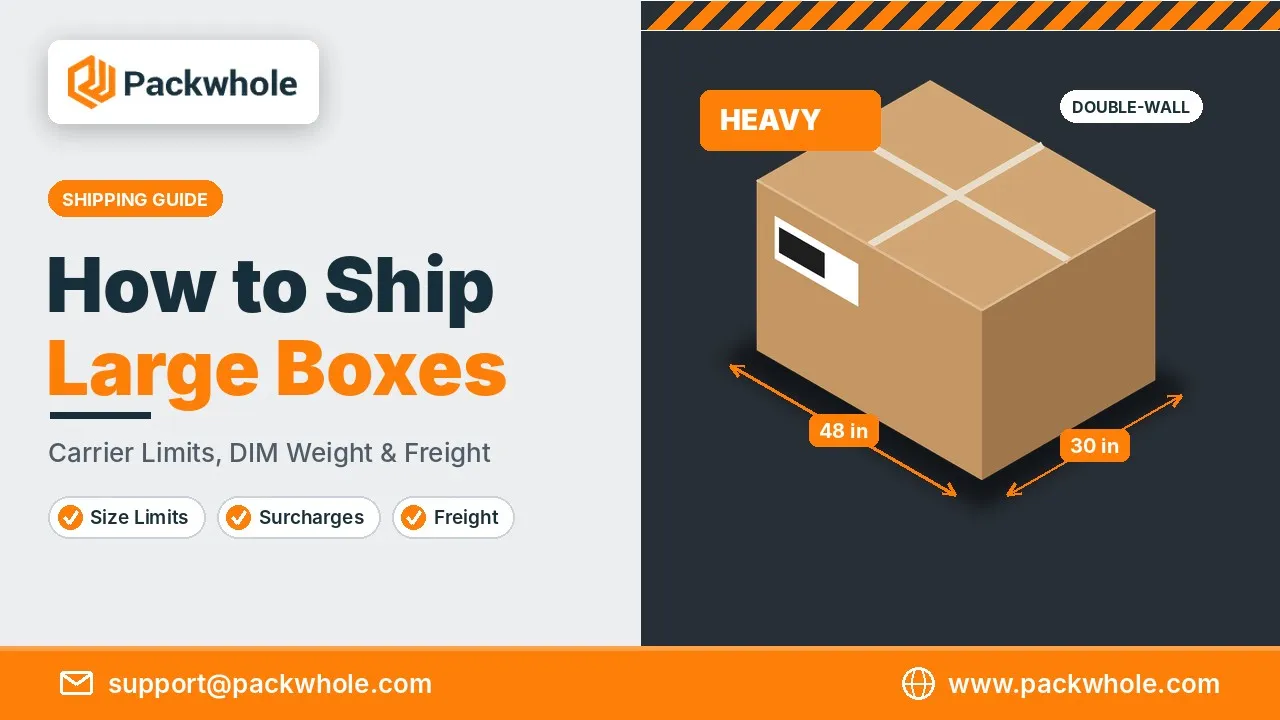
– Longest side over about 48 inches, or second-longest over about 30 inches
– Weight over about 50 pounds
– Length plus girth over about 130 inches, or length over about 96 inches (large package)
– Packages not in a corrugated box, such as wrapped or cylindrical items
Choosing the Right Box to Ship Large Boxes Safely
Big boxes carry more weight and face more stress from stacking and conveyor belts. A standard single-wall box may be fine for light, bulky items, but heavy or fragile products need stronger construction. Box strength is commonly rated by ECT (Edge Crush Test) or burst strength. Choosing the right rating prevents crushed corners and split seams.
| Box Construction | Typical Rating | Good For |
|---|---|---|
| Single-wall | 32 ECT | Light, bulky items up to about 40 lb |
| Heavy single-wall | 44 ECT | Medium items, frequent stacking |
| Double-wall | 48 to 51 ECT | Heavy or fragile items, up to about 80 lb |
| Triple-wall | Very high | Industrial parts, export, very heavy loads |
PackWhole produces custom corrugated boxes and corrugated cartons in single and double wall. For background on flutes, see our guide to corrugated boxes.
Packing Tips for Large and Heavy Items
The way you pack matters as much as the box. Large items have more room to shift, and heavy items put pressure on seams and corners. Follow these steps to keep products safe and reduce damage claims. Carriers may also deny claims if packaging does not meet their guidelines.
- Leave about 2 inches of cushioning on every side for fragile items.
- Use corner protectors and edge boards for furniture and frames.
- Fill voids with paper or custom inserts so nothing moves.
- Seal all seams with the H-taping method using strong 2- to 3-inch tape.
- Place heavy items at the bottom and center of the box.
- Add “Heavy” labels and lift-point markings for safer handling.
When to Switch From Parcel to Freight
At some point, parcel shipping becomes more expensive and riskier than freight. If you regularly ship items over 150 pounds, multiple large boxes to one business, or anything that does not fit parcel limits, LTL freight may be the better option. Freight shipments travel on pallets, usually 48 × 40 inches in the US, and are priced by weight, dimensions, density, and freight class.
Freight tips:
– Stack boxes squarely on the pallet without overhang.
– Stretch-wrap the load and add corner boards.
– Label every box with the destination and piece count.
– Confirm whether the receiver needs a liftgate or a dock.
Reducing Damage Claims on Large Shipments
Damage claims on large items are costly, both in replacement products and in time spent filing paperwork. Carriers also review packaging when deciding claims, so good practices help you recover costs when something goes wrong. A short internal checklist makes it easier for every team member to ship large boxes consistently.
Steps that reduce claims:
- Photograph the packed box before sealing and after labeling.
- Record the box strength rating and packing materials used.
- Use drop testing on a few sample shipments before launching a new product.
- Add “Fragile” and orientation arrows only where they are truly needed.
- Choose declared value or insurance for high-value items.
- Review every damage report and adjust the box or insert design.
Over time, this record shows which products need stronger boxes and which carriers handle your shipments best.
Mistakes People Make When They Ship Large Boxes
Large shipments are expensive, so mistakes hurt more. Most problems come from oversized boxes, weak construction, or not checking carrier rules before shipping. A few minutes of planning can save a lot in surcharges and damage. Watch for these.
- Using a box much bigger than the product and paying for air.
- Reusing old boxes that have lost strength.
- Ignoring additional handling thresholds by an inch or two.
- Shipping heavy items in single-wall boxes.
- Not getting freight quotes for very heavy orders.
Get Custom Boxes Designed to Ship Large Boxes Efficiently From PackWhole
PackWhole designs right-sized corrugated boxes for large and heavy products, with strength ratings matched to your weight and shipping method. We help you stay under carrier thresholds, reduce DIM weight, and protect your products with custom inserts. With free design help and modest minimums, it is simple to ship large boxes the smart way.
Send your product weight and size to support@packwhole.com, or request a heavy-duty box quote on www.packwhole.com.
FAQs on How to Ship Large Boxes
These answers cover the questions we hear most from sellers dealing with oversized parcels. Because carrier rules and rates change, always confirm the latest service guides before you finalize packaging. Our team can help you design a box that fits current limits.
What is the cheapest way to ship a large box?
Right-size the box to reduce DIM weight, compare carriers, and use negotiated or commercial rates when possible.
Can USPS ship large boxes?
Yes, within its size and 70-pound limits. USPS Ground Advantage accepts larger packages up to 130 inches in length plus girth.
When should I use double-wall boxes?
Use double wall for heavy, fragile, or high-value items, or when boxes will be stacked.
Do large boxes need special labels?
“Heavy” and orientation labels are not always required but help handlers move boxes safely.