Offices, schools, law firms and households all eventually face the same challenge: piles of paperwork that need to be stored, organized and found again later. The classic solution is a corrugated file storage box with a lid, widely known as a bankers box. The name comes from a well-known brand, but it is now used for most file storage boxes of a similar style. Knowing the standard bankers box dimensions helps you plan storage space, estimate how many boxes you need and choose the right style for your documents.
This guide covers common sizes, how many folders fit, weight limits, stacking tips and how file boxes compare with standard moving cartons.
Standard Bankers Box Dimensions
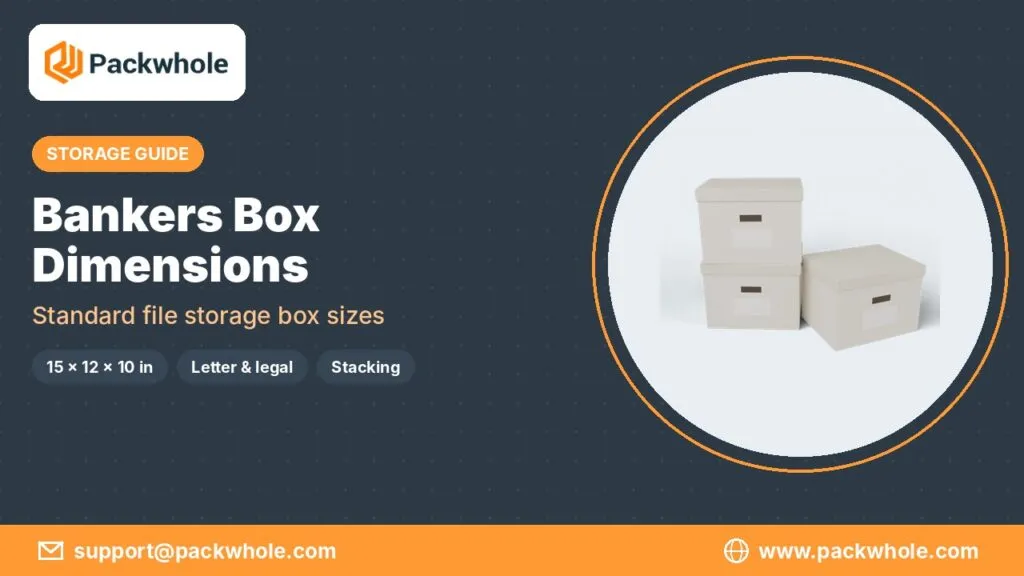
The most common file storage box measures about 15 x 12 x 10 inches. It is designed to hold both letter-size and legal-size hanging or standard folders, depending on how they are placed inside. Some brands list the size as 12 x 15 x 10 or give slightly different outer measurements, so check the listing for exact numbers.
| Box style | Typical size (inches) | Holds |
|---|---|---|
| Standard letter/legal | 15 x 12 x 10 | Letter files one way, legal files the other |
| Long or double-length | 24 x 12 x 10 | Twice the files of a standard box |
| Heavy-duty | About 15 x 12 x 10 | Same size, stronger board |
| Check or record box | Smaller, narrow formats | Checks, receipts, index cards |
Letter vs. Legal Files
Letter-size paper is 8.5 x 11 inches, while legal-size paper is 8.5 x 14 inches. In a standard 15 x 12 x 10 inch box, letter folders usually face one direction and legal folders face the other. This flexibility is one reason the size is so popular. If you store mostly legal documents, check that the box is labeled letter/legal so the longer folders fit without bending.
How Many Folders Fit?
The number of folders depends on how full each folder is. A standard file box holds roughly one standard file drawer’s worth of documents. Lightly filled folders fit more; thick case files fit fewer. Leave a little room so you can flip through files without pulling everything out.
- Count the folders in one drawer or shelf section.
- Estimate one file box per typical drawer.
- Add extra boxes for thick folders.
- Keep some space for easy access.
Weight and Strength
Paper is heavy. A full file box can weigh 30 pounds or more, so strength matters. Standard boxes suit light to moderate use, while heavy-duty boxes have double-wall sides or reinforced corners for stacking and frequent handling. Many file boxes have hand holes, which make lifting easier but can weaken the sides if the box is overloaded. Our article on corrugated flute types explains how board construction affects strength.
| Duty level | Best for |
|---|---|
| Light | Occasional storage, light files |
| Standard | Most office archives |
| Heavy-duty | Frequent access, tall stacks, long-term storage |
Stacking and Storage Tips
File boxes are designed to stack, but stacking too high can crush the bottom boxes, especially in damp areas. Keep stacks to a sensible height, place the heaviest boxes at the bottom and store boxes off the floor on shelves or pallets. Avoid basements and garages with moisture, because damp corrugated board loses strength quickly and can damage documents.
- Store boxes on shelves or pallets, not directly on concrete.
- Keep storage areas cool and dry.
- Place heavier boxes at the bottom of stacks.
- Leave labels facing outward for easy searching.
Labeling File Boxes
A good labeling system saves hours later. Write the department, date range and a short description on the box’s front panel. Many file boxes have printed label areas for this purpose. Number your boxes and keep a simple index, either on paper or in a spreadsheet, so anyone can find documents quickly. Color-coded labels by year or department make retrieval even faster.
Bankers Boxes for Moving
File boxes work well for moving books, records and paperwork because they are a manageable size and come with lids. However, the hand holes and thinner walls of some styles make them less suitable for very heavy loads. For other household items, standard moving cartons may be better. Our guide to moving boxes covers the sizes used in a typical home move, and our post on the 12x12x12 box explains another popular size for heavy items.
Comparing File Boxes With Other Cartons
File boxes have a few features that standard cartons lack: removable or attached lids, hand holes, label areas and sizing designed around paper. Standard shipping cartons are usually stronger for transport but less convenient for repeated access.
| Feature | File storage box | Standard shipping carton |
|---|---|---|
| Lid | Yes, removable or attached | Flaps that need tape |
| Hand holes | Usually | Sometimes |
| Sized for files | Yes | Not necessarily |
| Best use | Archiving and storage | Shipping and moving |
Retention and Security
Many businesses keep records for set periods for tax, legal or regulatory reasons. Retention rules vary by industry and document type, so check with your accountant or legal advisor about how long to keep each record. Store sensitive documents in a secure, access-controlled area, and use secure shredding when records reach the end of their retention period. This guide is general information rather than legal or tax advice.
Custom Storage Boxes
Some organizations order printed storage boxes with their logo, department codes or color schemes. Custom printing makes archives look tidy and helps staff identify boxes quickly. Printed boxes are also popular for records sent to clients, archives delivered to customers and branded document kits. Our custom shipping boxes can be produced in file-friendly sizes with your branding.
Planning Your Archive
Before buying dozens of boxes, measure your storage space, count your files and decide how often you will need access. If staff will retrieve files often, choose heavy-duty boxes with lids and clear labels. For long-term storage, durable boxes kept off the floor in a dry room will protect documents for years. Knowing the standard bankers box dimensions lets you plan shelf space and quantities with confidence.
Choosing Between Lid Styles
File boxes come with different lid styles. Lift-off lids are easy to remove and replace, which suits boxes you open often. Attached or hinged lids stay connected to the box so they do not get lost, which is helpful in shared storage rooms. Some boxes have locking lids that click into place for extra security during moves.
When comparing bankers box dimensions across brands, also look at lid fit and how the lid affects stacking. A lid that sits flush with the box sides stacks more neatly than one that overhangs.
Bankers Box Dimensions for Home Use
At home, file boxes are handy for tax records, medical paperwork, school projects, photos and keepsakes. The standard size fits neatly on closet shelves and under beds. Labeling each box by year or category keeps important documents easy to find. For family keepsakes such as children’s artwork, consider acid-free folders inside the box to protect paper over time. Knowing standard bankers box dimensions helps you plan shelf space before buying storage furniture or a set of boxes.
Moving an Office Archive
When relocating an office, file boxes make the process far easier. Number every box, record its contents and destination room, and keep the index with the moving team. Pack active files separately from long-term archives so staff can access current work quickly after the move. Heavy-duty boxes with secure lids reduce the risk of spills during loading. A clear plan keeps sensitive records organized and secure from the old office to the new one.
Branded Document Boxes for Your Office
Need printed storage or document boxes in a file-friendly size? Tell us how you store your files and how many boxes you need. We suggest a strong board, set up artwork with no extra layout fee, send a proof before production, accept smaller orders and deliver promptly. Contact support@packwhole.com, or ask for storage box pricing at www.packwhole.com.