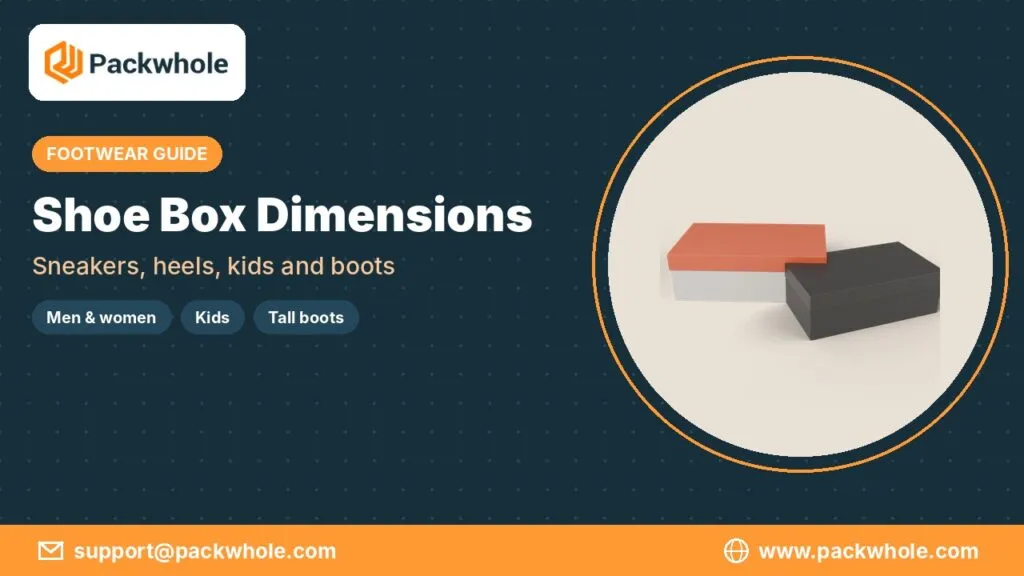
Shoe box dimensions look simple until you try to cover a whole size run. A women’s size 6 flat and a men’s size 13 high-top do not belong in the same carton, and a tall boot needs a completely different shape. Footwear brands, resellers and boutiques usually settle on a small family of box sizes that covers most of their range without wasting board or space on the shelf.
This guide shares typical inside measurements for common shoe categories, explains how to group sizes into a few boxes and covers what changes when shoes ship to customers instead of sitting in a stockroom. Sizes vary by brand and last, so always measure a pair with any tissue or inserts in place.
How Shoe Box Dimensions Are Usually Set
Shoe boxes are sized around a pair placed heel to toe, side by side, with the soles facing opposite directions. That arrangement uses the length of one shoe and the width of two. Height comes from the tallest part of the shoe, usually the heel counter, collar or shaft. A little extra space is added for tissue paper, a dust bag or a size card.
- Length: longest shoe in the size range plus about half an inch.
- Width: two shoes side by side, nested heel to toe.
- Height: tallest point plus room for tissue.
Typical Shoe Box Dimensions Chart
The figures below are common inside sizes used across the footwear industry. They are not official standards; different brands use different lasts and padding, so check your own pairs.
| Footwear category | Common inside measurements in inches |
|---|---|
| Kids’ shoes | 9 x 6 x 3.5 |
| Women’s flats and sneakers | 11 x 7 x 4 |
| Women’s heels | 12 x 8 x 4.5 |
| Men’s dress shoes | 13 x 8 x 4.5 |
| Men’s sneakers | 14 x 9 x 5 |
| High-top sneakers | 14 x 10 x 5.5 |
| Ankle boots | 13 x 9 x 5 |
| Tall boots | 18 x 13 x 5 |
Tall boots are often packed with one shaft folded or laid in opposite directions, which is why the box becomes longer and wider rather than taller.
Grouping a Size Run Into a Few Boxes
Ordering a different box for every shoe size is costly and complicated to manage. Most brands group sizes into three or four box sizes. For example, a sneaker brand might use one box for men’s sizes 7 to 9, another for 9.5 to 11.5 and a third for 12 and up. Grouping keeps inventory simple while still giving each pair a reasonably snug fit.
- Measure the smallest and largest shoe in your range.
- Divide the range into groups where length differs by no more than about an inch.
- Size each box to the largest shoe in its group.
- Use tissue or an insert to fill the gap for smaller sizes.
Lid Styles and How They Affect Size
The style of box changes the outside dimensions slightly even when the inside stays the same. Classic two-piece boxes with a lift-off lid are common for retail, because they stack well and open easily for try-ons. Folding boxes with an attached hinged lid save assembly time. Drawer-style boxes add a premium feel for limited editions.
| Style | Benefit | Notes |
|---|---|---|
| Two-piece lid | Easy try-ons, classic look | Lid adds a little to outer size |
| Hinged lid | One piece, quick to fold | Popular for e-commerce |
| Drawer box | Premium unboxing | Sleeve adds thickness |
| Mailer-style shoe box | Ships without outer box | Needs corrugated board |
See our custom shoe boxes for styles built around these sizes, and our post on reverse tuck vs straight tuck for folding-box basics.
Shoe Box Dimensions for Shipping
Retail shoe boxes are often made from paperboard that looks great on a shelf but is not strong enough to ship on its own. Online sellers usually place the shoe box inside a corrugated mailer, which adds a few inches to the total package. That matters for shipping costs, because carriers bill on size as well as weight. Keeping the outer box tight around the shoe box reduces dimensional weight.
Some brands skip the inner retail box and use a printed corrugated shoe box that ships directly. It protects the pair and still looks branded at the door. Our guide to shipping box sizes and our post on right-sized mailer boxes explain how to plan outer cartons.
Labels, Size Stickers and End Panels
In a stockroom, shoe boxes are stacked with only one end visible. That end panel is where staff look for the style, color and size, so it needs a clear label area. Many brands print a blank field and add a size sticker after packing. Barcodes also usually go on the end. Planning this space at the design stage avoids stickers covering important artwork later.
Tissue, Inserts and Shape Retention
Shoes keep their shape better when the toes are filled and the pair cannot slide. Tissue paper is the simplest option. Cardboard toe inserts and paper stuffing work for sneakers. For boots, a shaft support or a rolled card keeps the leg upright. These extras take up space, so measure with them in place before setting final shoe box dimensions.
Shoe Box Dimensions for Specialty Footwear
Not every pair fits neatly into the common categories. Slides and sandals are flat but wide, athletic cleats have studs that need extra height, and children’s light-up sneakers may include batteries and tags. Specialty footwear benefits from a quick test pack before settling on shoe box dimensions, because one oversized feature can change the whole box.
| Footwear type | Sizing note |
|---|---|
| Sandals and slides | Low height, often 3 inches or less |
| Cleats | Extra height for studs and stiff collars |
| Hiking boots | Wider and taller than sneakers |
| Slippers | Soft, can compress slightly |
| Infant shoes | Very small boxes, sometimes with windows |
Storage, Stacking and Stockroom Efficiency
Shoe stores and warehouses store hundreds of boxes, so dimensions affect how many pairs fit on a shelf. Uniform widths and heights across a size range make stacking stable and keep aisles tidy. Boxes that are slightly too tall waste vertical space across every shelf. When choosing shoe box dimensions, ask how many boxes you want per shelf and work backward to a size that fits your racks.
- Measure your shelving depth and height.
- Decide how many boxes should sit in each row.
- Choose box sizes that divide evenly into the shelf space.
- Keep the end panel facing out with a clear label.
Premium Packaging for Limited Releases
Limited sneaker drops and luxury footwear often use special boxes with unique printing, magnetic closures or slide-out drawers. These boxes still follow the same basic shoe box dimensions but add extra thickness and finishes. Collectors frequently keep the box, so durability and design matter. A dust bag and a printed card about the release can make the unboxing feel special. Our custom rigid boxes suit this kind of premium launch.
Order Shoe Boxes for Your Size Run
Tell us your size range, the tallest style you sell and whether boxes will ship on their own or inside a mailer. We will help group sizes, then provide a free dieline, a digital proof for approval, low minimum order quantities and short production times. Send the details to support@packwhole.com or start a footwear packaging quote on www.packwhole.com.