Walk into a hotel lobby, visitor center, dental office or car dealership and you will usually find a stand filled with tall, slim cards. These are rack cards, and they remain one of the most affordable ways for local businesses to put information directly into a customer’s hand. They are quick to read, easy to carry and designed to fit standard display racks.
This guide explains the standard size, paper and finish options, where rack cards work best and how to design one that gets picked up rather than ignored.
What Rack Cards Are
A rack card is a single printed card, usually printed on both sides, designed to sit in a brochure rack. Unlike a folded brochure, it has no panels to open. That simplicity makes it fast to read and inexpensive to print. Businesses use them to promote services, events, menus, special offers and attractions.
Standard Rack Card Size
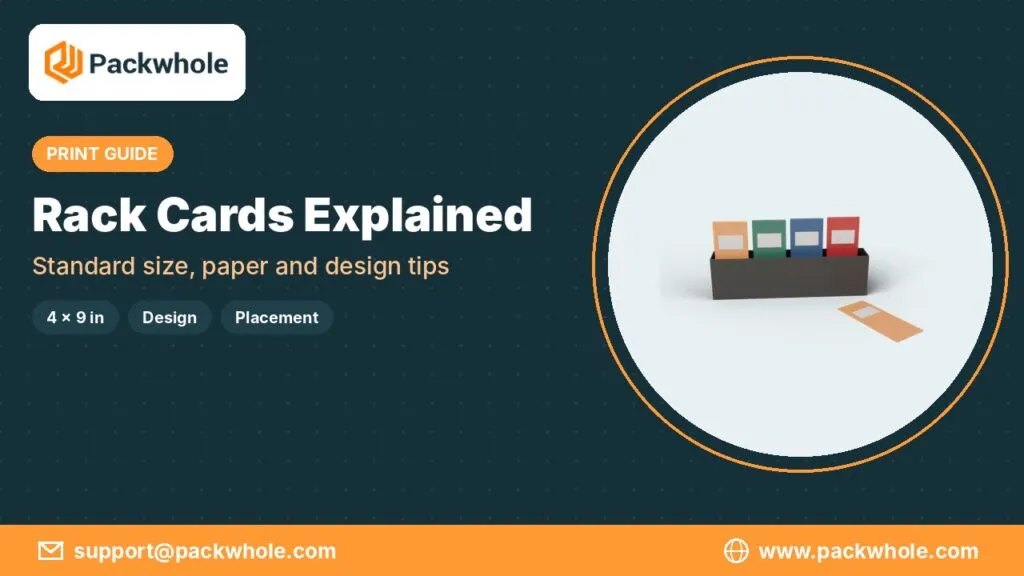
The most common size in the United States is 4 x 9 inches. This size fits standard literature racks and is tall enough for a strong headline, an image and key details. Some printers offer slightly smaller or larger formats, but 4 x 9 inches is the safe choice if your cards will sit in shared racks at hotels or tourism centers.
| Format | Size (inches) | Notes |
|---|---|---|
| Standard rack card | 4 x 9 | Fits most brochure racks |
| Slim variation | 3.5 x 8.5 | Similar to a trifold brochure panel |
| Large variation | 4.25 x 11 | Less common, may not fit all racks |
Remember to include bleed in your artwork, usually an extra eighth of an inch on each side, so the color reaches the edge after trimming. Ask your printer for their template to be sure.
Paper and Finish Options
Rack cards are typically printed on heavy cardstock so they stand upright in a rack without bending. A thicker stock also feels more professional in hand. Finishes affect both durability and appearance.
| Option | Effect |
|---|---|
| Matte finish | Soft, elegant, easy to write on |
| Gloss finish | Bright colors, vivid photos |
| UV coating | Extra shine and scuff resistance |
| Uncoated stock | Natural feel, good for writing notes |
If customers will write on the card, such as for appointment reminders, choose matte or uncoated stock. For photo-heavy designs, gloss or UV coating makes images pop.
Where Rack Cards Work Best
Rack cards shine in places where people browse while waiting or planning. Hotels, visitor centers, restaurants, salons, medical offices, gyms, real estate offices and trade shows are common locations. Many businesses also hand them out at events, leave them at partner businesses or tuck them into order packages.
- Tourism and attractions in hotel lobbies
- Services and pricing at the front desk
- Event schedules and special offers
- New patient or customer information
- Menus and catering options
Design Tips for Rack Cards
The top third of the card is the most important area, because it is often the only part visible when the card sits in a rack. Place your logo and a short, bold headline there. Use one strong image rather than several small ones. Keep text short and organized with clear headings, and end with a simple call to action, such as visiting a website, scanning a QR code or calling to book.
- Put the logo and headline in the top third.
- Use one high-quality image.
- Keep text brief and scannable.
- Add contact details and a clear call to action.
- Use the back side for details, maps or offers.
Rack Cards vs. Brochures and Flyers
Rack cards are simpler than brochures and sturdier than flyers. Brochures hold more information but cost more to print and fold. Flyers are cheap but often printed on thinner paper and in larger sizes that do not fit racks. For quick, focused messages, rack cards are often the most efficient choice.
| Item | Strengths | Trade-offs |
|---|---|---|
| Rack card | Quick to read, sturdy, rack-friendly | Limited space |
| Brochure | More information, panels | Higher cost, folding |
| Flyer | Cheap, large format | Thinner paper, not rack-friendly |
Using QR Codes Effectively
A QR code connects a printed card to online content, such as a booking page, menu or special offer. Make the code large enough to scan easily, at least about an inch square, and test it before printing. Add a short line explaining what the code does, such as “Scan to book” or “Scan for today’s specials.” Linking to a page made for that card lets you measure how many people respond.
Matching Rack Cards With Other Printed Materials
Rack cards work best as part of a consistent brand system. Use the same colors, fonts and logo as your business cards, signs and packaging. Customers who pick up a card and later receive a package or business card will recognize the brand immediately. Our business card printing and our guide to standard business card size help you keep the family of printed pieces consistent. If you ship products, a card tucked into each order alongside custom mailer boxes can promote a new service or offer.
Measuring Results
Because rack cards are inexpensive, it is easy to test different versions. Try two headlines or two offers in different locations and track responses with unique QR codes, promo codes or phone numbers. Over a few weeks, you will see which design or location brings the best results, and you can reprint the winner. Restock racks regularly, since an empty slot means lost opportunities.
Planning Quantities
Estimate how many cards each location will use per month and how many places will display them. Hotels and visitor centers can go through cards quickly during peak seasons. Printing a larger batch usually lowers the cost per card, but avoid overprinting if your offer or pricing might change soon. Seasonal businesses often print separate versions for summer and winter.
Writing Copy That Gets Read
People glance at rack cards for only a few seconds before deciding to pick one up. That means every word must earn its place. Lead with the benefit to the reader rather than your company name alone. A headline like “Family Dinners Delivered in 30 Minutes” is more inviting than a generic restaurant name. Follow with short, clear points about what you offer, where you are and how to get in touch.
Avoid long paragraphs and too many fonts. Two typefaces, one for headings and one for body text, keep the card tidy. Use bullet points for services or features, and keep contact details large and easy to find. A small offer, such as a discount code, encourages people to hold on to it and respond later.
Distribution Tips
Even a great design does not help if the cards sit in a box. Build relationships with local hotels, visitor centers and partner businesses that serve your target customers. Ask whether they accept rack cards and how often they restock. Offer to return regularly to refill the rack and remove outdated cards. Some areas have professional distribution services that place rack cards in many locations for a fee.
Think beyond racks too. Rack cards fit nicely in envelopes, product packages and event goodie bags. Placing them in every order shipment or handing them out at trade shows gets your message to people who already have an interest in your business.
Printed Pieces That Match Your Packaging
If you want your printed marketing to match your boxes and labels, we can help coordinate colors and design across your materials. Share your logo and the pieces you need; our team prepares layouts with no artwork fee, sends you a proof for sign-off, handles short runs and prints promptly. Email support@packwhole.com, or see our card and print options at www.packwhole.com.