A box can look perfect on the packing table and still fail somewhere between the sorting hub and the porch. Parcels are dropped, stacked, shaken on conveyor belts and left in humid trucks. That is why custom mailer boxes have to be planned for the journey as carefully as they are designed for the unboxing.
This guide covers what US brands should check before a mailer goes into the network: carrier limits, board strength, transit testing, Amazon FBA preparation, labels and environmental claims.
Please note: carrier, marketplace and labeling rules are updated often. Treat this guide as general information, not legal advice, and check the latest requirements with your carrier, Amazon Seller Central and the relevant agency before shipping.
Why Shipping-Ready Custom Mailer Boxes Protect Your Margins
Every damaged order costs a replacement product, a second shipping label and often a customer. Surcharges for oversized or awkward parcels can quietly add dollars to each shipment as well. Packaging that is built for the network avoids both problems. It also keeps your seller metrics healthy on marketplaces that track damage and return rates, which is why the checks below are worth doing before you place a large order.
Carrier Size and Weight Limits Every Ecommerce Brand Should Know
Each major US carrier publishes a maximum weight and a maximum size for a single parcel. Size is often expressed as length plus girth, where girth is twice the width plus twice the height. Most mailers sit far below these ceilings, but large apparel, home goods and bundle boxes can get close to the points where extra fees begin. The table shows the published limits at the time of writing.
| Carrier | Max Weight | Max Length | Max Length + Girth |
|---|---|---|---|
| USPS | 70 lb | Varies by service | 108 inches for most services, 130 inches for USPS Ground Advantage |
| UPS | 150 lb | 108 inches | 165 inches |
| FedEx Ground | 150 lb | 108 inches | 165 inches |
Staying under the maximum is only part of the picture. Carriers also bill by dimensional weight, so a large, light box can cost more than a small, heavy one. We explain that calculation in our guide to reducing shipping costs with right-sized mailers. Additional handling fees can also apply well before a parcel reaches the limits above, so check your carrier’s current rate guide.
Board Strength, Closures and Inserts That Survive the Parcel Network
Custom mailer boxes are only as strong as their board and their closure. The same printed design can be produced on a light board that suits a T-shirt or on a heavier grade that protects glass jars. Choosing correctly means matching the box to the weight and fragility of what goes inside. Three decisions do most of the work.
Edge Crush Test Ratings
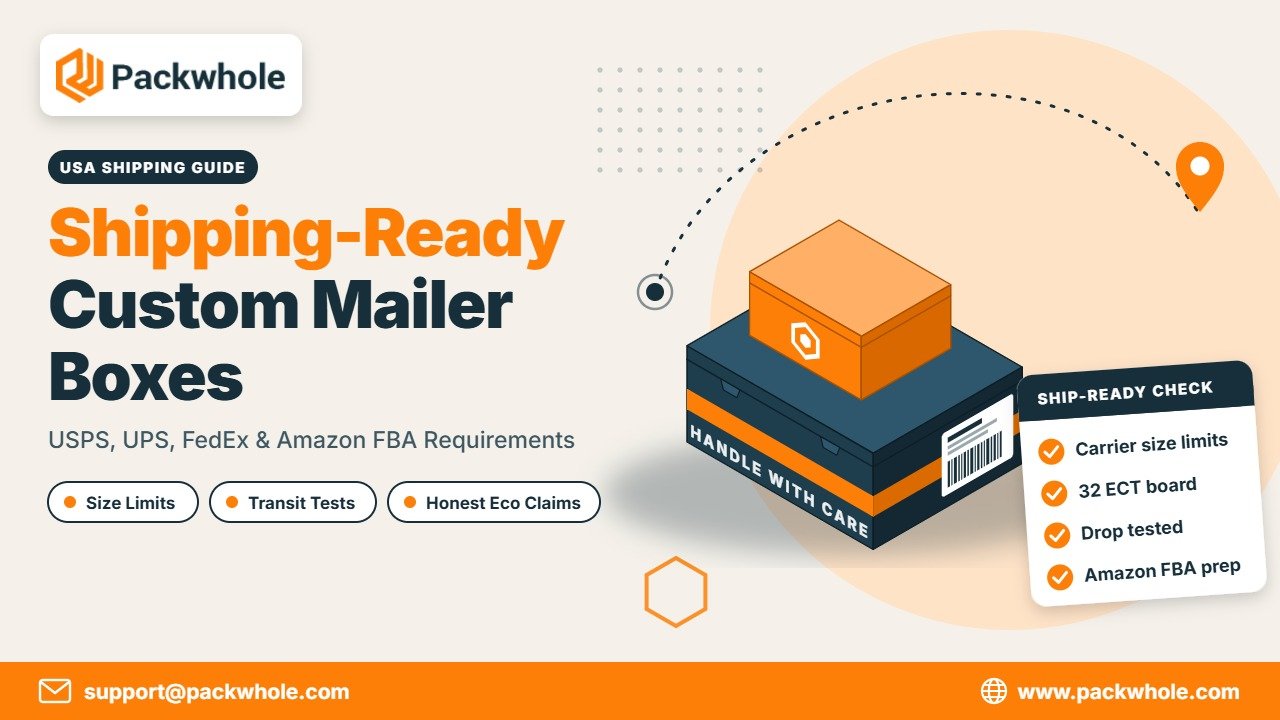
The Edge Crush Test (ECT) measures how much stacking force a board can take on its edge. A 32 ECT single-wall board is the everyday grade for light and medium parcels. Heavier or fragile contents may need a higher ECT rating, a thicker flute or double-wall board.
Closures and Seals
Tuck-in lids with locking tabs hold well for light products. For anything heavier, add a strip of tape or a branded sticker across the front flap. Peel-and-seal adhesive strips with a tear strip are the most secure choice and also show evidence of tampering.
Inserts and Cushioning
Movement inside the box causes more damage than impact from outside. Carriers generally recommend about two inches of cushioning around fragile items. A fitted insert does the same job with less material, as shown in our article on custom box inserts for shipping.
Transit Testing Custom Mailer Boxes Before a Full Production Run
Testing is the only way to know how a packed box behaves in the real world. The International Safe Transit Association (ISTA) publishes test procedures that labs use to simulate parcel delivery, and ISTA 3A is the common one for individual packages shipped through carrier networks. You do not need a lab to catch the obvious problems, though. A simple in-house routine with sample boxes will reveal most weaknesses.
- Pack a real order. Use the actual product, insert and any tissue or filler you plan to ship with.
- Drop it. Let the box fall from about waist height onto a hard floor, landing on each face, an edge and a corner.
- Shake it. If you can hear or feel movement, the fit or the insert needs work.
- Stack it. Place weight on top for a day to see whether the walls bow or the lid pops open.
- Inspect and repeat. Open the box, check the product and the closure, then adjust the design and test again.
For fragile, high-value or liquid products, a certified lab test is worth the cost. It gives you documented results that marketplaces and retail partners may ask for.
Preparing Mailer Boxes for Amazon FBA and Ships in Product Packaging
Amazon has its own packaging requirements on top of carrier rules, and they are enforced at the fulfillment center door. Units that arrive unprepared can be refused, relabeled at your expense or held back from sale. According to Amazon’s seller announcements, its US prep and labeling services for FBA ended on January 1, 2026, so inventory now has to arrive ready to stock. Keep these points in mind when you prepare custom mailer boxes for FBA.
- Scannable barcode: Each unit needs one scannable product barcode on the outside, with other barcodes covered.
- Inbound carton limits: Shipping cartons for standard-size items are generally limited to 25 inches on any side and 50 pounds.
- Sealed and secure: Units must stay closed and intact when handled, so add a seal to tuck-front lids.
- Ships in Product Packaging (SIPP): This program, formerly Ships in Own Container, lets certified products ship in their own box without an Amazon overbox.
- Testing for SIPP: Certification is based on ISTA 6 Amazon test methods, and fragile items usually need a lab report.
SIPP can lower fulfillment fees and reduce packaging waste, but the box has to be rectangular, sealed and strong enough to travel alone. Check Seller Central for the current size tiers and exclusions before you design around it.
Labels, Markings and Special Rules for Regulated Products
What goes on the outside of the box matters as much as what goes inside. A label that wraps over a seam or a barcode on a curved edge can cause a parcel to be missorted. Some products also bring federal rules with them, whichever box they ship in. Review the following before you finalize your artwork.
- Label placement: Leave a flat, unprinted area on the largest face for the shipping label, away from seams and edges.
- Lithium batteries: Power banks and battery-powered devices need specific marks under DOT rules. See our guide to mobile battery packaging rules in the USA.
- Food and cosmetics: FDA labeling applies to the product package, so plan space for ingredients and net contents on the retail pack.
- Privacy: For sensitive purchases, keep the outer box plain. Our article on discreet packaging explains the approach.
Making Honest Recycling and Eco Claims on Your Mailer Boxes
Corrugated board is one of the most widely recycled packaging materials in the United States, and many brands want to say so on the box. The Federal Trade Commission’s Green Guides explain how to make those statements without misleading customers. Broad phrases such as “eco-friendly” are discouraged unless you spell out the specific benefit. A few simple habits keep your claims accurate.
- Be specific: Say “Made with 70% recycled board” only when your supplier can document the figure.
- Qualify when needed: An unqualified “recyclable” claim fits items that at least 60 percent of consumers can recycle locally.
- Watch the extras: Plastic lamination, foam inserts and heavy coatings can change how recyclable the finished box is.
- Check state rules: Some states, including California, have their own labeling laws for recyclability claims.
For material ideas, read our sustainable packaging materials guide.
Mistakes That Get Mailer Boxes Damaged, Delayed or Surcharged
Most shipping problems trace back to a short list of avoidable decisions. They usually appear after a brand scales up, when small issues are multiplied across thousands of orders. Watch for these in particular.
- Relying on the tuck alone for heavy items. Lids can open under load without a seal.
- Designing artwork with no label zone. Labels then cover your logo or sit across a seam.
- Skipping the drop test. Damage patterns only show up when the box is packed and dropped.
- Ignoring humidity. Corrugated board loses strength in damp conditions, so allow a safety margin.
- Sending unprepared units to Amazon. Missing barcodes or unsealed lids lead to delays and fees.
Get Shipping-Ready Custom Mailer Boxes from PackWhole
At PackWhole, we build custom mailer boxes around the realities of US parcel networks and marketplaces. Tell us what you sell, how much it weighs and which carriers or marketplaces you use, and we will recommend the board grade, closure and insert to match. We can add peel-and-seal strips, tear strips and a dedicated label area, and we send samples so you can test before you commit. See our custom mailer box options, reach the team at support@packwhole.com, or head to www.packwhole.com and ask for pricing on your size.
Frequently Asked Questions About Shipping Custom Mailer Boxes in the USA
Shipping rules raise plenty of questions, especially for brands that are moving from stock cartons to printed packaging. Here are short answers to the ones our packaging team hears most. For anything specific to your product, confirm with your carrier or marketplace first.
Can a mailer box ship without an outer carton?
Yes. A corrugated mailer is designed to travel on its own, provided the board grade suits the weight and the lid is sealed.
What ECT rating do I need?
32 ECT single-wall board covers most light and medium ecommerce orders. Ask for a higher rating or a thicker flute for heavy or fragile contents.
Are mailer boxes accepted by Amazon FBA?
They are, as long as each unit is sealed, carries a scannable barcode and meets Amazon’s current size and weight requirements.
Can I print “recyclable” on my box?
In most cases, plain corrugated board supports that claim. Check any laminates or inserts first, and follow the FTC Green Guides and your state’s labeling rules.