
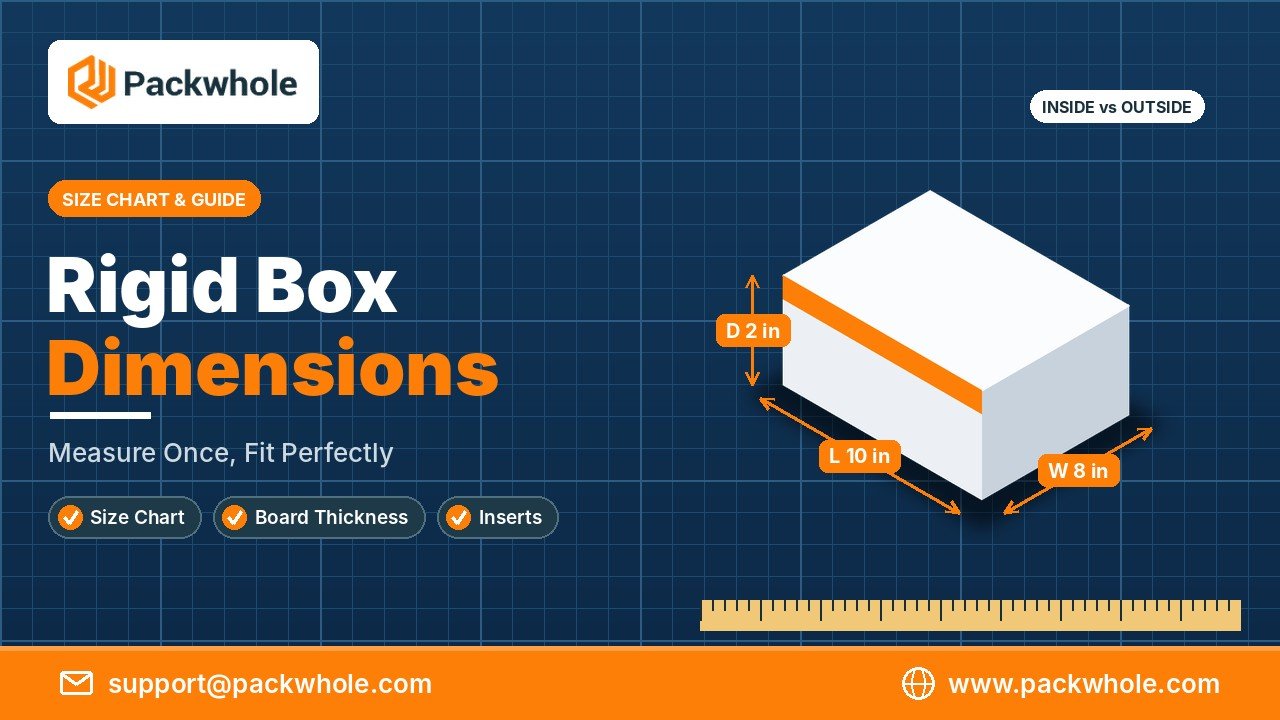
A rigid box that is a quarter inch too big feels sloppy. One that is a quarter inch too small is useless. Because rigid boxes are built from thick chipboard and cannot flex like a folding carton, getting rigid box dimensions right matters more here than with almost any other packaging style. There is very little room for “close enough.”
This guide gives you a starter size chart for popular products, explains how board thickness affects inside and outside measurements, and walks through worked examples so you can send accurate specs to your packaging partner.
Why Precision Matters More for Rigid Boxes Than Folding Cartons
A folding carton made from 18 to 24 pt paperboard has a little give. You can press a product in, and the panels bend slightly. A rigid box is built from heavy grayboard, covered in a printed wrap, and set permanently into its final form. It cannot stretch at all. A lid that is too tight will not close, and one that is too loose will slide off when the box is lifted. Small errors also multiply in sets, where several items share one insert.
Inside vs Outside Rigid Box Dimensions Explained
Every box has two sets of measurements, and confusing them is the most common sizing error. Inside dimensions describe the usable space for your product. Outside dimensions describe the overall footprint, which matters for shipping cartons, shelves, and display units. With rigid boxes, the gap between the two is bigger than people expect because of the thick walls and the lid overlap.
- Inside dimensions (ID): length × width × depth of the cavity. Always specify these for product fit.
- Outside dimensions (OD): add about twice the board thickness plus the wrap to length and width.
- Lid dimensions: a two-piece lid is slightly larger than the base so it can slide over it.
As a rough guide, with 2 mm board each outer side grows by about 2 to 2.5 mm, so the outside length is roughly 4 to 5 mm (about 3/16 inch) larger than the inside. Our tutorial on measuring box dimensions correctly walks through the L × W × D order.
A Starter Size Chart of Common Rigid Box Dimensions
The chart below lists typical inside sizes for popular rigid box products in the US market. Use it as a starting point when you brief a designer, then fine-tune around your actual product. Measurements are in inches with approximate metric conversions. Every product is different, so always confirm with a physical sample.
| Product | Typical Inside Size (L × W × D) | Approx. Metric |
|---|---|---|
| Ring or earring box | 2 × 2 × 1.5 in | 51 × 51 × 38 mm |
| Necklace box | 3.5 × 3.5 × 1.25 in | 89 × 89 × 32 mm |
| Watch box | 4 × 4 × 3 in | 102 × 102 × 76 mm |
| Perfume (50 ml) | 3 × 3 × 5 in | 76 × 76 × 127 mm |
| Skincare set (3 bottles) | 8 × 6 × 2.5 in | 203 × 152 × 64 mm |
| Folded T-shirt or scarf | 10 × 8 × 2 in | 254 × 203 × 51 mm |
| Folded hoodie or sweater | 13 × 10 × 3.5 in | 330 × 254 × 89 mm |
| Shoe box (adult sneaker) | 13 × 8 × 5 in | 330 × 203 × 127 mm |
| Wine bottle (750 ml) | 4 × 4 × 13.5 in | 102 × 102 × 343 mm |
| Corporate gift set | 12 × 9 × 4 in | 305 × 229 × 102 mm |
How to Measure Your Product for a Rigid Box in Five Steps
Measuring sounds simple, yet small habits make the difference between a perfect fit and a costly reprint. Measure the actual product, not the spec sheet, because labels, caps, and pumps often add size. Use a digital caliper for small items and a steel ruler for larger ones. Write everything down in the same unit before converting.
- Record the product’s length, width, and height at its largest points, counting caps, handles, or hang tags.
- Decide on an insert type (foam, paperboard, EVA, or none) and its wall thickness.
- Add clearance: most items need a sixteenth to an eighth of an inch per side.
- Add the insert thickness to each side if you use one.
- Send these inside rigid box dimensions to your supplier and request a plain white sample.
Worked Examples: Turning a Product Into Final Rigid Box Dimensions
Seeing the math in action makes the process much clearer. The examples below show how a product size becomes a box size. Each uses simple clearance and insert values; your supplier may suggest slightly different numbers depending on material and finish. Treat these as patterns you can repeat with your own products.
Example 1: Single perfume bottle with paperboard insert
– Bottle: 2.4 × 1.6 × 4.5 in
– Insert walls: 0.25 in per side; clearance 0.06 in per side
– Inside box: about 3.0 × 2.2 × 4.8 in
Example 2: Folded cashmere scarf, no insert
– Folded scarf: 9.5 × 7.5 × 1.5 in
– Clearance for tissue: 0.25 in per side
– Inside box: 10 × 8 × 2 in
Example 3: Three-candle gift set in foam
– Candles: three jars, each 3 in diameter × 3.5 in tall, in a row with 0.5 in gaps
– Foam border: 0.5 in all around
– Inside box: about 11 × 4 × 4 in
Board Thickness, Lid Depth, and Other Details That Affect Size
Beyond length, width, and depth, a few construction choices shape the final look and fit. Lid depth changes how a two-piece box feels when opened. Board thickness changes both strength and outside size. Shoulder or neck boxes add an inner collar that the lid rests on. Discuss these with your supplier while finalizing rigid box dimensions, not after artwork is done.
- Full-depth lid: covers the entire base; elegant, uses more material.
- Partial lid: covers one-third to one-half of the base depth; most common.
- Shoulder box: a visible inner collar; premium feel, needs extra height.
- Board choice: 1.5 mm for small items, 2 mm standard, 2.5 to 3 mm for heavy sets.
Learn more in our guide to custom rigid boxes.
How Rigid Box Dimensions Affect Shipping and Display
The box size you choose does not stop mattering once the product fits. It also decides how many boxes fit in a master carton, how they sit on a retail shelf, and how much you pay to ship each order. Rigid boxes are usually shipped inside an outer mailer or carton, so every extra inch on the gift box adds size to the shipping box as well. A slightly smaller rigid box can save money on every single order.
Keep these points in mind:
- Plan a master carton that holds a round number of boxes, such as 12 or 24, without gaps.
- Check retail shelf depth and height if your boxes will be sold in stores.
- Leave about half an inch of padding around a rigid box inside its shipping mailer.
- Compare dimensional weight for two or three box sizes before finalizing.
- Keep a consistent footprint across a product family so displays look tidy.
Sizing Mistakes That Lead to Costly Reprints
Reprinting a rigid box run is expensive because of the hand work involved. Most sizing problems can be traced to a handful of simple oversights. Review this list against your spec sheet before you approve a proof. A white sample is the cheapest insurance you can buy.
- Sending outside measurements when the supplier expects inside measurements.
- Forgetting pump tops, caps, or tags on the product.
- Ignoring insert thickness.
- Mixing inches and millimeters in the same spec sheet.
- Making the box much larger than the product, which raises shipping costs.
Get Accurate Rigid Box Dimensions and Samples From PackWhole
PackWhole’s packaging engineers help US brands lock in rigid box dimensions before a single sheet is printed. Send us your product, or its measurements, and we will recommend inside sizes, insert styles, and board thickness. We provide free design support, digital dielines, and plain samples, with low minimum orders for custom rigid boxes.
Send your product measurements to support@packwhole.com, or upload your details through www.packwhole.com.
FAQs About Rigid Box Dimensions
Buyers often ask the same few questions when they size a rigid box for the first time. These quick answers cover the essentials. For anything more complex, such as multi-item sets or heavy products, it is worth booking a short call so we can check the details together.
Should I give inside or outside measurements?
Give inside measurements for product fit. Mention any outside limits separately, such as a shelf or shipping carton size.
How much clearance should I leave?
Usually 1/16 to 1/8 inch per side, plus the thickness of any insert or tissue.
What board thickness is standard?
About 2 mm (sometimes listed as 1200 to 1400 gsm) is common for most retail gift boxes.
Can rigid boxes be any size?
Almost. Very small or very large sizes may need special tooling, so share your size early.