You found a packaging supplier, sent a message, and got back a question: “Do you want OEM or ODM?” If you are not sure what that means, you are not alone. The OEM vs ODM packaging choice decides who creates the design, who owns it, how fast you can launch, and how unique your box will look on the shelf.
In short, OEM means the manufacturer produces your design to your specs. ODM means you choose from the manufacturer’s existing designs and add your branding. Let’s unpack what that means in practice and how to decide.
What OEM and ODM Mean in the Packaging World
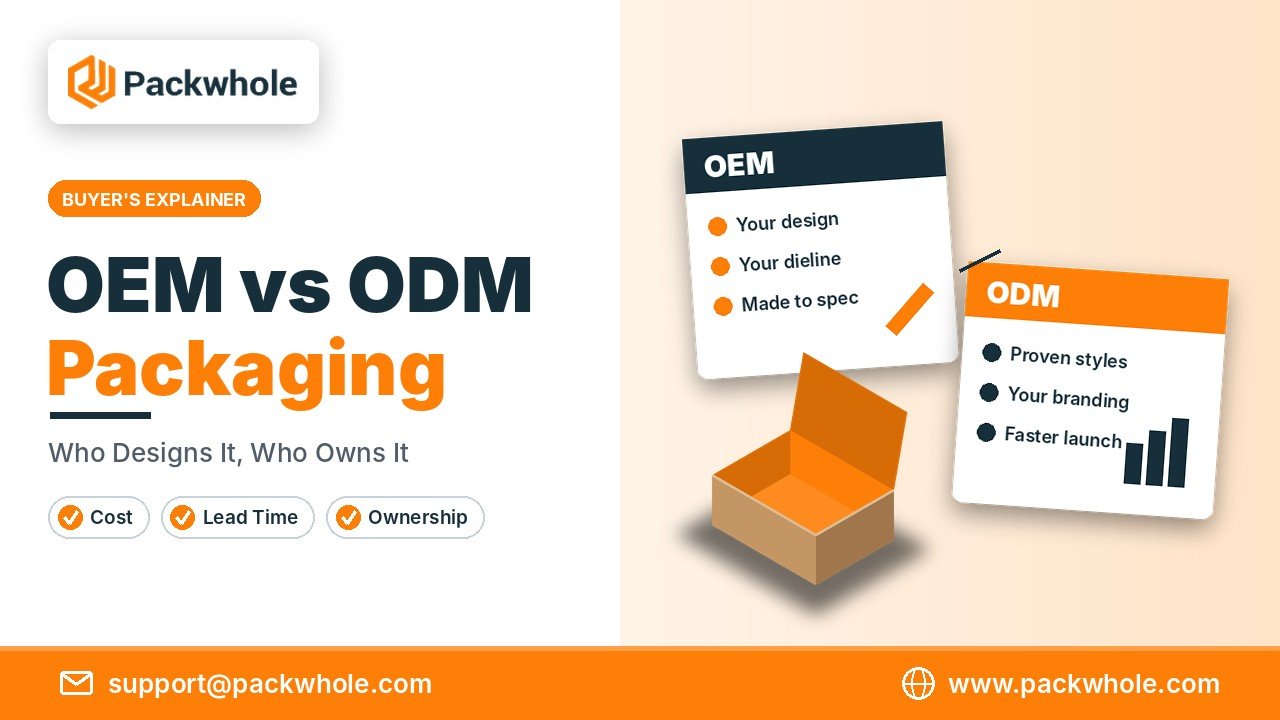
Both terms come from manufacturing in general, and they apply to packaging in a slightly simplified way. OEM stands for Original Equipment Manufacturer. In packaging, it means the supplier builds a box from your structural design, artwork, and specifications. ODM stands for Original Design Manufacturer. It means the supplier already has proven box structures, inserts, or templates, and you customize them with your logo, colors, and copy.
A simple way to remember it:
- OEM: “Make exactly what I designed.”
- ODM: “Show me what you’ve already designed, and I’ll brand it.”
OEM vs ODM Packaging Compared Point by Point
The differences show up in cost, speed, flexibility, and ownership. Neither model is better in every situation. Startups often begin with ODM to move quickly, then switch to OEM once they know which products sell. Established brands usually prefer OEM for flagship products and use ODM for seasonal or promotional items.
| Factor | OEM Packaging | ODM Packaging |
|---|---|---|
| Who designs the structure | Your brand or your agency | The manufacturer |
| Uniqueness | Fully unique | Shared base design, custom branding |
| Upfront cost | Higher (tooling, dielines, samples) | Lower |
| Lead time | Longer | Shorter |
| Minimum order | Often higher | Often lower |
| Design ownership | Usually yours (confirm in writing) | Structure stays with manufacturer |
| Best for | Signature products, strong brands | Launches, tests, promotions |
When OEM Packaging Is the Right Call
OEM is the path to a box nobody else has. If your product has an unusual shape, if you need a special opening mechanism, or if your packaging is part of your brand identity, OEM makes sense. It requires more preparation: you or your designer must supply structural drawings, dielines, artwork files, and material specs. In return, you gain full control.
Choose OEM if:
- Your product needs a custom insert or unusual dimensions.
- You want a signature unboxing experience competitors cannot copy.
- You plan to reorder the same box for years.
- You want to own the structural design and artwork.
When ODM Packaging Makes More Sense
ODM is ideal when speed and budget matter more than total uniqueness. The supplier has already tested the structure, so there is less risk of fit or assembly issues. You simply pick a style, such as a mailer box, tuck-end carton, or two-piece box, and apply your branding. Many small brands launch successfully this way.
ODM also lowers the risk of production surprises. Because the factory has made the same structure many times, glue lines, fold strength, and assembly speed are already proven. That matters for small teams that pack orders by hand, since a box that folds smoothly saves minutes every day. Ask to see a finished sample from a previous client before you commit.
Choose ODM if:
- You are testing a new product or market.
- You need packaging within a few weeks.
- Your budget is limited.
- Standard sizes already fit your product well.
The Hybrid Route Most US Brands Actually Use
In practice, many brands land in the middle of the OEM vs ODM packaging spectrum. They start from a supplier’s proven structure, then change the size, add a custom insert, and print fully custom artwork. This hybrid approach keeps costs and risks low while still delivering a box that feels unique. It is also how most custom packaging companies, including PackWhole, work with small and mid-size brands every day.
A typical hybrid project looks like this:
- Choose a base style such as a custom mailer box.
- Adjust dimensions to your product.
- Add a custom insert and inside printing.
- Pick finishes such as foil, embossing, or soft-touch.
Ownership, IP, and Contract Points to Clarify
The biggest risk in OEM vs ODM packaging deals is unclear ownership. If you pay for a custom structure, make sure the agreement says who owns the dieline and artwork files. With ODM, the base structure usually stays with the manufacturer, which means competitors might use the same shape. That is normal, but you should know it upfront.
Points to confirm in writing:
- Who owns artwork, dielines, and printing plates.
- Whether the supplier can sell your custom structure to others.
- Reorder pricing and how long tooling is stored.
- Quality standards, tolerances, and inspection steps.
This is general business information, not legal advice. Have a lawyer review important supply contracts.
Questions to Ask a Supplier Before You Choose a Model
A short conversation with your supplier can save weeks of back-and-forth. Some factories use the OEM and ODM labels loosely, so it helps to ask clear questions about what they will actually do and what they expect from you. Their answers show whether they can support your project and how much design help you will receive. Write the answers down and include them in your purchase order.
Useful questions:
- Do you have existing structures that fit my product, and can I see samples?
- If I supply my own dieline, will you check it for production issues?
- Who creates the final print-ready artwork, and is there a fee?
- How long are cutting dies and plates stored for reorders?
- What are the minimum order quantities for stock versus custom structures?
- How do you handle color matching and approval of printed proofs?
- What happens if the first production run does not match the approved sample?
Mistakes Buyers Make When Choosing Between OEM and ODM
Choosing the wrong model can cost time and money, but the mistakes are predictable. Most come from skipping questions or assuming terms mean the same thing to every supplier. Clear communication and a written brief prevent nearly all of them. Watch for these traps.
- Paying OEM prices for what is really a stock design with a logo.
- Assuming you own a design you did not pay to develop.
- Choosing OEM for a product that may change in three months.
- Skipping samples to save a week.
- Forgetting to compare landed cost, including freight and duties, when sourcing overseas.
Start Your OEM vs ODM Packaging Project With PackWhole
Whether you have a finished dieline or just a product and an idea, PackWhole can help. Our team produces your own designs, offers dozens of proven box styles you can customize, and provides free design support to bridge the gap between the two. With low minimum orders and fast proofs, it is easy to test a hybrid OEM vs ODM packaging approach before scaling up.
Tell us about your project at support@packwhole.com or explore options on www.packwhole.com.
OEM vs ODM Packaging FAQs
These questions come up often when buyers talk to packaging manufacturers for the first time. The answers below are short and practical. If a supplier uses either term differently, simply ask them to describe who designs what and who owns the files.
Is OEM always more expensive than ODM?
Upfront costs are usually higher with OEM because of design and tooling. Unit prices can be similar once production starts.
Can I switch from ODM to OEM later?
Yes. Many brands launch with ODM and move to OEM once sales are proven.
Do I need a designer for OEM packaging?
It helps. Some suppliers, including PackWhole, offer free structural and graphic design support.
Is ODM packaging less professional?
No. Well-branded ODM packaging can look fully custom. The only difference is that the base structure is not exclusive.