Pick up a cereal box, a notepad backing, a puzzle box, or the inside of a luxury gift box, and there is a good chance you are holding chipboard. It is one of the most widely used materials in packaging, yet few people outside the industry know its name. If you are sourcing custom boxes, understanding chipboard packaging helps you read quotes, compare materials, and choose the right thickness for your product.
This guide answers the basic question, then explains thickness, grades, uses, and the honest limits of the material.
What Chipboard Means in Packaging (and What It Doesn’t)
In US packaging, chipboard is a type of paperboard made mostly from recycled paper fibers, pressed into a dense, flat sheet. It is usually gray or brown on the inside. It is not the same as the wood-based “chipboard” sold in hardware stores in some countries, which Americans usually call particle board. Packaging chipboard is all paper, lightweight, and easy to cut, fold, glue, and wrap.
You may also hear related names:
– Grayboard or greyboard: thick chipboard used in rigid boxes.
– Clay-coated news back (CCNB): chipboard with a white printable coating on one side.
– Paperboard: the wider family that includes chipboard and other board grades.
How Chipboard Thickness Is Measured
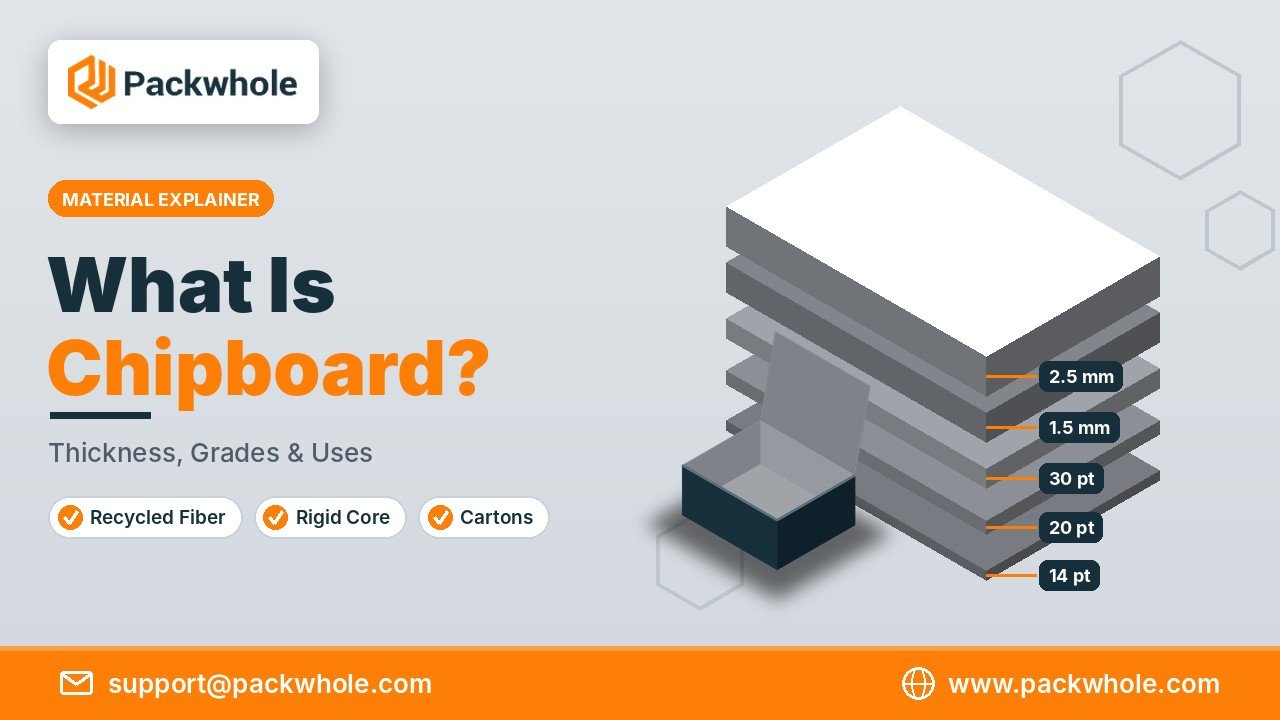
Chipboard thickness is usually given in points (pt) in the US, where 1 point equals 0.001 inch. You may also see thickness in millimeters or weight in grams per square meter (gsm), especially for rigid box board. The thicker the board, the stiffer and stronger it becomes, but also the heavier and more expensive.
| Thickness | Approx. Metric | Typical Use |
|---|---|---|
| 14 to 18 pt | 0.36 to 0.46 mm | Light cartons, inserts, backing cards |
| 20 to 24 pt | 0.5 to 0.6 mm | Folding cartons for food and cosmetics |
| 30 to 40 pt | 0.76 to 1 mm | Sturdy backs, dividers, set-up trays |
| 60 to 80 pt | 1.5 to 2 mm | Rigid boxes and book covers |
| 100 to 120 pt | 2.5 to 3 mm | Heavy rigid boxes and premium sets |
Where Chipboard Packaging Shows Up Every Day
Because it is inexpensive, printable when coated, and made from recycled fiber, chipboard appears in an enormous range of products. Thin grades fold into everyday retail cartons, while thick grades become the hidden structure of luxury rigid boxes. Many shoppers handle chipboard packaging dozens of times a week without noticing.
- Folding cartons: cereal, crackers, frozen food sleeves, toothpaste boxes.
- Rigid gift boxes: thick grayboard wrapped in printed paper. See custom rigid boxes.
- Inserts and dividers: to hold bottles, jars, or tech accessories in place.
- Backing boards: for notepads, calendars, and blister cards.
- Game and puzzle boxes: sturdy two-piece boxes for board games.
Chipboard Packaging Compared With Other Board Types
Chipboard is one of several paperboard options, and each has its own strengths. Solid bleached sulfate (SBS) is bright white and premium. Kraft board is brown and strong. Corrugated adds a fluted layer for shipping strength. Comparing them side by side shows where chipboard fits best.
| Material | Look | Strength | Cost | Best For |
|---|---|---|---|---|
| Chipboard (uncoated) | Gray or brown | Moderate | Low | Inner structure, rigid box core |
| Coated chipboard (CCNB) | White print side, gray inside | Moderate | Low | Food and household cartons |
| SBS paperboard | Bright white throughout | Moderate | Medium | Cosmetics, pharma, premium retail |
| Kraft board | Natural brown | High for weight | Medium | Eco-look cartons |
| Corrugated | Brown or white liners | High | Medium | Shipping, mailers |
Strengths and Limits You Should Know
Every material has trade-offs, and chipboard is no exception. It is affordable and versatile, but it is not designed to protect products in rough shipping on its own. Knowing these limits helps you decide when to pair it with a corrugated outer box or choose a different board.
Strengths:
– Low cost and widely available
– Made largely from recycled fibers
– Easy to die-cut, fold, and glue
– Great as a rigid box core when wrapped
Limits:
– Uncoated chipboard is not ideal for high-quality printing
– Absorbs moisture and can warp in humid conditions
– Less crush resistance than corrugated for shipping
– Recycled fibers may contain contaminants, so food contact needs the right grade or a barrier
Food Contact and Sustainability Notes
Recycled chipboard is widely used for dry food packaging, often with a liner bag inside, as in cereal boxes. Materials that touch food directly must be appropriate for food contact under FDA rules, so ask your supplier which grade and coating they use. On the sustainability side, chipboard packaging is generally recyclable in US curbside programs, and its high recycled content is a genuine benefit. Avoid vague claims and follow the FTC Green Guides when you mention recycled content on your box.
Moisture is another practical concern. Chipboard can swell or curl if it is stored in a damp warehouse or a garage, so keep stock off the floor and away from exterior walls. Cartons that will travel through refrigerated supply chains often need a coated or moisture-resistant grade instead of plain recycled board.
General information, not legal advice.
How to Read a Chipboard Specification on a Quote
Supplier quotes often list materials in shorthand that can confuse first-time buyers. A line such as “24 pt CCNB, 4/0, aqueous coating” contains a lot of information once you know the code. Understanding these details lets you compare quotes fairly and spot when two suppliers are pricing different materials. If anything is unclear, ask the supplier to explain it before you approve.
Common terms you may see:
- Points (pt): board thickness, where 1 pt equals 0.001 inch.
- CCNB: clay-coated news back, a chipboard with a white printable surface.
- 4/0: four-color printing on the outside and none on the inside.
- Aqueous coating: a water-based protective layer over the print.
- Grayboard thickness in mm: used for rigid box cores, such as 2 mm.
- Wrap: the printed paper glued over the board in rigid boxes.
Comparing these lines side by side ensures you are not paying more for a thinner or lower-grade board.
Mistakes to Avoid When Specifying Chipboard
Choosing the wrong grade or thickness can lead to boxes that warp, crush, or print poorly. Most issues come from treating all paperboard as the same thing. A few minutes of planning with your packaging supplier prevents expensive surprises. Keep these points in mind.
- Using uncoated chipboard when you need sharp, full-color printing.
- Sending chipboard cartons through carriers with no protective shipper around them.
- Choosing board that is too thin for heavy items.
- Storing chipboard packaging in damp areas before use.
- Forgetting a barrier liner for greasy or moist food products.
Order Chipboard Packaging and Rigid Boxes From PackWhole
PackWhole uses chipboard in many of the boxes we make, from printed folding cartons to luxury rigid gift boxes. Our team will help you choose the right thickness, coating, and finish for your product, and we offer free design support with low minimum orders. If chipboard packaging is not the best fit, we will recommend a better material.
Forward your spec sheet to support@packwhole.com for a plain-language review, or get a price on www.packwhole.com.
FAQs About Chipboard Packaging
These quick answers address the questions buyers ask most when they first come across chipboard in a quote. If you need help reading a spec sheet, send it to our team and we will explain each line in plain language.
Is chipboard the same as cardboard?
In everyday speech, people often call chipboard “cardboard.” In packaging terms, chipboard is a specific type of recycled paperboard.
Is chipboard strong?
It is stiff and sturdy for its weight, especially in thick grades, but it is not as crush resistant as corrugated board.
Can you print on chipboard?
Yes, especially on coated chipboard. Uncoated chipboard works for simple one- or two-color designs.
Is chipboard recyclable?
Yes. It is widely accepted in curbside recycling programs across the US.