Walk into any fulfillment center and you will see the same thing: a wall of boxes in a dozen sizes, half of which rarely get used. Choosing the right shipping box sizes is one of the simplest ways to cut costs. The right set reduces wasted space, lowers dimensional-weight charges, speeds up packing, and keeps products from rattling around in transit.
This guide gives you a chart of common US box sizes, matches them to typical products, lists USPS flat rate box dimensions, and shows how to build a lean box lineup for your store.
How Box Sizes Are Written and Measured
Box sizes in the US are usually written as length × width × depth (or height), in inches, using inside dimensions. Length is the longer side of the opening, width is the shorter side, and depth is the distance from the opening to the bottom. Knowing this order prevents mix-ups when you compare suppliers or order custom boxes. You can follow the full process in our measuring box and packaging dimensions tutorial.
- Inside dimensions: what your product needs to fit.
- Outside dimensions: what carriers measure for pricing.
Common Shipping Box Sizes and What Fits in Them
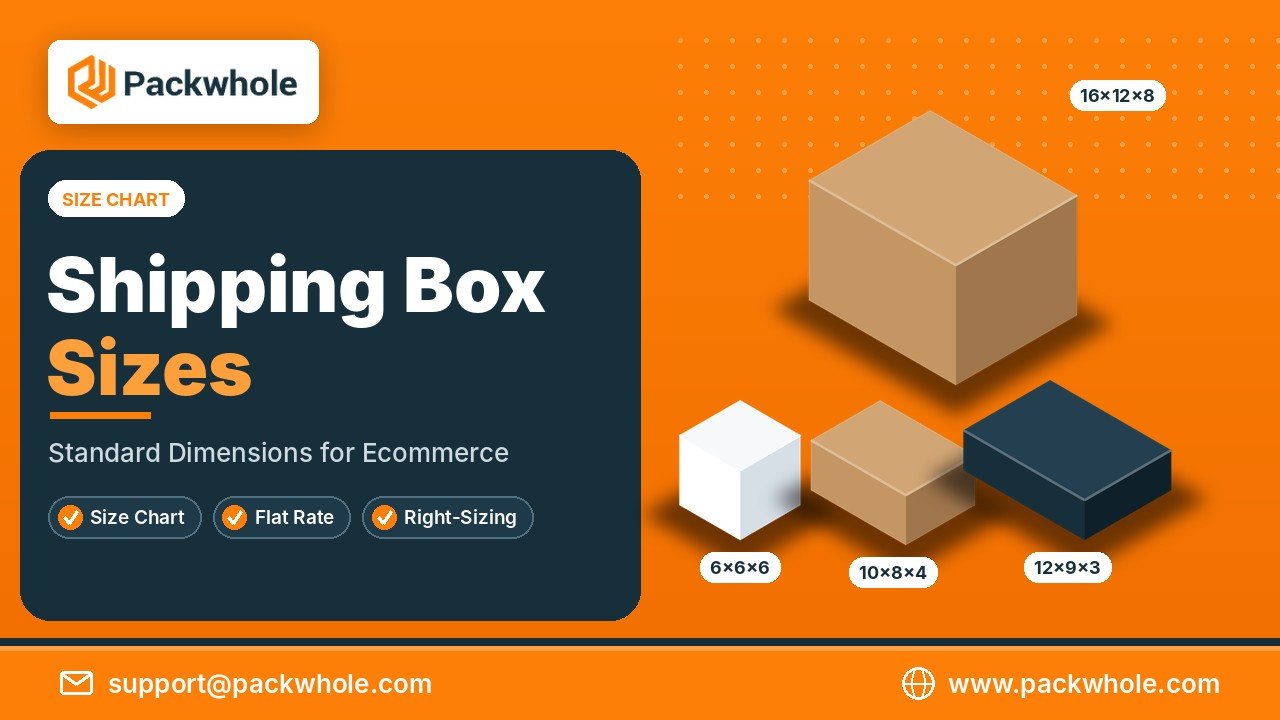
The chart below lists widely used stock sizes in US ecommerce and the products that typically fit. Your exact needs depend on product shape and how much cushioning you use, but this is a reliable starting point. Many brands find that four or five of these sizes cover most orders.
| Box Size (inches) | Typical Contents |
|---|---|
| 4 × 4 × 4 | Jewelry, small cosmetics, cables |
| 6 × 4 × 4 | Phone accessories, candles, small jars |
| 6 × 6 × 6 | Mugs, small gift sets, candles |
| 8 × 6 × 4 | Books, cosmetics sets, supplements |
| 9 × 6 × 3 | Folded tees, small apparel, flat items |
| 10 × 8 × 4 | Shoes (kids), small electronics, kits |
| 12 × 9 × 3 | Apparel, hoodies, flat gift sets |
| 12 × 12 × 6 | Home décor, multi-item orders |
| 14 × 10 × 4 | Adult shoes, jackets |
| 16 × 12 × 8 | Small appliances, bulk orders |
| 18 × 18 × 18 | Large home goods, bedding |
| 20 × 20 × 20 | Bulky, lightweight items |
For more on a popular cube size, read our article on customizing 6x6x6 cardboard boxes.
USPS Flat Rate Box Dimensions at a Glance
USPS Priority Mail Flat Rate boxes are free from the post office and charge one price regardless of weight (up to 70 pounds) or destination within the US. They work well for small, heavy items. However, they are plain and unbranded, and the sizes are fixed. The approximate inside dimensions are below; check USPS for current versions.
| Flat Rate Box | Approx. Inside Dimensions |
|---|---|
| Small | 8 5/8 × 5 3/8 × 1 5/8 in |
| Medium (top-loading) | 11 × 8 1/2 × 5 1/2 in |
| Medium (side-loading) | 13 5/8 × 11 7/8 × 3 3/8 in |
| Large | 12 × 12 × 5 1/2 in |
If branding matters, a custom box sized to your product often costs less to ship than a flat rate box for light items.
How to Choose the Right Shipping Box Sizes for Your Store
The goal is not to have a perfect box for every product. It is to have a small set of shipping box sizes that fit most orders with minimal empty space. Analyzing your order data is the best way to find that set. Even a simple spreadsheet of your top-selling items and common order combinations will reveal patterns.
- List your 20 best-selling products and their dimensions.
- Note your most common multi-item order combinations.
- Group products that fit the same size with 1 to 2 inches of cushioning.
- Choose three to five sizes that cover about 80% to 90% of orders.
- Keep one larger size for occasional big orders.
- Review the lineup every six months as your catalog changes.
Why Right-Sizing Saves Money
Carriers price packages by dimensional weight, which means empty space costs real money. A box that is two inches too large on each side can raise the billable weight significantly. Smaller boxes also need less void fill and less tape, and they take up less room in storage. Worked examples appear in the post about right-sized custom mailer boxes.
Benefits of right-sizing:
– Lower DIM weight charges with USPS, UPS, and FedEx
– Less void fill and packing time
– Better product protection with less movement
– A cleaner unboxing experience for customers
Stock Boxes vs Custom-Sized Boxes
Stock boxes are convenient and easy to reorder, but they rarely fit your product perfectly. Custom-sized boxes cost a bit more upfront but can reduce shipping costs and make your brand look more professional. Many growing brands use a mix: custom printed boxes for their best sellers and stock boxes for occasional items.
A practical middle ground is to keep stock boxes in plain brown for rare items and invest in printed custom sizes only for the three or four products that drive most of your orders. That way, your most frequent customers always receive a branded package, while your packing team still has a fallback for unusual orders. Review the split every quarter as your best sellers change.
| Factor | Stock Boxes | Custom-Sized Boxes |
|---|---|---|
| Availability | Immediate | Short production time |
| Fit | Approximate | Exact |
| Branding | Usually plain | Fully printed |
| Shipping cost | Can be higher due to extra space | Often lower |
| Best for | Low-volume or odd items | Best sellers and subscriptions |
Box Sizes for Subscription and Multi-Item Orders
Subscription boxes and bundles have their own sizing challenges. Contents change from month to month, and customers often order several items at once. The trick is to choose a box that comfortably fits the largest typical combination while using inserts or fill to secure smaller assortments. A consistent outer size also helps your brand feel recognizable every month.
Common choices:
- 12 × 9 × 4 inches: a popular size for beauty and snack subscriptions.
- 12 × 12 × 4 inches: works for lifestyle and gift bundles.
- 14 × 10 × 5 inches: suits apparel bundles and larger assortments.
Tips for subscription sizing:
- Plan contents around your box, not the other way around.
- Use a simple paperboard insert to keep items organized.
- Track the most common combinations each month and adjust if needed.
Mistakes Sellers Make With Box Sizes
Box size errors add up quietly over hundreds or thousands of orders. Many sellers keep using the same few boxes they started with, even after their products change. A regular review fixes most problems. Watch for these common mistakes.
- Stocking too many sizes, which complicates packing and storage.
- Using one large box for everything.
- Measuring outside dimensions when ordering for product fit.
- Forgetting to account for cushioning or inserts.
- Never reviewing box usage against order data.
Get Custom Shipping Box Sizes From PackWhole
PackWhole helps ecommerce brands design a lean set of shipping box sizes that fit their products perfectly. We make printed custom mailer boxes, custom corrugated boxes, and shipping cartons in any dimension. Design help is free, and small minimum runs are welcome. Send us your product list and we will suggest the right sizes.
Email your product list to support@packwhole.com, or size your next order on www.packwhole.com.
Frequently Asked Questions About Shipping Box Sizes
These quick answers cover the most common questions about box sizing for online stores. If you are unsure which sizes to choose, share your best-selling products with our team and we will recommend a starter set.
What is the most common shipping box size?
There is no single standard, but sizes like 12 × 9 × 3, 10 × 8 × 4, and 12 × 12 × 6 inches are very common in ecommerce.
How many box sizes should a small business stock?
Three to five sizes usually cover most orders.
Are inside or outside dimensions used for shipping costs?
Carriers measure the outside of the package for pricing.
Is a flat rate box always cheaper?
No. Flat rate boxes are best for small, heavy items. Light items often ship cheaper in a right-sized box.