Pillow boxes are small, charming, and surprisingly clever. They ship flat, pop into a soft curved shape in seconds, and close without glue. That makes them a favorite for jewelry, gift cards, soap bars, hair accessories, wedding favors, and samples. But their curves also make sizing confusing. A pillow box that looks big enough on paper may be too shallow at the ends. Understanding pillow box dimensions is the key to a snug, attractive fit.
This guide explains how these boxes are measured, gives a size chart for common products, and shares practical tips for choosing the right size and material.
How a Pillow Box Is Shaped
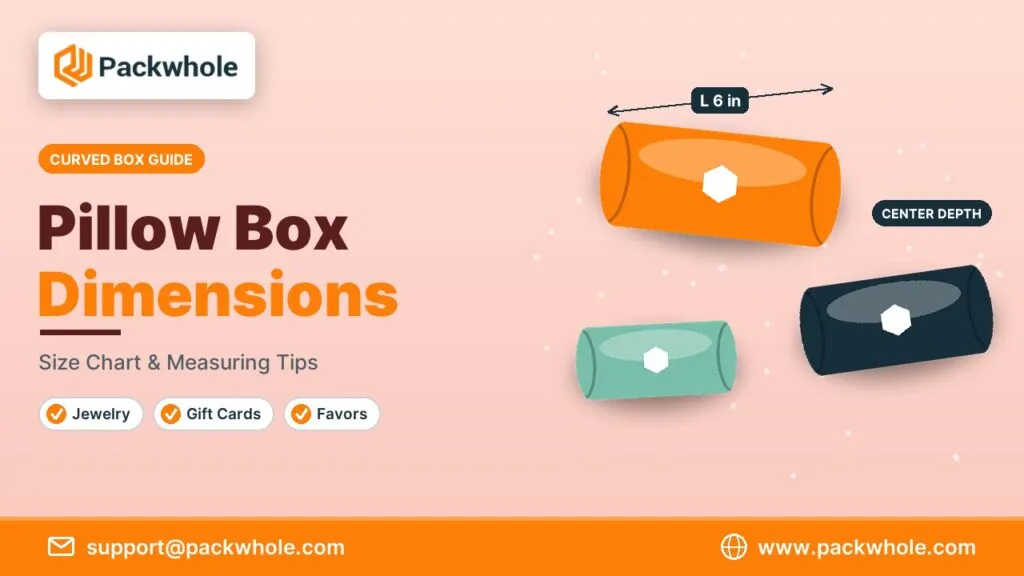
A pillow box is made from a single die-cut sheet with curved score lines at each end. When you fold it, the curved ends push inward and the two long sides bow outward, creating the familiar pillow shape. The box is deepest at the center and narrows to a flat edge at both ends. This shape is attractive but means usable space is not a simple rectangle.
Because of the curves, the depth listed by a supplier is the maximum depth at the center. Products sit best in the middle third of the box, where the depth is greatest.
Reading Pillow Box Dimensions Correctly
Suppliers usually list three numbers. It is important to know which is which, because they don’t follow the same rules as a standard carton. Ask your supplier to confirm how they measure if a quote is unclear.
| Measurement | What It Means | Tip |
|---|---|---|
| Length (L) | Distance between the two curved ends | Product should be shorter by about 1 in |
| Width (W) | Across the face of the box | Product should be slightly narrower |
| Depth (D) | Maximum thickness at the center | Product must fit within this at its thickest point |
A good rule of thumb: the product’s thickest part should be no more than about 80% of the listed center depth, and it should sit in the center of the box, away from the tapered ends.
Pillow Box Dimensions Chart for Popular Products
The table below lists widely used sizes and the products they suit. All sizes are approximate and written as length × width × center depth in inches. Custom sizes are easy to produce because the structure is simple.
| Size (L × W × D, inches) | Good For |
|---|---|
| 3 × 2.5 × 0.75 | Rings, earrings, small charms |
| 4 × 3 × 1 | Gift cards, bracelets, lip balm |
| 4.5 × 3.5 × 1 | Hair clips, scrunchies, small favors |
| 5 × 3.5 × 1.25 | Soap bars, tea samples, candy |
| 6 × 4 × 1.5 | Wallets, bath products, socks |
| 7 × 4 × 1.5 | Cosmetics sets, small accessories |
| 8 × 5 × 2 | Scarves, small apparel, gift sets |
| 9 × 6 × 2 | Folded tees, larger gifts |
| 10 × 4 × 1.5 | Pens, makeup brushes, slim items |
How to Choose the Right Size for Your Product
The easiest way to size a pillow box is to measure your product and then work outward, remembering the tapered ends. Products that are flat and flexible, like gift cards or fabric, are forgiving. Rigid, thick items like soap bars need more careful sizing because they cannot bend into the curve.
- Measure your product’s length, width, and thickest point.
- Add about 1 inch to the length so the product sits clear of the curved ends.
- Add about 1/4 inch to the width for easy insertion.
- Make sure the center depth is at least 20% greater than the product’s thickness.
- Test with a plain sample before ordering printed boxes.
If your product is thick or heavy, consider a custom die cut box or tuck box instead.
Materials and Finishes for Pillow Boxes
Most pillow boxes are made from paperboard because it curves smoothly and holds its shape. Thicker board feels sturdier but is harder to curve, so suppliers usually recommend 14 pt to 18 pt for most sizes. Kraft, white, and colored stocks are all popular, and finishes like matte lamination, foil, and spot UV make small boxes feel special.
Popular options:
- White paperboard: clean base for full-color printing.
- Kraft board: natural look for soap, tea, and handmade goods.
- Black or colored board: striking with gold or silver foil.
- Clear PET: shows the product; good for favors and candy.
- Window cut-outs: combine branding with a product view.
Creative Uses and Design Ideas
Pillow boxes are inexpensive and easy to customize, which makes them perfect for marketing and gifting. Many brands use them as add-ons rather than primary packaging. Their size and shape also make them easy to hand out at events or include in larger orders.
- Free samples tucked inside ecommerce orders
- Wedding and party favors with names and dates
- Gift card holders for retail and restaurants
- Jewelry packaging for craft fairs and boutiques
- Holiday stocking stuffers and seasonal promotions
- Loyalty rewards and thank-you gifts
Add a ribbon, a hang tag, or a sticker seal for a finished look.
Pricing and Ordering Tips for Pillow Boxes
Pillow boxes are among the most affordable custom boxes because they use one small sheet, no separate lid, and a single glue seam. Price depends mostly on size, board, finish, and quantity. Because they ship and store flat, even large orders take up little space, which makes bulk ordering easier than with rigid boxes.
Ways to keep costs down without losing impact:
- Stick to a standard size from the chart when your product fits.
- Print one or two colors on kraft for a natural, low-cost look.
- Use a sticker or hang tag for seasonal messages instead of reprinting.
- Order one size for several products by adding a small insert card.
- Combine pillow boxes with your main packaging order to share setup costs.
Ask for a few plain samples in two neighboring sizes as well; holding them with the real product in hand is the fastest way to settle on a final choice. When you request a quote, share the product, preferred pillow box dimensions, board, finish, and quantity, so the supplier can price accurately the first time.
Common Mistakes With Pillow Box Sizing
Pillow boxes are simple, but the curved shape leads to a few predictable errors. Most come from treating the listed dimensions like those of a rectangular carton. Check your plans against this list before ordering.
- Using the full length for the product and ignoring the tapered ends.
- Choosing a center depth that is too close to the product’s thickness.
- Picking board that is too thick to curve smoothly.
- Placing logos or text across the curved fold lines.
- Using pillow boxes for heavy items that need more support.
Order Custom Pillow Box Dimensions From PackWhole
PackWhole prints custom pillow boxes in standard and custom pillow box dimensions, with kraft, white, colored, and window options. Share your product size and we will recommend the right fit, finish, and quantity. With free artwork help and small minimums, pillow boxes are an easy, affordable upgrade for small brands.
Send your product size to support@packwhole.com, or browse pillow box styles at www.packwhole.com.
FAQs About Pillow Box Dimensions
These short answers cover the questions people ask most about sizing pillow boxes. If you have an unusual product, send us its measurements or a photo and we will help you choose.
How are pillow boxes measured?
By length between the curved ends, width across the face, and maximum depth at the center.
What size pillow box fits a gift card?
A box around 4 × 3 × 1 inches fits a standard gift card with room for a carrier.
Can pillow boxes hold heavy items?
They are best for light items. Heavy products need a tuck box or rigid box.
Do pillow boxes need glue?
No. They are pre-glued along one seam and close by folding in the curved ends.
Can I add a window?
Yes. A die-cut window with clear film is a popular option.