
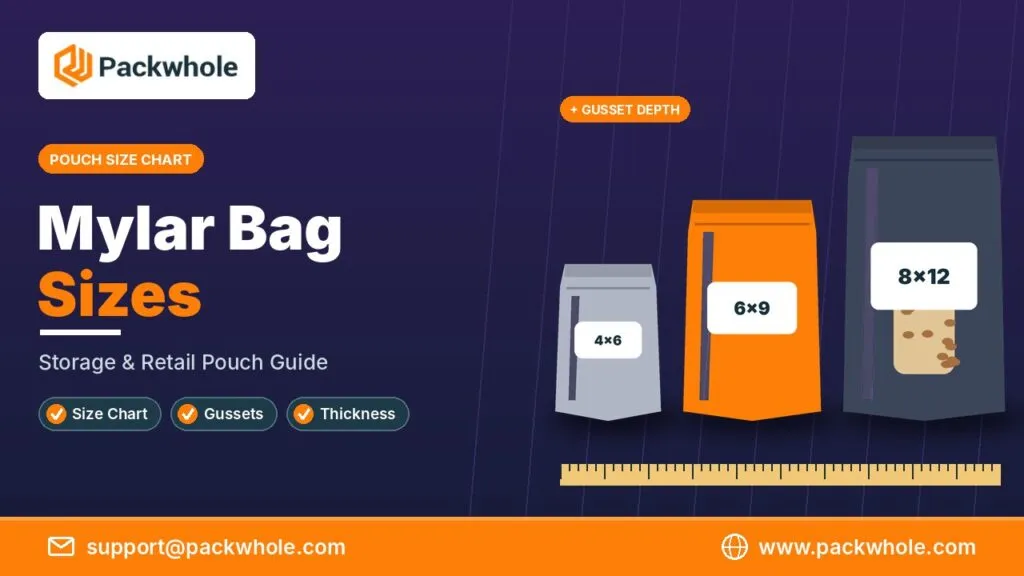
Mylar bags are everywhere: long-term food storage, coffee, jerky, tea, bath salts, supplements, and many legal hemp and cannabis products. They block light, oxygen, and moisture far better than plain plastic. But ordering the wrong size is easy, because a bag’s flat dimensions do not tell you how much it holds once filled. Understanding mylar bag sizes saves money, reduces waste, and makes your product look properly packed rather than half empty.
This guide covers the common storage and retail sizes, explains how gussets change capacity, and gives a simple method for picking the right bag for your product.
How Mylar Bags Are Measured
Mylar bags are listed by their flat width and height, measured from edge to edge while the bag is empty and laid flat. Stand-up pouches also list a bottom gusset, which is the folded panel that opens to let the bag stand. Those flat measurements include the seal areas and the space above the zipper, so the usable fill area is always smaller than the listed size.
Typical labels look like this:
– 6 × 9 in: flat width × height
– 5.5 × 8.5 + 3 in: width × height + bottom gusset
Common Mylar Bag Sizes for Long-Term Food Storage
Food storage bags are usually larger, thicker, and often sealed with a heat sealer and an oxygen absorber. They are commonly placed inside buckets for extra protection. The volumes below are approximate, because the real capacity depends on the product’s shape and density. Rice packs tighter than pasta, for example.
| Bag Name | Approx. Flat Size | Approx. Volume | Typical Use |
|---|---|---|---|
| Pint | 6 × 10 in | 2 cups | Spices, seeds, small portions |
| Quart | 8 × 12 in | 4 cups | Beans, rice, oats portions |
| Half gallon | 10 × 12 in | 8 cups | Flour, sugar, pasta |
| 1 gallon | 10 × 14 in | 16 cups | Bulk grains and legumes |
| 5 gallon | 20 × 30 in | Fits a 5-gallon bucket | Long-term bulk storage |
Retail Stand-Up Pouch Sizes by Product Weight
Retail pouches are made for shelves and online shops, so they often include a zipper, tear notch, hang hole, or clear window. They come in many sizes, and suppliers vary in exact dimensions. The chart below offers common starting points for typical fill weights of light, dry products. Dense items such as nuts or bath salts need smaller bags for the same weight.
| Typical Fill | Approx. Pouch Size (W × H + Gusset) | Common Products |
|---|---|---|
| 1 to 2 oz | 4 × 6 + 2 in | Tea samples, herbs, candy |
| 3 to 4 oz | 5 × 8 + 3 in | Jerky, granola, coffee samples |
| 8 oz | 6 × 9 + 3.5 in | Coffee, trail mix, protein snacks |
| 12 oz | 7 × 11.5 + 4 in | Coffee bags, pet treats |
| 16 oz (1 lb) | 8 × 12 + 4 in | Coffee, flour, bath salts |
| 2 lb | 9 × 13.5 + 4.5 in | Bulk snacks, pet food |
How Gussets and Shape Change Capacity
Two pouches with the same width and height can hold very different amounts depending on the gusset. A deeper gusset lets the bag open into more of a box shape, which increases volume and helps it stand straight. Flat (pillow) pouches without a gusset hold much less and lie flat, which suits single servings and mailers. When comparing mylar bag sizes from different suppliers, always check the gusset depth, not just the face size.
- Flat pouch: best for small single-use items and samples.
- Stand-up pouch with bottom gusset: best for retail shelves.
- Side-gusset bag: common for coffee, often paired with a valve.
- Flat-bottom (box) pouch: very stable, premium look, highest capacity.
Choosing Thickness for Protection
Mylar bag thickness is measured in mils (1 mil = 0.001 inch). Thicker bags resist punctures from sharp items like pasta or dried fruit, and they generally provide better long-term protection. Retail pouches often use a multi-layer film that combines metallized or foil layers with other plastics, so the total thickness may be listed differently.
- 3 to 4 mil: light retail products and short shelf life.
- 5 mil: good general-purpose storage.
- 7 mil and up: long-term food storage and sharp-edged products.
A Quick Method for Picking the Right Size
The fastest way to choose is to test with your actual product. Fill a measuring cup or a sample bag and see how much space it takes. Then leave extra room at the top for heat sealing and the zipper. If you have to fold or force the bag closed, it is too small.
- Weigh and measure the volume of one unit of product.
- Check the chart above for a starting size.
- Add 1.5 to 2 inches of headspace for the zipper and seal.
- Fill a sample bag and test standing, sealing, and shelf appearance.
- Order a small run before committing to a large printed order.
For a comparison of mylar with other formats, read our article on mylar vs rigid packaging.
Labeling and Compliance Notes for US Sellers
The pouch is only part of the package. Food sold in pouches needs FDA-compliant labels that show what the product is, how much is inside (in both US customary and metric measures), the ingredients, allergens, and who made or distributed it. Hemp and cannabis products often require child-resistant packaging and state-specific warnings. Child-resistant zippers must be tested under CPSC protocols (16 CFR 1700) to make that claim.
Treat this as general guidance rather than legal advice, and verify federal and state requirements before printing.
Matching Mylar Bags With Boxes and Displays
A pouch on its own can look great online, but in physical stores it often needs help to stand out and stay upright. Secondary packaging solves both problems. It can also protect pouches during shipping, where sharp corners and pressure can cause leaks. Planning boxes and displays while choosing mylar bag sizes ensures everything fits together on the first try.
Practical pairings:
- Header cards: turn flat pouches into hanging retail packs for peg hooks.
- Counter displays: hold 12 to 24 small pouches neatly at checkout.
- Printed folding cartons: give a pouch a box shape and more branding space.
- Mailer boxes: protect multi-pouch orders shipped to customers.
- Labels and stickers: let one plain pouch serve many products.
When you measure for a display or carton, measure the pouch after it is filled and sealed, since a filled bag is wider at the base and shorter overall than its flat size suggests.
Common Mistakes When Ordering Mylar Bags
Mylar bags are simple once you understand them, but buyers often make the same few errors. Most involve sizing by flat dimensions alone or forgetting headspace. Review these before ordering your next batch of mylar bag sizes, and you will avoid most surprises.
- Ordering by face size without checking the gusset.
- Leaving no room above the product for sealing.
- Choosing thin bags for sharp or heavy products.
- Forgetting oxygen absorbers for long-term food storage.
- Ignoring how the pouch will be displayed or shipped.
Complete Your Mylar Bag Sizes Lineup With Packaging From PackWhole
PackWhole does not manufacture mylar film, but we create the printed packaging that helps pouches sell. That includes custom header cards for bag tops, labels and stickers, counter display boxes for retail shelves, and mailer boxes for online orders, sized to your chosen mylar bag sizes. Our designers help at no charge, and short runs are welcome.
Send your pouch sizes to support@packwhole.com and we will match cartons and displays, or browse www.packwhole.com.
Mylar Bag Sizes FAQ
Here are fast answers to questions people ask most when they start using mylar bags. Because supplier sizes vary, treat these numbers as approximate and always test with your own product. When in doubt, order a small sample pack in two or three sizes.
What size mylar bag fits in a 5-gallon bucket?
A bag around 20 × 30 inches is the common choice for lining a standard 5-gallon bucket.
How many pounds of rice fit in a 1-gallon mylar bag?
Roughly 6 to 7 pounds of white rice, depending on the bag shape and how full you fill it.
What does the gusset number mean?
It is the depth of the folded bottom panel. A larger gusset gives more capacity and better stability.
Are clear-front mylar bags as protective?
Not fully. Clear windows let in some light, so they are better for short shelf-life retail products.