
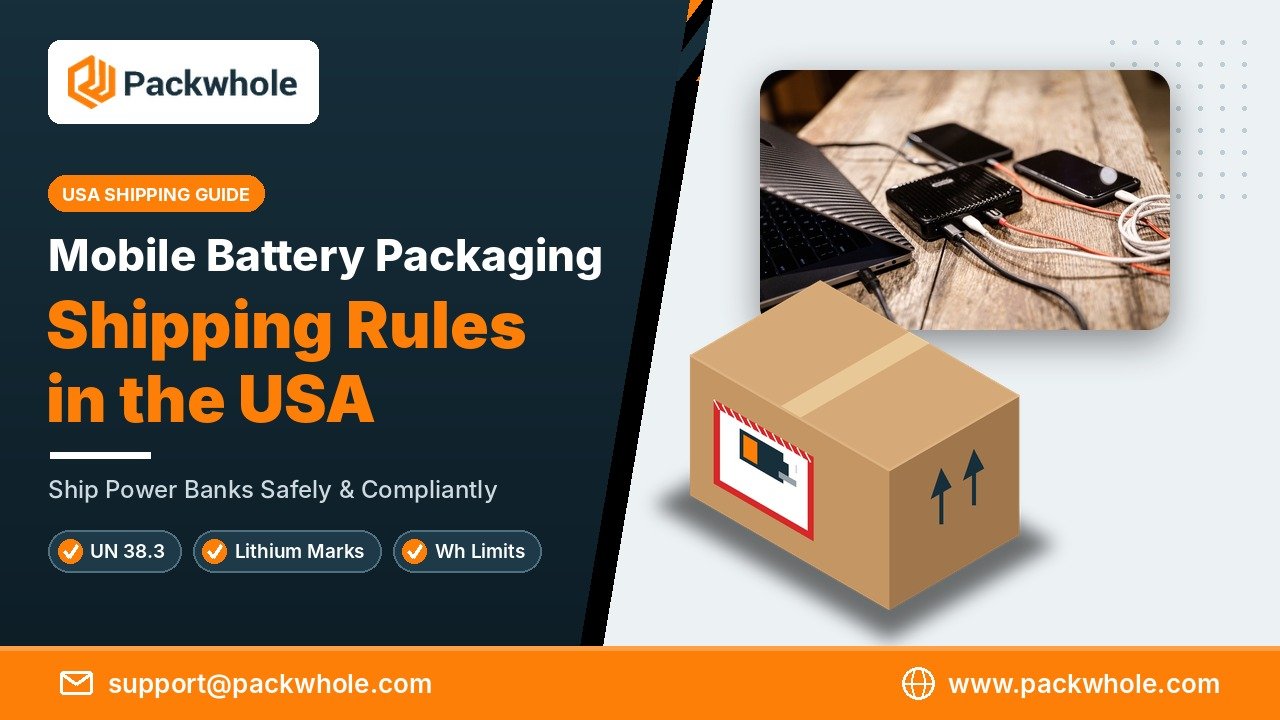
Selling power banks online is a great business, but shipping them is not as simple as dropping a box at the post office. Mobile batteries contain lithium-ion cells, which are regulated as hazardous materials in the United States. That means your mobile battery packaging has to do more than look good. It must protect against short circuits and damage, carry the right markings, and follow the rules set by regulators and carriers.
This guide explains the key US requirements for mobile battery packaging and shipping, in plain language, so you can ship power banks safely and avoid rejected or delayed parcels.
Important: Hazardous materials rules are detailed and change from time to time. This article is general information, not legal or compliance advice. Always confirm current requirements with the U.S. Department of Transportation (PHMSA), your carrier, and, for air shipments, IATA rules before shipping.
Why Mobile Battery Packaging Is Regulated in the USA
Lithium-ion batteries store a lot of energy in a small space. If they are damaged, short-circuited, or poorly packed, they can overheat and, in rare cases, catch fire. Because of this risk, the U.S. Department of Transportation treats lithium batteries as Class 9 hazardous materials. Regulators, airlines, and parcel carriers all have rules about how mobile batteries must be packed, marked, and shipped.
For ecommerce brands, getting this right protects your customers, your carrier relationships, and your business. Non-compliant shipments can be refused, returned, or result in penalties.
Key US Regulations for Mobile Battery Packaging
Several rules and standards shape how power banks must be packaged and shipped in the USA. You don’t need to memorize them all, but you should know what they are and make sure your supplier and shipping team follow them. Here are the most important ones.
DOT Hazardous Materials Regulations (49 CFR)
The Pipeline and Hazardous Materials Safety Administration (PHMSA), part of the U.S. DOT, sets the Hazardous Materials Regulations. The main section for lithium batteries is 49 CFR 173.185, which covers testing, packaging, marking, and exceptions for smaller batteries.
UN 38.3 Testing
Lithium cells and batteries must pass the UN 38.3 series of tests before they can be shipped. These tests check how the battery handles altitude, temperature changes, vibration, shock, external short circuits, impact, and overcharging. Manufacturers are expected to make a UN 38.3 test summary available, so always request it from your battery supplier.
UN Numbers for Power Banks
- UN3480: Lithium-ion batteries shipped on their own. Most power banks shipped by themselves fall here.
- UN3481: Lithium-ion batteries packed with equipment or contained in equipment, such as a phone with its battery installed.
Air Transport Rules (FAA and IATA)
Shipping by air adds extra restrictions. Standalone lithium-ion batteries (UN3480) are generally restricted to cargo aircraft and must be shipped at a reduced state of charge under IATA rules. Many brands ship power banks by ground in the USA to avoid these extra requirements.
Watt-Hour Ratings and Why They Matter
The watt-hour (Wh) rating of a power bank affects which rules apply to it. Smaller batteries can qualify for simplified shipping exceptions, while larger ones are fully regulated. Knowing your product’s Wh rating is the first step to planning compliant power bank packaging.
To calculate watt-hours: Wh = (mAh ÷ 1,000) × Voltage. For example, a 20,000 mAh power bank at 3.7 V is about 74 Wh.
| Battery Size | Typical Treatment | Notes |
|---|---|---|
| Up to 100 Wh per battery (20 Wh per cell) | Eligible for small-battery exceptions | Most consumer power banks fall here |
| Over 100 Wh | Fully regulated Class 9 | Requires hazmat training, Class 9 labels, and specification packaging |
Always print the Wh rating clearly on the power bank and its packaging. Airlines and passengers also use this figure, since US travelers can usually carry power banks up to 100 Wh in carry-on bags.
Packaging Requirements for Mobile Battery Shipments
The core goal of your packaging is to prevent short circuits, stop movement, and protect the battery from damage. These principles apply whether you are shipping one power bank to a customer or a pallet to a warehouse. Your packaging should be strong, well-fitted, and designed so terminals and ports can never touch other metal objects.
- Protect terminals: Cover exposed terminals and prevent contact with metal objects or other batteries.
- Prevent movement: Use a snug inner box and an insert so the battery cannot shift or be crushed.
- Use strong outer packaging: Rigid, sturdy outer boxes such as corrugated boxes are essential.
- Separate batteries: When shipping multiple units, keep each battery in its own inner packaging.
- Drop resistance: Packages using the small-battery exception are generally expected to withstand a 1.2-meter drop test without damage.
- Prevent accidental activation: Make sure power buttons can’t be pressed in transit.
Marks and Labels for Mobile Battery Packaging
Correct markings tell carriers what is inside the box and how to handle it. The marks you need depend on the battery size, how it is packed, and the shipping method. Getting this wrong is one of the most common reasons lithium battery shipments are rejected.
- Lithium battery mark: A rectangular mark with a red hatched border, the battery symbol, the UN number (UN3480 or UN3481), and a contact phone number. It is used for many small-battery shipments under the exceptions.
- Class 9 lithium battery hazard label: Required for fully regulated shipments, such as batteries over 100 Wh.
- Cargo Aircraft Only label: Required for certain air shipments of standalone batteries.
Your custom outer box can be designed with a clear panel for these labels, so they are easy to apply and never cover your branding.
Carrier Tips for Shipping Power Banks in the USA
Each US carrier has its own policies for lithium batteries on top of federal rules. These policies can include service restrictions, special agreements, or additional documentation. Before shipping, review the current rules for every carrier you use.
- USPS: Review USPS Publication 52 for current lithium battery rules. Standalone lithium batteries are generally restricted to ground services domestically.
- UPS and FedEx: Both accept lithium batteries under specific conditions. Fully regulated shipments typically require a hazmat agreement.
- Amazon FBA: Amazon requires safety documentation, such as a Safety Data Sheet and UN 38.3 test summary, for lithium battery products.
- Train your team: Anyone preparing fully regulated hazmat shipments must have hazmat training under DOT rules.
Branding Without Breaking the Rules
Compliance doesn’t mean your packaging has to look boring. You can keep a strong brand presence while meeting every requirement. The key is to plan your design with regulatory space in mind from the beginning.
- Print your brand on the retail box and keep the outer shipper simple with a dedicated label area.
- Use a printed mailer box with a clear panel for the lithium battery mark.
- Add a QR code linking to safety information and usage instructions.
- Use die-cut inserts to keep the product secure and the unboxing tidy.
Looking for design ideas? Read our battery packaging design guide.
Common Mistakes to Avoid With Mobile Battery Packaging
Lithium battery shipping mistakes can lead to refused packages, fines, or safety risks. Most problems come from missing documentation or packaging that doesn’t prevent movement and short circuits. Use this checklist before your next shipment.
- No UN 38.3 summary: Always get it from your battery manufacturer.
- Loose batteries: Items that rattle around can be damaged or short-circuit.
- Missing or wrong marks: Using the wrong UN number or no lithium battery mark.
- Assuming air is allowed: Standalone batteries face strict air restrictions.
- Not checking carrier policies: Federal rules are only part of the picture.
Get Compliant Mobile Battery Packaging from PackWhole
PackWhole designs custom mobile battery packaging for power bank brands, electronics sellers, and Amazon merchants across the USA. We create sturdy retail boxes, corrugated shippers, and custom inserts that keep batteries secure, with dedicated panels for required marks and labels. Tell us your product size, Wh rating, and how you ship, and we will recommend the right packaging structure.
Email support@packwhole.com or visit www.packwhole.com for a free quote.
Frequently Asked Questions About Mobile Battery Packaging Rules
Shipping power banks raises many questions for ecommerce brands, especially those new to hazmat rules. Below are clear answers to the most common ones. For your specific product, always confirm with your carrier and current DOT guidance.
Are power banks considered hazardous materials in the USA?
Yes. Lithium-ion power banks are regulated as Class 9 hazardous materials by the U.S. DOT, although smaller batteries can qualify for simplified exceptions.
Can I ship power banks with USPS?
USPS accepts lithium batteries under specific conditions. Standalone batteries are generally limited to ground services domestically. Check USPS Publication 52 for the latest rules.
What is UN 38.3?
UN 38.3 is a set of safety tests lithium batteries must pass before they can be shipped. Ask your manufacturer for the test summary.
What does the lithium battery mark look like?
It is a rectangle with a red hatched border, a battery symbol, the UN number, and a contact phone number.
How do I calculate my power bank’s watt-hours?
Divide the mAh rating by 1,000 and multiply by the voltage. For example, 10,000 mAh at 3.7 V is 37 Wh.