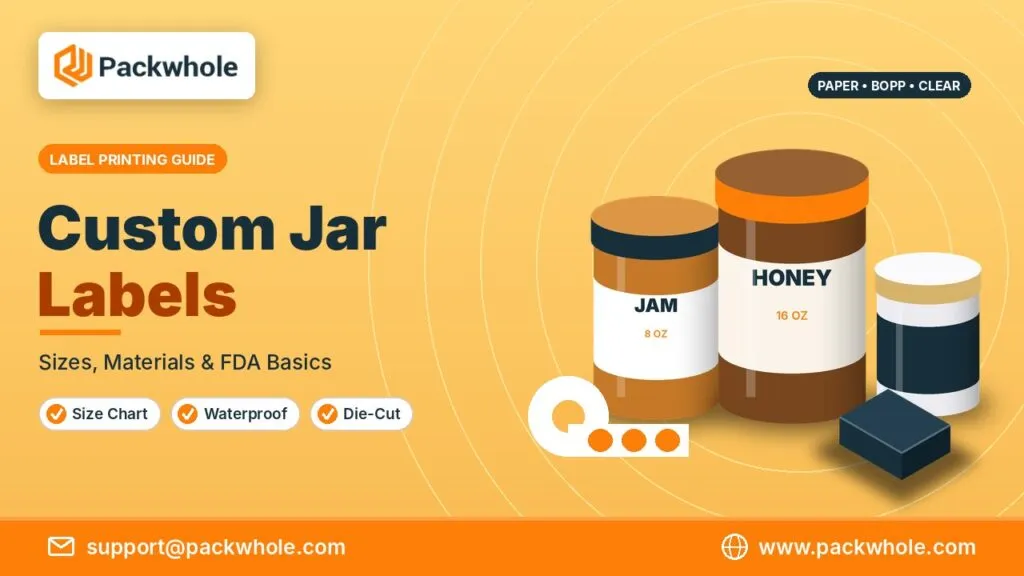
Home cooks turned jam brands, candle makers, and skincare startups all face the same moment: the product is ready, the jars are stacked, and now they need labels. Custom jar labels look simple, but they have to do a lot. They must fit a curved surface, survive fridges, bathrooms, and shipping, and still carry all the information US regulations require.
This guide helps you choose the right size, shape, and material for your jar type, avoid wrinkled or peeling labels, and plan the information layout before you print.
Start With the Jar, Not the Artwork
The biggest labeling mistakes happen when a brand designs the artwork first and then tries to make it fit the container. Jars vary more than people think. Some have straight sides, some taper, and many have shoulders or embossed panels that limit the flat label area. A label placed on a tapered surface will wrinkle, while one that wraps too far around may overlap itself and look messy.
Before you design, measure the jar’s straight “label panel”: the flat or evenly curved area between the shoulder and the base. Then measure the circumference so you know how far a wrap label can go.
Custom Jar Labels Size Guide by Jar Type
Every jar style has a sweet spot for label size. The chart below lists typical label dimensions for common US jar sizes. These are starting points, so always test print on paper and wrap it around the real jar before ordering.
| Jar Type | Common Size | Typical Front Label | Wrap Label |
|---|---|---|---|
| Regular-mouth mason jar | 8 oz (half pint) | 2 in round or 2.5 × 2 in | 7.5 × 2 in |
| Regular-mouth mason jar | 16 oz (pint) | 3 in round or 3 × 2.5 in | 9 × 2.5 in |
| Wide-mouth mason jar | 16 oz | 3 × 3 in | 10 × 3 in |
| Hex honey jar | 12 oz | 2 × 2.5 in | Not ideal |
| Straight-sided candle jar | 8 oz | 3 × 2 in | 9.5 × 2.5 in |
| Cosmetic jar | 2 oz | 1.5 in round | 6 × 1 in |
| Amber apothecary jar | 4 oz | 2.5 × 1.5 in | 7 × 1.5 in |
| Lid label (any jar) | Regular / wide mouth | 2.25 in / 3 in round | n/a |
For wrap labels, leave a gap of about 0.25 to 0.5 inch between the two ends so they never overlap unevenly.
Picking the Right Label Material for Each Environment
Material is where function meets brand image. Paper labels look natural and print beautifully, but they can tear, smudge, or wrinkle with moisture. Synthetic labels such as BOPP (often called vinyl or waterproof labels) resist water, oils, and fridge condensation. The right choice depends on where the jar lives after purchase.
- Uncoated or kraft paper: rustic jams, dry spices, farmers’ market products.
- Coated paper with gloss or matte: dry goods and gift jars kept indoors.
- White BOPP: refrigerated foods, sauces, body scrubs, bath products.
- Clear BOPP: a “no-label” look on glass, great for honey and candles.
- Metallic BOPP: premium cosmetics and candles.
Our related guide on the best sticker for corrugated boxes explains adhesives in more depth.
Shapes, Finishes, and Layout Ideas That Sell
Once material and size are set, you can focus on making the jar irresistible on a shelf. Shape alone can signal your brand style: a round label feels friendly and handmade, a tall rectangle feels clean and modern, and a die-cut custom shape feels premium. Finishes such as foil or spot gloss draw the eye under store lighting.
- Use a round lid label plus a front label for a two-touchpoint design.
- Try a die-cut shape that echoes your logo or product, such as a leaf or a flame.
- Add foil accents to the product name for gift and candle jars.
- Keep a consistent color band to separate flavors or scents.
- Leave white space so key information stays readable.
PackWhole prints circle stickers, oval stickers, and rounded rectangle stickers in all these finishes.
What US Rules Expect on Food and Cosmetic Jar Labels
Your custom jar labels are also legal documents. For packaged food, the FDA expects certain elements on the label, usually split between the principal display panel (the front) and the information panel (typically to the right of the front). Cosmetics follow different but related rules under the Federal Food, Drug, and Cosmetic Act and the Fair Packaging and Labeling Act.
Common food label elements:
- Statement of identity (what the product is)
- Net quantity in both US and metric units
- Ingredient list in descending order by weight
- Major food allergen declaration (including sesame)
- Nutrition Facts panel, unless an exemption applies
- Name and place of business of the manufacturer, packer, or distributor
Candles have their own considerations, such as fire safety warnings. General information only, not legal advice; please review FDA guidance and state cottage food rules for your product.
Planning a Label System for a Growing Product Line
Most jar brands start with one or two products and quickly grow to a dozen flavors, scents, or sizes. Without a plan, each new label is designed from scratch and the shelf starts to look mismatched. A simple label system keeps custom jar labels consistent while still letting each product stand out. It also speeds up design, because new products only need a few changes.
Build your system around fixed and flexible elements:
- Fixed: logo position, font family, label shape, and layout grid.
- Flexible: one accent color, the product name, and a small illustration or icon.
- Shared back label: a common template for ingredients, warnings, and barcodes.
- Size variants: scale the same layout for 4 oz, 8 oz, and 16 oz jars.
Document these rules in a one-page style guide. When you order new custom jar labels, send the guide with your artwork so every batch matches the last.
Application Tips to Prevent Bubbles and Peeling
Even a perfect label can fail if it is applied badly. Most peeling and bubbling problems come from dirty glass, cold jars, or labels placed on curved shoulders. A few small habits make a big difference in how professional your jars look.
- Clean jars with rubbing alcohol to remove oils and dust before labeling.
- Apply labels at room temperature, not straight from a cold store room.
- Press from the center outward with a soft squeegee or cloth.
- Wait 24 hours before filling jars with hot product or refrigerating them.
- Use a simple jig, such as a cardboard guide, to keep labels straight.
Order Custom Jar Labels From PackWhole
PackWhole prints custom jar labels and stickers on paper, kraft, white, clear, and metallic materials, in round, oval, rectangle, and die-cut shapes. Our designers will check your layout, sizes, and bleed for free, so every label wraps cleanly. We also make matching custom product boxes and gift packaging for jar sets, all with low minimum orders.
Send your jar size and artwork to support@packwhole.com, or start your label order on www.packwhole.com.
Questions People Ask About Custom Jar Labels
These are the questions jar-based brands ask most often when they order labels for the first time. The answers focus on durability, sizing, and printing basics. If you are unsure about your jar shape, send us a photo and the dimensions, and we will recommend a label size.
Are vinyl labels really waterproof?
Synthetic BOPP labels resist water and oil very well, especially with a laminate. They are ideal for fridges and bathrooms.
Can I use one label size for different jars?
Sometimes, but it is better to size each label to the jar’s panel. One-size labels often look too big or too small.
What resolution should label artwork be?
Use 300 dpi at actual size, with 1/16 to 1/8 inch bleed on all sides.
Should labels go on the lid too?
A lid label is a great way to show your logo from above and is useful when jars are stacked or displayed in crates.