In everyday American English, people call almost any brown box “cardboard.” Packaging professionals, however, draw a clear line between paperboard cartons and corrugated boxes. Mixing them up can lead to the wrong quote, a box that crushes in transit, or paying for strength you do not need. Understanding cardboard vs corrugated boxes is the first step toward ordering packaging with confidence.
This guide explains the terms in plain language, shows you a two-second test to identify each material, and helps you pick the right one for your product.
Why the Words Get Mixed Up So Often
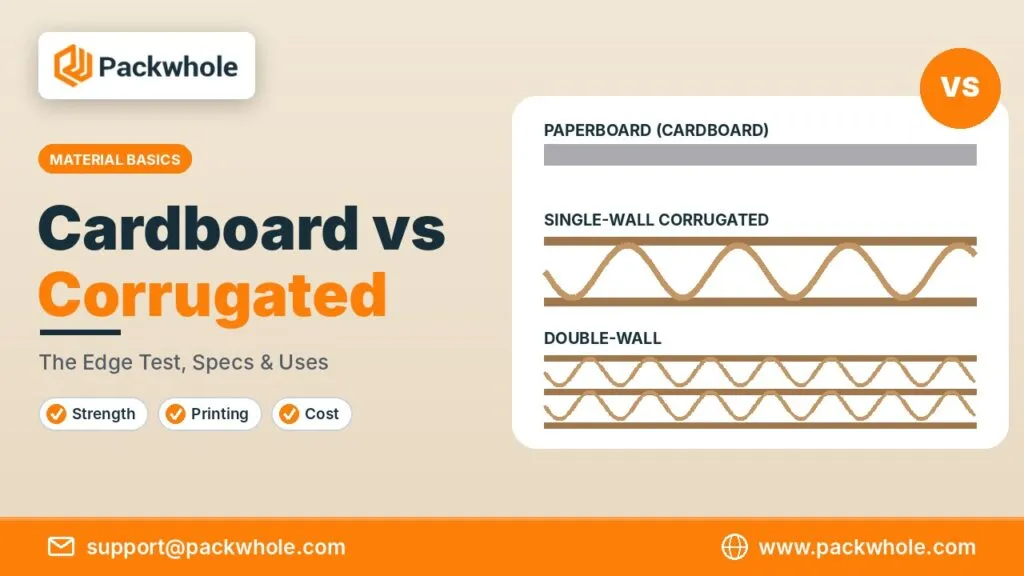
The confusion is understandable. Both materials are made from paper fibers, both can be brown or white, and both fold into boxes. Retail stores, moving companies, and even some suppliers use “cardboard box” to mean a corrugated shipping carton. Technically, though, “cardboard” usually refers to paperboard: a single, thick, solid sheet of pressed paper. Corrugated board is a layered structure with a wavy middle.
When you talk to a packaging supplier, use these more precise terms:
- Paperboard or folding carton: a single solid layer, like a cereal or cosmetics box.
- Corrugated board: liners with a fluted (wavy) medium in between, like a shipping box.
The Two-Second Edge Test
The easiest way to tell the difference is to look at the cut edge of the box. Hold it up to the light or tear a small corner. If you see a solid, even layer, it is paperboard. If you see a row of tiny arches between two flat sheets, it is corrugated. That fluted layer acts like a series of small columns, giving corrugated board much more crush resistance and cushioning.
| What You See on the Edge | Material | Typical Use |
|---|---|---|
| One solid layer, thin and stiff | Paperboard (cardboard) | Retail cartons, cereal, cosmetics |
| Two flat sheets with waves inside | Single-wall corrugated | Shipping and mailer boxes |
| Three flat sheets with two wavy layers | Double-wall corrugated | Heavy or large shipments |
| Very thick, dense, wrapped board | Rigid chipboard | Luxury gift boxes |
Comparing Cardboard vs Corrugated Boxes on Strength and Specs
The materials are measured differently, which is another source of confusion. Paperboard is specified by thickness in points (pt), where 1 pt equals 0.001 inch. Common retail cartons run from about 14 to 24 pt. Corrugated board is described by flute size and strength ratings, such as ECT (Edge Crush Test) or burst strength. A common shipping box is single-wall B or C flute rated around 32 ECT.
- Paperboard strengths: smooth surface for sharp printing, lightweight, low cost, great for shelves.
- Corrugated strengths: cushioning, stacking strength, puncture resistance, ships on its own.
For a deeper dive into flute types, read our ultimate guide to corrugated boxes.
Cost, Weight, and Printing Differences
Price usually tracks material use and construction. Paperboard cartons are thinner and lighter, so they often cost less per unit and add very little shipping weight. Corrugated boxes use more material and cost more, but they replace the need for an extra outer box in ecommerce. Printing also behaves differently: paperboard has a smooth surface that reproduces fine detail, while corrugated can show slight “washboarding” unless it uses a fine E or F flute with a printed top liner.
| Factor | Paperboard Carton | Corrugated Box |
|---|---|---|
| Relative unit cost | Lower | Higher |
| Weight | Very light | Light to moderate |
| Print detail | Excellent | Good to very good (fine flutes best) |
| Ships alone by carrier | Not recommended | Yes |
| Shelf display | Excellent | Good for display and club stores |
When to Choose Each Material
The right choice depends on where the box spends most of its life. If it sits on a store shelf inside a protective case, paperboard is usually enough. If it travels through USPS, UPS, or FedEx networks on its own, corrugated is the safer bet. Many brands use both: a printed paperboard carton for the product and a corrugated shipper for the journey.
Choose paperboard for:
– Cosmetics, supplements, candles, and food cartons on retail shelves
– Lightweight items packed inside a larger shipping carton
– Products that need fine, detailed printing
Choose corrugated for:
– Direct-to-consumer ecommerce orders
– Heavy, fragile, or high-value items
– Subscription boxes and custom mailer boxes
– Bulk shipping cartons and warehouse storage
Recycling Notes for US Customers
Both materials are paper-based and widely recycled across the United States. Corrugated cardboard in particular is one of the most recycled packaging materials in the country. To keep boxes easy to recycle, avoid heavy plastic lamination where you do not need it, and use paper tape or paper-based stickers when possible. Clear instructions such as “Please recycle this box” encourage customers to do the right thing.
A quick tip for customers: flattening boxes before putting them in the recycling bin saves space in their cart and at the sorting facility. Printing a small “Flatten me” icon on the bottom flap is a friendly nudge that most people appreciate.
Questions to Ask Before You Order Cardboard vs Corrugated Boxes
A few minutes of planning before you request a quote will help any supplier recommend the right material. The cardboard vs corrugated boxes choice depends less on the product’s look and more on its journey from your warehouse to the customer. Write down the answers to the questions below and include them in your request. You will get more accurate prices and avoid samples that miss the mark.
- Will the box travel through a carrier network on its own, or inside another box?
- How much does the packed product weigh?
- Will boxes be stacked in a warehouse or on a pallet?
- Does the box need to sit on a retail shelf or hang on a peg?
- How detailed is the artwork, and does it need photo-quality printing?
- Are there moisture or temperature concerns during storage?
If the answers include shipping alone, heavy weight, or stacking, corrugated is usually the right call. If the box mainly needs to look good on a shelf, paperboard often wins on cost and print quality.
Common Mistakes When Choosing Box Material
Ordering the wrong material is one of the most frequent packaging errors we see, especially from brands moving from retail into ecommerce. A carton that looked perfect on a shelf can arrive crushed when shipped on its own. On the other hand, some brands overspend on heavy corrugated for products that never leave a store. Watch for these issues.
- Asking for “cardboard boxes” without saying whether you need shipping strength.
- Shipping paperboard cartons without an outer corrugated box.
- Choosing thick double-wall for light products and paying for extra weight.
- Expecting photo-quality printing on coarse flute corrugated.
- Forgetting to ask for ECT or burst ratings for shipping boxes.
Get the Right Cardboard vs Corrugated Boxes From PackWhole
Not sure which material fits your product? Send us a description, and PackWhole will recommend the right option in the cardboard vs corrugated boxes decision. We make printed custom cardboard boxes, custom corrugated boxes, and mailer boxes in many styles. Artwork help is free, and minimum runs stay small.
Describe your product to support@packwhole.com, or get material advice through www.packwhole.com.
Cardboard vs Corrugated Boxes FAQs
People often ask these questions when they first source custom boxes. The short answers below should clear up the most common points. If you still have doubts, a sample of each material is the quickest way to feel the difference in your hands.
Is cardboard the same as corrugated?
Not exactly. In packaging terms, “cardboard” usually means solid paperboard, while corrugated has a fluted middle layer.
Which is stronger?
Corrugated board is much stronger and more protective, especially for shipping and stacking.
Can paperboard boxes be shipped?
Usually only inside an outer corrugated box. On their own, they can crush or tear.
Is corrugated more expensive?
Generally yes per unit, but it can remove the need for a second shipping box.