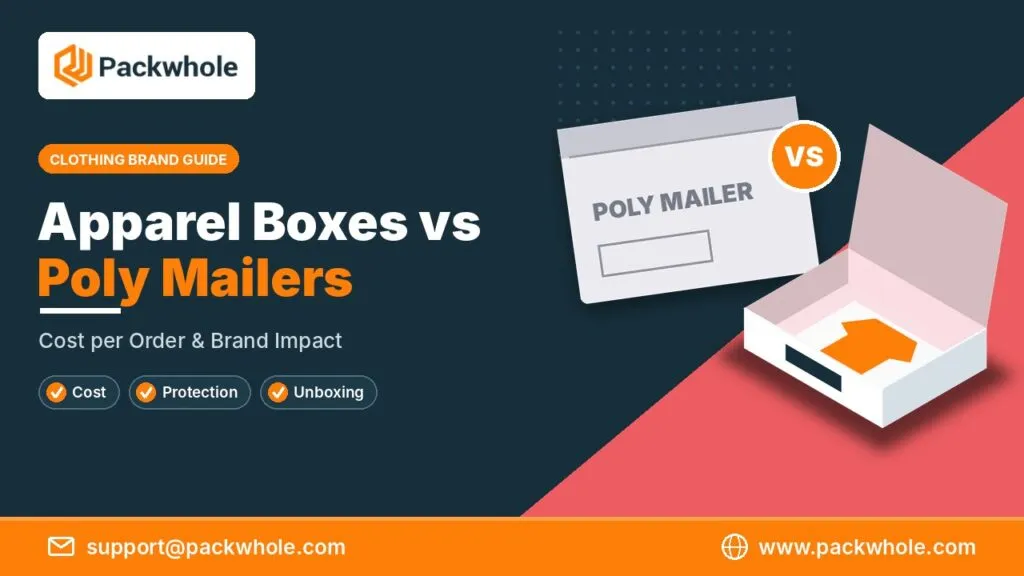
If you sell clothing online, you have probably had this debate with yourself, a co-founder, or your fulfillment partner. Poly mailers are light and cheap. Printed boxes look better and protect more. The apparel boxes vs poly mailers decision affects your shipping bill, return rate, customer reviews, and how often people post your package on social media.
The honest answer is that most growing brands end up using both. This guide shows you how to decide which products, orders, and customers get which format, using real cost factors rather than gut feeling.
How Each Option Works in a Clothing Fulfillment Line
A poly mailer is a flexible plastic envelope with a peel-and-seal strip. You fold the garment, slide it in, and ship. An apparel box can be a printed custom mailer box, a folding carton, or a tray-and-sleeve box such as our apparel sleeve boxes. It holds the garment flat and often includes tissue paper, a thank-you card, or a sticker seal. Both are valid choices, but they serve different goals.
For a broader look at all clothing mailers, see our earlier article on what kind of packaging is best for mailing clothing.
Apparel Boxes vs Poly Mailers: Cost Per Order Breakdown
The sticker price of a poly mailer is far lower than a printed box, but packaging cost per unit is only part of the story. Shipping cost, packing time, damage, and repeat purchases also count. When you add them together, the gap between the two formats can shrink. The table below compares the main cost factors in relative terms.
| Cost Factor | Poly Mailer | Printed Apparel Box |
|---|---|---|
| Packaging unit cost | Very low | Low to medium |
| Package weight | Very light | Light to moderate |
| Dimensional weight risk | Low (flat) | Higher if box is oversized |
| Packing time | Fast | A little slower (tissue, folding) |
| Damage and wrinkle rate | Higher for structured items | Low |
| Perceived value | Basic | High |
| Social sharing potential | Low | High |
USPS, UPS, and FedEx price parcels by actual or dimensional weight, so a right-sized box is essential. A flat apparel box with a depth of 2 to 3 inches often stays in a low pricing tier.
Protection: What Each Format Does to Your Garments
Different clothing items react differently in transit. T-shirts, leggings, and socks are hard to damage, so a poly mailer protects them adequately from rain and dirt. Structured pieces such as blazers, dress shirts, caps, and folded knitwear can crush or crease in a soft bag. Boxes also protect against punctures from other parcels on conveyor belts.
- Low risk items (poly mailer is fine): basic tees, leggings, socks, swimwear.
- Medium risk items (either works): hoodies, joggers, casual dresses.
- High risk items (use a box): structured caps, blazers, formal shirts, embellished pieces, gift sets.
Customer Experience and Brand Perception
Clothing is an emotional purchase, and the package is the first physical touchpoint with your brand. A printed apparel box with tissue paper creates a “gift” moment that encourages unboxing videos and repeat purchases. A poly mailer feels efficient but forgettable, unless it is custom printed. Many premium and boutique labels choose boxes for this reason alone.
That said, customers increasingly care about waste. A huge box for a single T-shirt feels wasteful. The best approach in the apparel boxes vs poly mailers decision is to match the package to the order rather than default to one format.
Returns and Reusability
Returns are a reality in fashion ecommerce. Your packaging can make them easier or harder. A box that customers can reseal and reuse for a return reduces friction and keeps garments in good condition on the way back. Poly mailers with a second adhesive strip offer similar convenience at a lower cost.
Tips for return-friendly packaging:
- Add a second peel-and-seal strip to poly mailers.
- Use mailer boxes with a tear strip and a return tape strip.
- Include a return label or QR code inside the package.
- Print simple return instructions on the inside lid.
Sustainability Trade-Offs Without the Greenwashing
Neither option is automatically “green.” Corrugated and paperboard boxes are widely recycled in curbside programs across the US. Plastic poly mailers are lighter, which lowers transport emissions per package, but they are usually accepted only at store drop-off points rather than curbside. Recycled-content poly mailers and paper mailers are both growing categories. Be careful with environmental claims and follow the FTC Green Guides, which call for specific, qualified wording.
General information, not legal advice.
A Simple Decision Framework for Clothing Brands
To bring it all together, use the framework below. It assigns a format based on product type, order value, and the customer moment. Many brands print it out for their packing team so everyone makes the same choice every time.
| Situation | Best Choice |
|---|---|
| Single basic tee or leggings, standard order | Poly mailer |
| First order from a new customer | Printed apparel box |
| Order over your average order value | Printed apparel box |
| Structured items, hats, or gift sets | Box with insert |
| Wholesale or bulk restock | Corrugated shipping carton |
| Holiday and gift orders | Printed box with tissue and sticker |
Testing Both Formats With Real Customers
The best way to settle the apparel boxes vs poly mailers question for your own store is a simple test. Ship one format to half of your orders and the other format to the rest for four to six weeks, using similar products and order values. Then compare the results with real numbers instead of guesses. Many brands are surprised by what they find, in both directions.
Metrics to compare:
- Packaging and shipping cost per order.
- Damage and return rates.
- Customer reviews that mention packaging.
- Social media posts and tags showing your package.
- Repeat purchase rate within 60 to 90 days.
If boxes lift repeat purchases or reduce damage enough to cover their extra cost, they are paying for themselves. If not, reserve them for first orders, gifts, and premium products.
Mistakes to Avoid With Clothing Packaging
Clothing brands often make packaging choices based on what a competitor does or what is cheapest this month. That leads to mismatched packaging, damaged goods, and higher costs over time. A few simple guardrails can prevent most issues. Keep this list handy when reviewing your packing process.
- Shipping oversized boxes that trigger dimensional-weight charges.
- Using thin poly mailers for heavy items, which can split.
- Forgetting tissue or a bag inside boxes, leaving garments exposed.
- Printing a box design that does not match your website and labels.
- Ignoring customer feedback about waste.
Get Branded Packaging for Every Apparel Boxes vs Poly Mailers Decision With PackWhole
PackWhole helps clothing brands build a packaging mix that fits every order. We make printed mailer boxes, apparel sleeve boxes, baseball cap boxes, stickers, tissue-ready inserts, and custom hang tags. Our designers offer free support to keep your look consistent, and our low minimum orders suit new and growing labels weighing apparel boxes vs poly mailers.
Email support@packwhole.com with your best-selling garments, or see apparel packaging on www.packwhole.com.
FAQs on Apparel Boxes vs Poly Mailers
Clothing sellers ask a lot of practical questions when they compare these two formats. Here are short answers to the ones we hear most. If you are unsure, start with a small run of boxes for your best customers and measure the impact on reviews and repeat orders.
Are poly mailers cheaper to ship than boxes?
Usually yes, because they are lighter and flatter. A right-sized flat box can come close.
What box size fits a folded hoodie?
A typical adult hoodie sits well in a 12 by 10 by 3 inch box. Heavyweight fleece may need a 4 inch depth.
Can I print my logo on poly mailers?
Yes, custom printed poly mailers are common, though a printed box offers more space for design.
Do boxes reduce returns?
They can reduce damage-related returns for structured items and make the return process easier.